



Sanjaya, probing the depths of spiritual truth through the lens of Arjuna’s troubled mind, conveyed both the condition and the remedy offered by Lord Sri Krishna, while striking, as it were, upon the deaf and blind attitude of the monarch. Sri Krishna rightly discerned the source of Arjuna’s despondency and sought to uproot it at its very origin, for the ego arises only when the pure Self is not recognised. The ignorance deeply seated in humanity not only veils divine nature from one’s own vision but also casts upon reality a false and misleading appearance.
The ego-driven notion that the conditioned body, mind, and intellect constitute the self became the root of Arjuna’s delusory bondage to his relations, from which flowed an overwhelming compassion that rendered him helpless and bereft of action. When one rediscovers oneself beyond the ego, sorrow and false identification end. The eternal spirit within asserts a false relationship with the body, binds itself in attachments, and thus experiences the impurities of the emotional realm, until the divine spark of life burns away this false identity and releases the mind from grief and suffering that had long occupied it.
Sri Krishna, in his infinite wisdom, perceived Arjuna’s misapprehension of reality and instructed him as the apostle of knowledge proclaimed in the immortal teachings of the Upanishads. True to the ancient tradition of education, the Lord addressed Arjuna directly on the nature of the eternal. Sanjaya, reading the king’s mind, chose his words with care to suit the moment, thus transmitting this precious wisdom to future generations, while seeking an immediate and fitting response from the monarch, the sole authority capable of halting destruction.
He examined the inner spirit of both Bhishma and Drona and allowed their lives a glorious and incomparable expression in the clash of arms. Arjuna’s greater Self, united with the divine Krishna, transcended mortal limits, standing beyond physical estimation and distinct from the emotional plane. Krishna advised Arjuna to renounce the physical, emotional, and intellectual estimations of his teachers, grandsires, and the entire battlefield, and to re-evaluate all from the spiritual standpoint. This transcendent truth, suddenly revealed, struck Arjuna with the force of an instant awakening.
The essential point thus underlined was why none deserved grief, because all are eternal. The Lord explained that the Self embodied in every being is set upon a pilgrimage, identifying with varied forms to gather experiences for a time. The presence of Arjuna and of the kings in both armies was but a passing convergence. They came from nowhere and would appear to vanish at death, yet the true philosophy that guides the intellect affirms the continuity of spirit through past, present, and future. Conditioned by different bodies and self-created environments, it journeys onward, thereby establishing a clear understanding of rebirth.
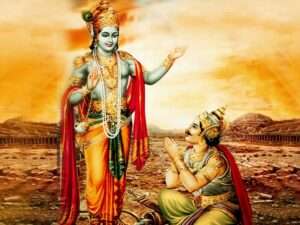
The uncompromising quest of the intellect to comprehend life cannot be satisfied if thwarted at every turn by apparent irregularities, nor can these be dismissed as mere chance. Krishna declared that Arjuna and the great kings would not cease to exist after death. Arjuna’s questioning eyes prompted further explanation. In the law of memory, the experiencer and the one who remembers are the same entity; one cannot recall another’s experiences. In old age, one remembers childhood, and through growth, childhood transforms into youth, youth into old age, yet neither youth nor age remains permanently, though their experiences are remembered by the same being.
Thus youth may be called a birth when childhood dies, and old age a birth when youth has passed, yet none is disturbed by these changes; rather, one rejoices in the wealth of experience gained through these stages. Using this subjective experience as a standard, Krishna taught Arjuna that the wise do not grieve when leaving the body to assume another. This implies not the extinction of individuality, but that the embodied ego abandons an old structure when it can no longer express itself fully, to seek fulfilment in another form.
In the theory of perception, an object is known not by the senses alone but by the knowledge stored within the perceiver. The same object may yield different experiences to different minds according to their inner composition. One who understands that the objective world is in constant flux, ever arising and perishing, will not allow himself to be tossed about by its finite movements. In the waves of time, events, circumstances, and environments flow from the present into the unknown future, offering experiences of varying intensity, yet never remaining fixed, for fluidity is their nature.
Nothing in the world of objects remains unchanged even for a moment; change alone is its law. Having understood the finite nature of all that begins and ends, the wise do not despair. Heat and cold, success and failure, pain and joy, all are fleeting. Since every situation continually alters, it is pointless to be disturbed by visible change. The wise move through life in joy and sorrow, success and failure, pain and pleasure, with the constant awareness that even this shall pass. Krishna thus added that external challenges are impermanent by nature.
Meanwhile, Sanjaya, with his skillful narration, prepared the king alike for present good and future calamity. Krishna further enlightened Arjuna, shaping him into a hero of immeasurable stature, fit to rise above all limitations and fear.

