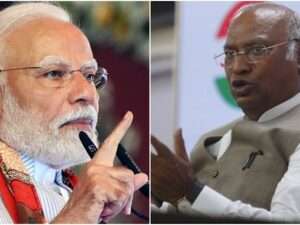
When political rhetoric descends into name-calling, it often reveals more about the speaker’s predicament than the target. Mallikarjun Kharge’s recent remark branding Narendra Modi a “terrorist” is one such moment—less a serious allegation, more a reflection of a party grappling with shrinking relevance and mounting electoral anxieties.
The Indian National Congress has struggled to regain national footing for over a decade. Setbacks across key states, uneasy alliances with regional players like All India Trinamool Congress, and the erosion of a once-formidable vote base have created a sense of drift. In such a climate, sharp rhetoric can appear tempting. But reckless language, especially on matters as grave as terrorism, demands scrutiny against facts—not sentiment.
India’s tryst with terrorism is neither recent nor abstract. From the devastating 2008 Mumbai attacks, which killed over 160 people, to a string of urban bombings through the 2000s, the country endured a period where terror networks operated with alarming frequency. Security responses existed, but the perception of a reactive, often diffused approach persisted.
The last decade, however, has seen a measurable shift. According to data periodically released by the Ministry of Home Affairs, terror incidents in Jammu & Kashmir have declined significantly from their mid-2010s peak. Civilian and security force casualties have also trended downward in recent years, even as infiltration attempts along the Line of Control have been more aggressively countered.
Policy changes have been central to this shift. The abrogation of Article 370 in 2019 marked a structural reset in Jammu & Kashmir’s governance. Simultaneously, the security establishment adopted a more proactive posture. The response to the Pulwama attack—through cross-border strikes—signalled a willingness to escalate beyond conventional restraint. Whether one agrees with every tactical choice or not, the broader doctrine was clear: impose costs on terror sponsors.
This shift extended to the diplomatic arena. India consistently pushed to isolate Pakistan-based groups in multilateral forums, tightening financial scrutiny and leveraging global counter-terror frameworks. The cumulative effect has been to constrain the operational space for cross-border networks, even if the threat has not been eliminated.
None of this suggests that terrorism has vanished. Incidents still occur, and the risks remain real. But the trajectory matters. When violence trends downward, it reflects coordination between intelligence agencies, security forces, and political leadership. Reducing this complex reality to a political slur does little to inform public debate.
Equally significant is the standard of political discourse. Democracies thrive on disagreement, even sharp disagreement. But branding an elected Prime Minister a “terrorist” without evidence crosses from critique into caricature. It trivializes the suffering of victims and dilutes the meaning of a term that should be used with precision and responsibility.

There is also an institutional dimension. Kharge’s statement comes when the Election Commission’s Model Code of Conduct was in force. Complaints against incendiary remarks are not new, but consistent enforcement is vital. A show-cause notice, has already been issued, as a first step; what follows will signal whether boundaries in public discourse are meaningful or merely symbolic.
For the Congress, the road to revival will not be paved by rhetorical recklessness or desperate name-calling. It demands the hard work of rebuilding a hollowed-out organization, offering credible policy alternatives, and reconnecting with an electorate that has repeatedly rejected its politics of entitlement. For the ruling establishment, the task remains to consolidate security gains while upholding transparency and accountability.
But the larger point is far more serious. Terrorism is not a throwaway insult to be deployed for fleeting political applause. It is a brutal national reality that India has battled for decades—measured in lives lost, families shattered, and security forces pushed to their limits. To reduce such a grave challenge into a casual political slur is not merely irresponsible—it is an affront to the nation’s collective memory.
That is precisely why statements like those made by Mallikarjun Kharge cannot be brushed aside as routine political rhetoric. They represent a deeper malaise within a party that appears increasingly unmoored from both facts and responsibility. When a senior leader, occupying the highest office in his party, chooses provocation over prudence, it raises serious questions about judgment, intent, and accountability.
There must be consequences. Not out of political vendetta, but to establish a clear precedent that reckless, defamatory language against a democratically elected Prime Minister—chosen by over 140 crore Indians—will not be normalized in public discourse. Free speech does not grant a license for deliberate distortion or incendiary labelling, especially on matters as sensitive as national security.
More importantly, Kharge cannot escape scrutiny for his own political positioning. His elevation is less a testament to merit or mass appeal, and more a reflection of the enduring grip of the Nehru-Gandhi family over the Congress ecosystem. To pretend otherwise is to insult the intelligence of the public. At a time when the party desperately needs generational renewal and credible leadership, it has instead doubled down on a system where loyalty outweighs capability.
If such extreme remarks are intended to curry favour with entrenched power centres within the party, they only expose the Congress’ continued dependence on dynastic validation rather than democratic legitimacy. And in doing so, they further erode whatever little credibility the party still retains in the eyes of the electorate.
India deserves a more serious opposition—one that challenges the government with facts, vision, and integrity, not with careless rhetoric that trivializes national suffering. When political discourse sinks to this level, it is not just one leader who is diminished, but the very standard of public debate.