The son of Rahūgaṇa, the sage Goutama, in the measured cadence of Paṅkti chandas, raises his voice in praise of Indra. His prayer arises from the serene depths of forests and valleys, where silence itself becomes a vessel of sacred resonance. In that tranquil vastness, the hymn is not merely uttered but lived—its sound woven into the subtle fabric of nature. Faith, prayer, and the living world stand intertwined, forming a delicate yet enduring unity. The rhythm of the hymn transcends ordinary thought, belief, and perception, entering instead the dynamic realm where the human spirit meets celestial grace.
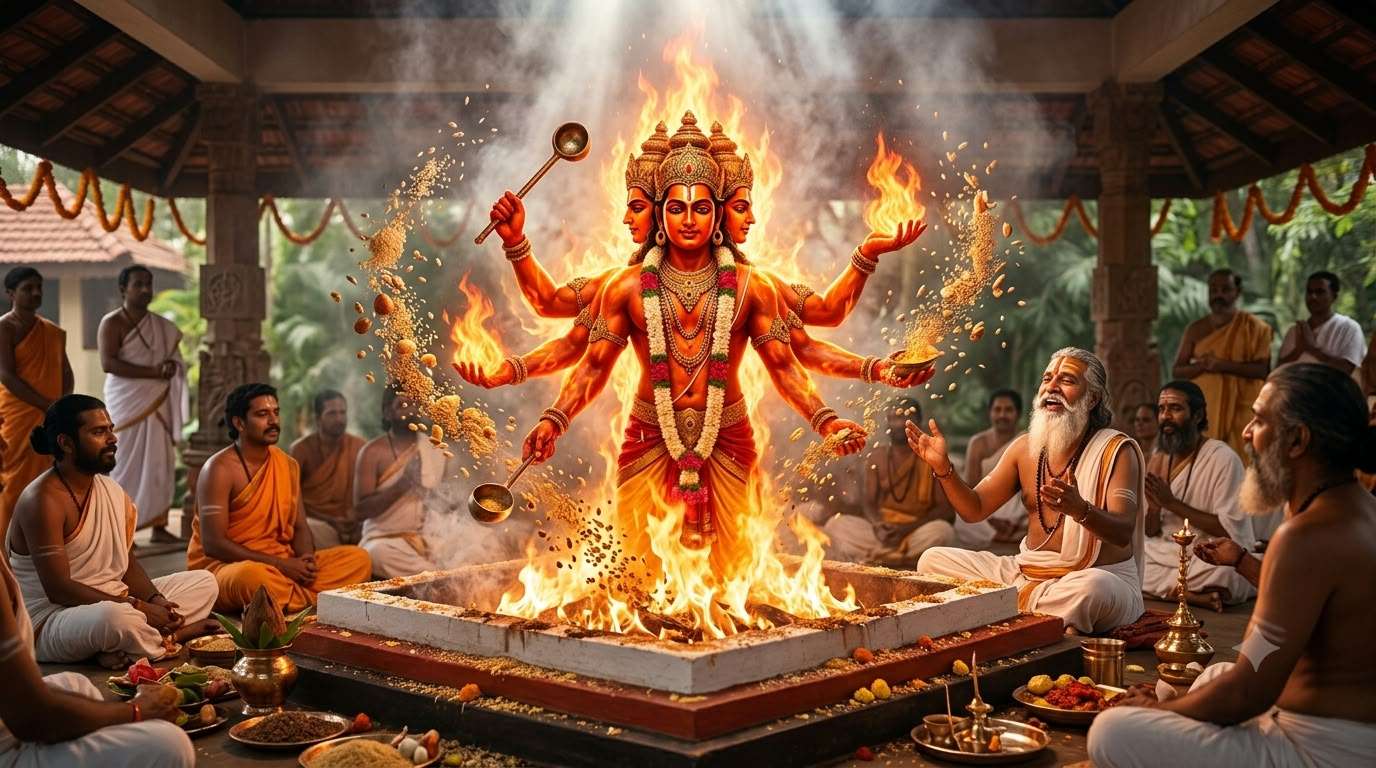
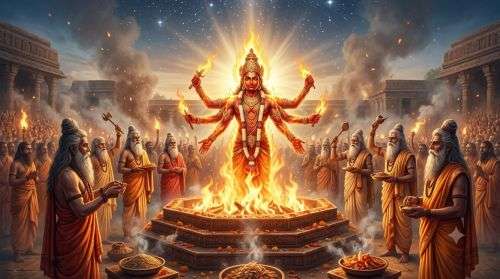
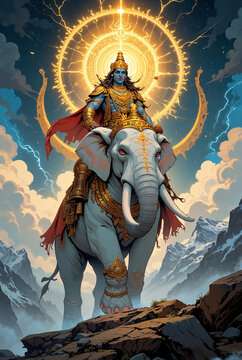
In this sacred utterance, Indra is invoked as the wielder of the vajra, the thunderbolt held firmly in his hand. He is proclaimed stronger than the strongest, invigorated by the potent soma elixir. The Brahma and Ṛtvija priests, custodians of the Vedic rites, offer their hymns from the depths of the Ṛgveda and Atharvaveda, strengthening him through sacrifice and sound. Their chants are not mere praises but acts of cosmic alignment, enhancing the divine potency that sustains his sovereignty. Through such sanctified energy, Indra establishes his dominion and commands the subjugation of Vṛtra upon the earthly plane.
The soma, brought from the radiant heights by Gāyatrī in the form of an eagle, becomes both a symbol and a force. It elevates, yet also tests, stirring within the devotee both devotion and the subtle danger of pride. It binds mind and form, shaping consciousness itself. Empowered by this sacred elixir, Indra rises in strength and resolve, and with that force, he destroys Vṛtra—the embodiment of obstruction and drought. This act is not merely a battle but a restoration of balance, a release of the life-giving waters held captive.
The hymn continues with a fervent exhortation: Indra is called upon to observe the enemy, to reject falsehood without hesitation. His vajra is declared invincible, beyond the reach of any adversary. He is the regulator of the clouds, the one who draws their boundaries and releases their waters. Through wind and rain, he nourishes the earth and sustains life. The imagery reflects not only divine action but an early understanding of natural cycles—cloud formation, atmospheric movement, and rainfall—woven seamlessly into spiritual expression.
In the intensity of battle, Indra’s wrath blazes forth. With his many-edged vajra, he strikes at Vṛtra’s jaws, shattering resistance. The trembling of earth and sky signifies the magnitude of this cosmic struggle. Vṛtra, who had seized ninety-nine rivers, stands as a symbol of withheld abundance. Indra, through strength and precision, liberates these waters, restoring the natural order. His weapon, taking manifold forms, signifies adaptability and intelligence—qualities essential both in warfare and governance.
The seers declare that Indra’s vitality is immeasurable, his sinews unbounded in strength. Supported by the Maruts, the storm deities, he embodies the collective force of nature. The hymns recount how multitudes—thousands together, hundreds of sages, and even smaller gatherings—offer oblations and praises unto him. These acts of worship reflect not only numbers but also the universality of reverence, cutting across the scales of human assembly.
Yet the hymn also turns inward, acknowledging the mystery of Indra’s presence. He pervades all directions, yet remains beyond easy recognition. How can human beings fully comprehend such a being? The gods themselves place within him riches, ritual power, might, and grace. The sages—Atharva, Dadhyañc, and Manu, the progenitor of mankind—offer their oblations, affirming that divine order is sustained through both action and understanding.
Underlying the narrative is a profound reflection on governance. Indra’s rule is not merely dominion but responsibility. His independence is balanced by obedience to cosmic law. The relationship between ruler and the ruled is presented as a finely woven fabric, where authority exists in harmony with care and sustenance. This vision mirrors an early conception of ordered society, aligned with natural principles and ethical responsibility.
Thus, the hymn reveals more than devotion; it embodies a synthesis of spiritual insight and observational awareness. The cosmic functions attributed to Indra—control of rain, release of waters, and regulation of natural forces—suggest a scientific temperament expressed through symbolic language. Faith and reason are not separate but united, each enriching the other.
In its final resonance, the prayer affirms that divine rule, when aligned with righteousness, leads to the welfare of all beings. The cosmic and the human are not divided but reflect one another. Through devotion, discipline, and understanding, the hymn offers an enduring vision: that power guided by wisdom and compassion becomes a force of universal good, sustaining both the heavens above and the life upon earth.