



The farmer’s hard work will be protected only by avoiding the deception spread in the name of faith.
In the villages of North India, wheat harvesting is not just a season, but a celebration of life. It’s the time when a farmer’s months of hard work, sunburnt hands, cold nights of vigilance, and a battle with uncertain weather finally pay off. The golden ears of corn swaying in the fields are not just a scene of an ordinary harvest, but a symbol of hope, struggle, and self-respect. When this crop is harvested and piled up in the courtyard of the house, it’s not just grain—it’s security for the entire year, the foundation for children’s education, support during illness, and strength to fight the uncertainties of the future. The women of the house collect, clean, dry, and carefully store the grain, knowing that these grains will strengthen the foundation of the home in the years to come.
But alongside this golden and contented scene, a shadow descends upon the village streets, slowly diminishing this joy. This shadow is that of the so-called babas and swindlers who wander about with bags, waiting for this season. As soon as grain arrives in homes, these individuals suddenly appear in villages. Their clothing, their appearance, and their speech are all designed to make them appear worthy of reverence. A tilak on the forehead, a turban or cap on the head, colorful clothes, and a bag in hand—all this creates an image that easily captivates the average villager. They go from house to house, standing at the doorsteps, offering sweet blessings—“God bless,” “May Mother Goddess bless”—and expect some grain or money in return.
The tradition of charity and service has been prevalent in villages for centuries. This tradition is not only religious but also social, strengthening the spirit of mutual cooperation and coexistence. Women, in particular, play a vital role in maintaining this tradition. They stand at the doorsteps of their homes, welcoming visitors and donating as much as they can. For them, this is not just a social duty, but a part of their faith. But this faith can sometimes become a weakness when some people take advantage of it.
A handful of wheat donated by one household may seem like a small thing. The giver might think it won’t make much difference. But when this process is repeated throughout the village, these small handfuls add up to a large pile. Grain collected from hundreds of households throughout the day adds up to a large amount by evening. This grain is then often sold in the market, and complaints arise that the proceeds are used for drugs, gambling, or other inappropriate activities rather than for essential needs. Thus, the grain that the farmer cultivated with his hard work and sweat gradually ends up in hands that are not respected.
This isn’t just about financial loss, it’s also about a breakdown in trust. When someone exploits someone’s hard work by invoking religion and faith, they not only steal resources but also undermine social values. Even more worrying is when some people resort to intimidation if donations are not made. “If you don’t donate, there will be disaster,” “There will be unrest in the home”—such words not only promote superstition but also create unnecessary fear in people’s minds. This fear particularly affects women and the elderly, who are already deeply rooted in religious beliefs.
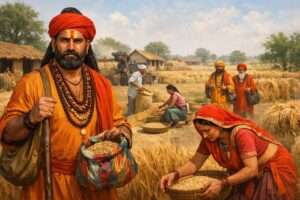
However, there’s another aspect to this whole picture that can’t be ignored. There are people in society who are truly in need—the elderly, the disabled, or those without any means of subsistence. For them, begging isn’t a choice, but a compulsion. Their faces reflect not pretense, but the reality of struggle and exhaustion. Therefore, it’s unfair to treat every person carrying a bag with the same eyes. This is where both discretion and sensitivity are required.
The solution to the problem lies not in mere protest, but in understanding. First, awareness is essential. It is important to explain to all family members that donations should be made thoughtfully, not based solely on emotion. Women, in particular, need to be taught not to make decisions under any kind of fear or pressure. If someone tries to force or intimidate, they should be opposed, and if necessary, seek the help of neighbors or the Panchayat.
The second important step is to channel donations correctly. If someone has a giving spirit, they should direct it to those truly in need. Villages contain many economically vulnerable families whose lives could be improved with help. Widows, the elderly, orphans, or those in need of education and health—these are where donations have a real impact. This not only ensures the proper use of resources but also strengthens mutual cooperation and trust in society.
Third, it’s important to understand the power of collective decision-making. If the entire village decides together to limit the practice of door-to-door distribution of grain, this problem can be solved naturally. It may be difficult for an individual to refuse, but when the entire community stands together, the situation changes. Collective awareness and solidarity are the most powerful weapons against such exploitation.
Ultimately, the issue isn’t just about grain, but about the respect a farmer earns through his hard work. The sweat shed in the fields is not just water, but a part of his life. Every grain grown from that sweat is precious, and it is the duty of every society to respect it. Letting it go to waste due to any kind of deceit, pressure, or superstition is not only a financial loss but also a loss of self-respect.
Faith is an important part of our lives, but faith doesn’t mean blind faith. True faith is one that is accompanied by reason, capable of distinguishing between right and wrong. When someone exploits our hard work in the name of faith, true wisdom lies in recognizing and avoiding it.
Therefore, the times demand that we respect our traditions, but not blindly. We must remain vigilant and vigilant to protect our society, our resources, and our hard work. Because, ultimately, only those societies that remain connected to their roots but also evolve their thinking with changing times will thrive.
And when this understanding develops within us, perhaps this golden harvest of wheat will flourish not only in the fields, but also in our thoughts—with respect, awareness, and wisdom.


