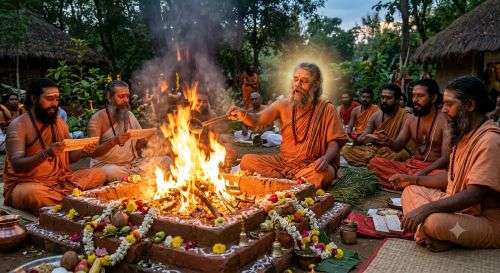

From the dawn of contemplative consciousness, the seers of the Vedic age turned their inward gaze toward the immeasurable vastness of existence. With disciplined intellect and unwavering devotion, they examined every visible and invisible clue in the universe, not as idle observers but as discoverers of an immortal essence. Their quest was not for material dominion, but for the elixir of spiritual truth—Amrta, the nectar of imperishable knowledge. This eternal search crystallized into the sacred corpus of the Vedas, revered as Sruti, that which was heard in states of profound illumination.
The hymns dedicated to Indra in the Rigveda stand as radiant testimonies to this discovery. Indra, extolled as the sovereign of strength and luminous intelligence, appears not merely as a warrior-God but as the embodiment of awakened consciousness. The seers praised him as the charioteer supreme, guiding the forces of life as a skilled driver guides horses yoked to a purposeful journey. His sovereignty over sustenance signifies his governance over the energies that nourish both body and spirit. To the righteous, he is tender and approachable, yet in battle against ignorance, he is invincible.
The Vedic poets often invoked Indra as the wielder of the thunderbolt, the vajra, symbol of concentrated spiritual power. The slaying of the serpent-demon Vṛtra, who imprisoned the celestial waters, is not merely a mythic episode but an allegory of liberation. When Indra shattered the obstructive forces, the rivers flowed, the cows were released from cavernous darkness, and the world was restored to abundance. Here, cows symbolize rays of illumination, wealth of wisdom, and streams of inspiration hidden within the caves of ignorance. Thus, Indra’s victory is the triumph of awakened consciousness over delusion.
The ritual specialists known as ṛtvijas sang his praise in elaborate hymns, recognizing that divine generosity does not diminish through giving. Indra’s wealth, unlike mortal treasure, multiplies through benevolence. The Vedic worldview affirms that righteous charity harmonizes human effort with cosmic order, ṛta. Hence, patrons who offered cows, gold, and sustenance to the officiating priests did so with the conviction that such offerings aligned them with Indra’s inexhaustible abundance.
Yet Indra’s power is not brute force alone. He conquers through insight as much as through strength. When confronting deceptive beings such as Śuṣṇa, he employs discernment to dissolve illusion. This recurring motif reveals a profound spiritual principle: ignorance is dispelled not by violence but by awakened awareness. Thus, Indra becomes both external deity and internal force—the courage within the aspirant that penetrates psychological fortresses and frees the hidden light.
Complementing Indra’s dynamic sovereignty is the sacred presence of Agni, the divine fire. If Indra represents the victorious expansion of power, Agni signifies the transformative medium through which human aspiration ascends to the divine realm. The opening hymn of the Rigveda invokes Agni as priest, messenger, and bearer of oblations. Born of the friction between the araṇis—the sacred wooden sticks used to kindle ritual fire—Agni symbolizes knowledge born of disciplined effort. Just as fire emerges from hidden potential within wood, spiritual insight arises from sustained contemplation.
Agni is described as the mouth of the gods, receiving clarified butter and sacred offerings, transmuting them into subtle essence. In the ritual arena, darbha grass is spread as a seat of sanctity, inviting the divine presence. The sacrificial fire becomes the axis between earthly devotion and celestial grace. Through Agni, prayers ascend, and blessings descend. Thus, ritual is not mere ceremony but a symbolic enactment of cosmic reciprocity.
Philosophically, Agni embodies digestion and perception—the fire within that assimilates experience. He is the appetite for truth and the discernment that tastes reality. The Vedic sages perceived no division between external flame and internal consciousness; both are manifestations of a single luminous principle. When Agni is tended with reverence, whether in hermitage or household, he protects the patron, sustains the community, and purifies destructive tendencies.
The birth of one fire from another—household fire kindled from sacred flame—illustrates continuity of knowledge across generations. Each new flame is not separate but a continuation of primordial radiance. In this way, Vedic tradition preserves spiritual insight through transmission, ensuring that the light of awareness never fades.
The hymns dedicated to Indra and Agni are not isolated praises but interconnected revelations. Indra’s release of the waters corresponds with Agni’s upward aspiration; one liberates the flow of grace, the other carries devotion to its source. Together they represent the dual movement of spiritual life—divine descent and human ascent.
In the broader spiritual significance, these deities symbolize faculties within the aspirant. Indra is courage, clarity, and victorious will. Agni is aspiration, purification, and transformative knowledge. The demons they conquer are not merely mythic adversaries but inner obstructions—fear, greed, confusion, and inertia. The cows released from caves are insights recovered from subconscious depths. The rivers restored are streams of creative energy.
Thus, Vedic study is not antiquarian scholarship but a living discipline. Through mantra, meditation, and ethical conduct, the seeker reenacts the cosmic drama daily. When hymns are recited with sincerity, they awaken latent strength; when offerings are made in selflessness, they kindle inner fire. The ultimate teaching of the Vedas affirms that the divine powers praised in the hymns reside within the human spirit.
Therefore, the sages’ ancient quest continues. The elixir they sought is the realization that the universe is woven of consciousness, and that devotion harmonized with insight leads to fearless living. In praising Indra, one invokes strength; in serving Agni, one awakens illumination. And in understanding both, one participates in the eternal rhythm of giving, receiving, conquering ignorance, and radiating light.