


Upadhyayula Lakshman Rao
In the luminous dawn of Vedic thought, the sages were not mere poets of nature but explorers of existence. Their search was neither casual nor finite; it was a ceaseless quest to discern the subtle forces that sustain life. Having meditated upon Agni—the divine flame that bridges earth and heaven—they journeyed further in contemplation, seeking the other life-breaths that animate the cosmos. Fire revealed transformation; yet transformation required motion, protection, order, nourishment, and rain. Thus, one by one, the sustaining powers of existence were invoked and revered.
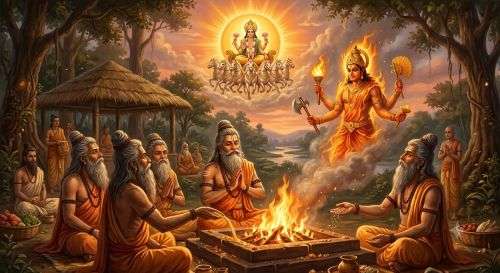
After Agni, they venerated Vayu, the invisible yet ever-present breath of life. Without wind, fire cannot blaze, clouds cannot move, and beings cannot breathe. In the Vedic imagination, Vayu is not merely air but prāṇa—the vital force permeating all creation. The sages prepared the sacred soma elixir for him, purified by learned ritualists according to strict Vedic injunctions. They invited him with humility: “O Vayu, manifest thy presence. The ambrosia awaits thee in sacred urns.” His arrival symbolized vitality itself entering the sacrificial arena. His words, sweet and invigorating, were believed to strengthen mortal resolve, reminding humanity that life is sustained through breath and rhythm.
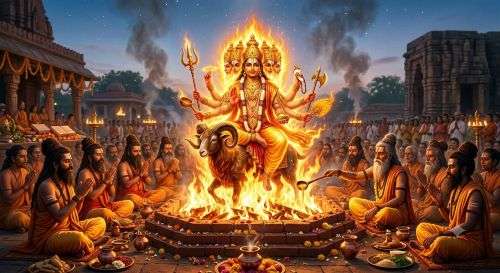
Alongside Vayu stands Indra, the mighty sovereign of the celestial realms. Indra, resplendent and unconquerable, is celebrated as the wielder of thunder and the conqueror of inner and outer adversaries. He is the lord of rain, knowledge, joy, and enrichment. Tradition proclaims him the performer of a hundred yajñas—sacrificial rites whose merit established his supremacy. As king of the gods, his authority is not selfish but cosmic; his rituals are conducted not for personal gain but for universal harmony. When the sages invited Indra and Vayu together to partake of soma, they sought both strength and movement, courage and continuity.
The hymns also exalt Mitra and Varuna, guardians of order and moral law. Mitra embodies friendship, harmony, and benevolent strength. His power is gentle yet firm, preserving bonds among beings. Varuna, majestic and profound, governs cosmic waters and upholds ṛta—the universal order. He commands the rains that sustain crops and life itself. Together, Mitra and Varuna regulate the balance between affection and discipline, mercy and law. The sages invited them to the great yajña, recognizing that society thrives only where justice and friendship coexist.
Wind, rain, fire, and water are not isolated forces but interdependent principles. The Vedic seers understood that no single element sustains life alone. Rain without wind stagnates; wind without water desiccates; fire without offering consumes destructively. Hence, their hymns narrate each deity in sequence, acknowledging the intricate web of existence. This holistic vision anticipates ecological wisdom: life flourishes through balance.
Within this cosmic framework arise the Maruts, the storm-gods—forty-nine in number, arranged in seven groups. They are described as youthful, radiant, adorned with golden ornaments and armed with flashing weapons. Their chariots roar like thunder, and their banners gleam like rainbows. As companions and brothers of Indra, sons of Kashyapa Prajapati, they stir the heavens, bringing rain that nourishes fields and forests. Their dynamic energy represents collective strength, the power of cooperation in sustaining the world.
Central to these invocations is soma—the sacred elixir. Soma is at once herb, offering, and symbol. Extracted with precision, filtered with chants, and offered with devotion, it represents rejuvenation and wisdom. Mythically associated with sun and moon, soma quenches thirst, heals illness, and bestows clarity. To partake of soma is to partake of insight; to offer it is to affirm hospitality toward the divine. In Vedic culture, the householder’s duty to honor guests finds its sacred parallel in offering soma to the gods. The yajña thus becomes a reciprocal exchange: humans offer devotion; the gods grant sustenance.
Indra’s thunder releases rain; Vayu carries fragrance and breath; Mitra fosters concord; Varuna guards moral order; the Maruts energize the skies. Each deity personifies a dimension of existence, yet together they form a unified cosmos. The sages’ perpetual search was not merely theological—it was existential. To know these forces was to live wisely within them.
The essence of the Veda is simplicity anchored in cosmic awareness. Life must be safe, harmonious, and enriched—not through domination but through reverent participation in nature’s rhythms. The friendly disposition of Mitra, the justice of Varuna, the strength of Indra, and the vitality of Vayu illustrate that true prosperity arises from balance.
Thus the narrative of the sages teaches that the universe is sustained by cooperation between seen and unseen forces. Yajña symbolizes this cooperation. The soma elixir signifies knowledge distilled from discipline. And the eternal search of the sages reminds humanity that discovery is endless—each dawn revealing new avenues of understanding, each ritual reaffirming the sacred interdependence of life.


The panchabhutas as a witness of karmic actions and determinants of all existence , their mutual dependence further illustrating the concept of ‘ sangha “ as vital for harmonious survival is understood so well with this article. While reading epics in childhood, many questions remained as doubts..the birth of Hanuman, the Govardhan Giridhari the supernatural act of Sri Krishna, Kunti s boons of offsprings from the sage ..and as grown ups we understand the cosmic interplay and sages blending with it . Thanks for adding to the gamut of knowledge.