


Vinay Rao
The battle to save Hyderabad’s iconic Kasu Brahmananda Reddy National Park is no longer merely an environmental issue. It has become a defining test of governance, urban planning, public accountability, and the government’s commitment to preserving the city’s rapidly vanishing green spaces.
Despite mounting protests from citizens, environmentalists, walkers’ groups, wildlife activists, and urban planners, the A. Revanth Reddy government appears determined to push ahead with the proposed construction of seven flyovers around KBR Park — a project critics warn could irreversibly damage Hyderabad’s ecological balance.
For lakhs of Hyderabadis, KBR Park is not just another patch of greenery. It is the city’s breathing lung. Nestled in the heart of the elite and densely populated Jubilee Hills, the park serves as a rare ecological refuge amid relentless urban expansion, rising temperatures, and concrete chaos.
Environmental experts and activists fear that boxing the park in with elevated flyovers and widened roads will dramatically alter the area’s microclimate. Studies globally have shown that excessive concretisation traps heat, increases ambient temperatures, and reduces groundwater recharge. Activists estimate that the proposed construction could raise surrounding temperatures by 2 to 5 degrees Celsius while severely affecting groundwater recharge capacity, reportedly amounting to nearly three crore litres annually.
More worrying is the impact on biodiversity. KBR Park is home to peacocks, pangolins, monitor lizards, migratory birds, butterflies, and hundreds of plant and animal species that survive within this shrinking urban ecosystem. Noise pollution, vibrations, dust, vehicular emissions, and large-scale tree cutting threaten to disturb this fragile habitat permanently.
Ironically, while national parks across the country enjoy Supreme Court-mandated eco-sensitive buffer zones extending up to one kilometre, KBR Park’s protective zone has allegedly been reduced to a mere 35 metres. Critics argue that such dilution defeats the very purpose of environmental safeguards and opens the door for unchecked commercial and infrastructural intrusion.
Equally troubling are allegations surrounding procedural violations. Activists claim no comprehensive Environmental Impact Assessment (EIA) has been conducted for the entire project. Instead, they allege the project was split into multiple smaller components to circumvent statutory EIA requirements applicable to large infrastructure works. Public hearings — an essential democratic process in projects affecting ecology and citizens’ lives — have reportedly not been conducted either.
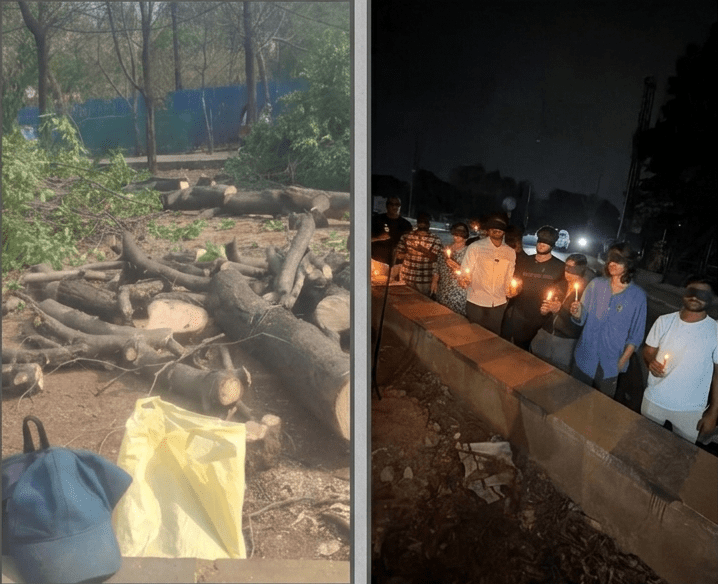
What further angers citizens is that legal proceedings concerning the project are still pending before courts, yet preparatory work, including tree felling, has allegedly already begun.
This has intensified public outrage.
Every evening now, candlelight vigils, silent marches, awareness drives, and citizen protests have become common sights around KBR Park. Young professionals, senior citizens, fitness enthusiasts, students, environmentalists, and ordinary Hyderabad residents are uniting under the “Save KBR” movement, arguing that the city is fast approaching an ecological tipping point.
Their concern is not emotional romanticism alone. Urban planners worldwide increasingly acknowledge that flyovers are not permanent traffic solutions. In many cities, they merely induce more traffic over time — a phenomenon known as “induced demand.” More roads often encourage more vehicles, eventually recreating congestion at an even larger scale.
Critics therefore question why alternative traffic management strategies were not seriously explored before resorting to aggressive construction around one of Hyderabad’s last major green lungs. Better public transport integration, synchronised traffic systems, improved junction management, staggered office timings, intelligent urban mobility planning, underground solutions in select stretches, and decentralised business districts are among the options many experts believe deserve consideration.
Unfortunately, Indian cities too often embrace development through the narrow prism of visible concrete structures while neglecting long-term ecological costs. Trees are seen as obstacles. Lakes become real estate opportunities. Parks are viewed as “vacant” spaces waiting to be monetised.
But cities cannot survive on flyovers alone.
A modern global city requires balance — infrastructure on one side and environmental sustainability on the other. Hyderabad, already grappling with soaring summer temperatures, water stress, disappearing lakes, worsening air quality, and rampant urban flooding, can ill-afford further ecological destruction in the name of development.
The government certainly has a responsibility to address traffic congestion and improve urban mobility. No reasonable citizen disputes that. But development cannot become synonymous with indiscriminate concretisation. The real hallmark of visionary governance lies in finding solutions that minimise ecological damage rather than bulldozing through public concerns.
The growing protests around KBR Park are not anti-development movements. They are appeals for responsible development.
The Telangana government still has an opportunity to pause, consult widely, reassess environmental consequences, and explore alternative engineering solutions that protect both mobility needs and ecological heritage. Rigidity in governance rarely serves public interest. Consultation does.
If Hyderabad loses KBR Park’s ecological balance today, future generations will inherit a hotter, harsher, and far less liveable city tomorrow.
The question now is simple — will the government listen before it is too late?


As a resident nearby the KBR park and regular walker in the early morning,I feel as I am seeing the dead bodies all around.The age old trees are cut ,every limb chopped.As an environmentalist I feel sad at the situation,but for whose happiness in the future generations? Tomorrow they may start building structures in the park!!! Is there no consideration for people,s voices? We are cutting out own lives spoiling the mather Nature..
The author has given a very good analysts but some more noise is needed.