



Every election season brings with it a familiar spectacle: flashing graphics, confident projections, and the near-theatrical unveiling of exit polls that claim to decode the “mood of the nation.” Yet, beneath this data-driven bravado lies a deeper philosophical question—can voter behaviour ever be measured with precision, or are exit polls merely a sophisticated guess wrapped in statistical confidence?
To grapple with this, it is worth revisiting the ideas of John Stuart Mill and his seminal work On Liberty. Mill’s reflections on liberty, individuality, and democratic participation offer a striking lens through which to examine the limits of exit polls.
Mill stood at the crossroads of classical and modern democratic thought. While influenced by Jeremy Bentham—the architect of utilitarianism—Mill ultimately broke away from his mentor’s reductionist framework. Bentham’s famous doctrine held that human behaviour could be understood through the calculus of pleasure and pain, even proposing a “felicity calculus” to quantify these experiences. In Bentham’s world, all pleasures were equal—his infamous assertion that “pushpin is as good as poetry” reduced human motivation to measurable units.
Mill rejected this mechanical view of human nature. His powerful rebuttal—“I would rather be a Socrates dissatisfied than a pig satisfied”—was not mere rhetoric; it was a philosophical revolt. Human choices, Mill argued, are layered, qualitative, and often shaped by moral, intellectual, and emotional complexities that defy simple measurement.
This is precisely where exit polls begin to falter.
At their core, exit polls attempt to do what Bentham’s felicity calculus tried—reduce human decision-making into quantifiable data points. They rely on structured questionnaires, sampling techniques, and statistical extrapolation to predict outcomes. But voting is not a mere transactional act; it is an intensely personal expression shaped by identity, aspiration, fear, social pressure, and sometimes even silence.
Mill’s emphasis on individuality and freedom of thought suggests that a voter’s “true choice” may not always be revealed, even in the anonymity of an exit poll. The very act of asking someone how they voted introduces layers of distortion—hesitation, social desirability bias, or even deliberate concealment. In societies where political polarization runs deep, voters may choose to mask their preferences, rendering the collected data inherently fragile.
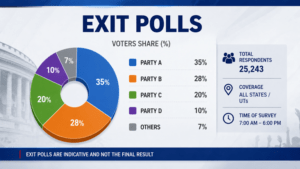
Mill also advocated for institutional safeguards against what he famously termed the “tyranny of the majority.” His support for proportional representation was rooted in the belief that democracy must capture diversity, not flatten it. Exit polls, however, often do the opposite—they aggregate, generalize, and compress complex electoral behaviour into simplified narratives. In doing so, they risk amplifying majoritarian assumptions while overlooking minority currents that could decisively shape outcomes.
Interestingly, some of Mill’s more controversial ideas—such as plural voting and the open ballot system—also intersect with this debate. His proposal for plural voting, which suggested additional weightage for the educated, was criticized for elitism. Meanwhile, the open ballot system raised concerns about whether voters would truly express their independent will without fear or influence.
These concerns echo in the context of exit polls. Even though modern polling is conducted post-voting and claims anonymity, the question remains: does it truly capture the “innate choice” of the voter, or merely a filtered version of it? If the open expression of preference itself can be influenced, as Mill feared, then expecting absolute honesty in exit poll responses may be optimistic at best.
Moreover, the predictive ambition of exit polls often overlooks the dynamic nature of democracy. Voter behaviour is not static; it evolves until the very last moment. Strategic voting, late swings, and silent waves—phenomena observed across democracies—are difficult to capture through sample-based estimations.
This is not to dismiss exit polls entirely. When conducted rigorously, they can offer valuable insights into voting patterns, demographic trends, and issue-based preferences. But to treat them as definitive predictors of electoral outcomes is to overestimate the capacity of data to capture human complexity.
Mill’s enduring lesson is one of humility. Democracy, at its core, is not just a system of counting votes but an expression of human freedom—messy, unpredictable, and deeply individual. Exit polls, for all their sophistication, operate within the limits of what can be measured. The voter, however, often operates beyond it.
In the end, the ballot remains a private act of conscience—far more profound than any post-vote survey can fully reveal.




Dr Asha Chadha, a thoughtful piece, but perhaps a shade too sceptical of what exit polls can reasonably claim to do.
At their best, they are simply well-designed snapshots, scientifically sampled across diverse voters, to gauge the broad public pulse.
Yes, there are margins of error. Some agencies may occasionally lean towards pleasing their patrons. And certainly, as you argue drawing from Mill, human choices are too layered to be perfectly captured in a questionnaire. But that does not render the exercise futile.
Exit polls may not capture every silent voter or late swing, but they do indicate which way the wind is blowing. They are neither gospel nor guesswork – they are approximations.