



In the context of the theory of reincarnation, there are references in the Bhagavad Gita –
Chapter 2 – verse 13
देहिनोஉस्मिन्यथा देहे कौमारं यौवनं जरा ।
तथा देहान्तरप्राप्तिर्धीरस्तत्र न मुह्यति ॥ 2.13 ॥
Just as the embodied in this body (passes through) childhood, youth, and old age, so does it pass into another body, there the wise one doesn’t grieve at it.
The embodied mentioned in this verse refers to the subtle and causal body. The Atman, life-giving force, does not leave the body, as it is all-pervading. Just as we do not mourn moving from childhood to youth and to old age, we need not grieve moving from this body to another body. You are grieving the death of a person because of your attachment to a wrong relationship with the individual. When that individual moves on, it causes grief.
Chapter 2 – Verse 22
वासांसि जीर्णानि यथा विहाय नवानि गृह्णाति नरोஉपराणि ।
तथा शरीराणि विहाय जीर्णान्यन्यानि संयाति नवानि देही ॥ 2.22 ॥
Just as a man casts off worn-out garments and puts on new ones, so also the embodied casts off its worn-out bodies and enters new ones.
The concept of birth and death is merely like changing one’s garments. It can be understood clearly when we analyse based on the following points:
1) Who gives vitality to the clothes?
The clothes get their vitality because of the person who wears it. The garment referred to the gross body and embodied is the subtle and causal matter. The gross body gets vitality because of the in-dweller, the subtle body.
2) Who decides to change the garment?
The wearer decides to change the garments. Similarly, the subtle body decides the next birth. Death is not determined by an external environment, circumstances, accidents, or suicide until the subtle body decides to change.
3) Why do you need to wear the garments?
One wears the garment to interact and communicate with the world. Similarly, you need the gross body to contact the world. You cannot exhaust your vasanas without the gross body.
4) When do you change the garment?
We change the garments to suit the next environment, also when the clothes are worn out, or you get fed up. Similarly, the gross body will change when the present body is not suitable for next experience. The embodied (subtle matter) moves from this gross body to the next body.
These answers give you clarity on the difficult concept of what determines death. In these two verses, Lord Krishna says that death is purely determined by the subtle body, which is the vasanas.
Subtle body + Atman enlivens the gross body. For life to express or manifest, you need all three elements – gross + subtle + Atman.
Eg: When you see a bulb glowing, there is a filament, the outer structure of the bulb, and electricity passing through the bulb. Sometimes, when there is no light, the electricity is there, the outer bulb is there but the filament has snapped. That is the death of the bulb. What is missing is the filament, which is a subtle element.
Not by prana nor by apana does any mortal live; but it is by some other, on which these two depend.
One is alive not because of prana and apana but the Atman, which is a life-giving force.
Human being = Gross body + Subtle body + Causal body + Atman
Movable matter is subtle matter consisting of the mind, intellect, and vasanas.
All the assemblages of the elements and matter, which are gross, subtle, and causal body, are insentient and dependent. Atman is an independent, sentient, life-giving principle.
Eg: A house consists of a structure made up of walls, roof, tiles, doors, furniture, fittings, etc. These are immovable, insentient, and dependent on each other. They all form a composite entity, making it a house. All of them are made for the in-dweller or householder. He is sentient, independent of these things, and free to walk in and out, but not the dependent, insentient matter.
The mantra establishes that the only movable factor is the subtle and independent existence of Atman. Atman is the only factor that is outside the assemblage of elements.
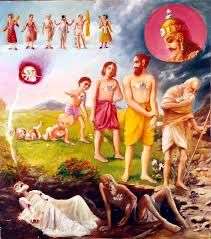
Well now, O! Gautama, I will explain to thee the secret and ancient Brahman, and also what happens to Atman after death.
Lord is initiating into the knowledge of what happens to the jiva at the relative level and Atman at the absolute level after death.
Atman in this context refers to jiva, the ego. At the absolute level, nothing happens to Atman.
The ego or jiva is a subtle matter. Ahankar is the arrogating notion kartritva bhavana of one’s actions and bhogtrivtva bhavana enjoyment to the fruits of action, from a relative point of view. From an absolute point of view, you can call a jiva the ego because this jiva has separated from the Atman. So, when I assume the individuality, and this is jiva is also ahankar. This is different from the ahankar an egoistic person has. The most spiritual person is still a jiva, because that person has not attained the state of Brahman. Between you and Brahman, that individuality exists. The fact that we have not realised Brahman, there is individuality, and that itself is jiva or ahankar. As long as duality exists, there is the jiva or ego. This is from an absolute point of view. When a person has annihilated all the desires and ego, when he dies, it is realisation.
Subtle matter leaves the body, comprising manas (mind), buddhi (intellect), chitta (conditioned consciousness), and ahankar (ego). When we say ego has left, it is a part of the subtle body. Subtle matter is the element that conditions the pure consciousness.
Pure consciousness (PC) + Thoughts = Conditioned consciousness (CC)
The subtle body is the mind, intellect and ego. These are nothing but thoughts. So thoughts are which conditions the PC.
Thoughts with reference to :
Mind – Indiscriminative thoughts
Intellect – Discriminative thoughts
Ego – Arrogant thoughts
Subtle body in its entirety: Mano, buddhi, ahankara, chitta = mind, intellect, ego, and conditioned consciousness.
Emerson says, “Every man is a divinity in disguise, a god playing the fool.”
Q: Why ego come under the subtle body and not the causal body, because the ego is closely associated with desires and vasanas?
A: Causal body is just a seed. The subtle body is an expression of the causal body. Vasanas are unmanifest. When we look at a tree, we are seeing the manifested part of the seed. A seed embedded in soil is unmanifest. Similarly, the ego is the manifestation of Vasanas.

