


Tradition, Market, and Changing Identity
The place of festivals in India’s cultural fabric is not limited to mere joy and celebration; rather, they are deeply intertwined with society’s historical memory, economic structure, relationship with nature, and human sensibilities. Here, festivals touch every aspect of life—farming, seasonal changes, family ties, and faith. But today, the question is being seriously raised: are our traditional festivals drifting away from their original spirit? Are they facing a kind of ‘cultural attack’, gradually altering their true identity?
While the term “cultural invasion” may seem offensive, it is not meant to be an accusation directed at any one class or group. It refers to the slow, subtle, and often unseen process by which traditions, outside their original social and cultural context, begin to take on new meanings. This change can sometimes be natural, and sometimes the result of deliberate economic and ideological influences.
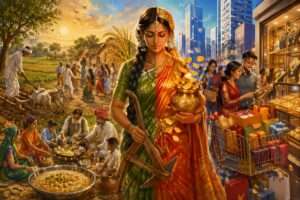
Indian festivals are primarily rooted in agriculture and nature. Much of India’s society has been agriculturally dependent for centuries, and therefore, it has a deep connection with crops, seasons, and the land. The joy of harvest, the beginning of new sowing, and the arrival of rain—all of these were expressed through festivals. The farmer was central to these celebrations, as he was the producer of food and maintained the lifeline of society. Such festivals were less ostentatious and more participatory. People would gather together to sing and play music, share feasts, and express gratitude to nature.
But as society became increasingly urbanized, industrialized, and market forces strengthened, the nature of festivals began to change. Festivals were now viewed not only from a cultural or social perspective, but also as economic opportunities. The market linked festivals to consumption, where shopping, decoration, and display became central. Ideas like “offers,” “discounts,” and “auspicious shopping” became associated with festivals, which impacted their original form.
This change isn’t just external, but also in mindset. Previously, festivals were about gathering, sharing, and expressing gratitude to nature. Now, in many places, they have become a competition—who spent how much, who bought what, whose celebration was grander. In this process, the spirit of festivals has been lost.
When discussing the “cultural invasion” of festivals, another important aspect emerges—the marginalization of folk traditions. Every region in India has had its own unique traditions, rooted in local lifestyles, languages, and resources. However, today, under the influence of media and the market, a kind of cultural homogenization is being observed. Certain festivals and their specific practices have become standardized across the country, leading to the gradual disappearance of local variations.
For example, many folk festivals that were once associated with agriculture and rural life have now been transformed into urban and religious interpretations. Their original spirit—connected to labour, nature, and collectively—is now being overshadowed by mythology and market-driven symbols. This is diminishing the role of the segments of society that were truly the heart of these festivals—farmers and labourers.
It’s also important to clarify that it’s unfair to view every change negatively. Culture is inherently changeable. New elements are added to it over time, and this is proof of its vitality. However, problems arise when this change becomes unbalanced—when it begins to undermine the very foundations of society.
The biggest question in today’s context is whether we understand the true meaning of our festivals. Do we recognize that they are not merely religious rituals but also reflections of social and economic life? If festivals forget the role of the farmer, if the respect for labour is ignored, this signals a serious cultural imbalance.
It is impossible, nor is it necessary, to completely separate festivals from the market. The market is a part of society and plays its role. However, the market mustn’t overpower the spirit of festivals. Maintaining a balance between consumption and ostentation is essential to ensure that the true spirit of festivals remains alive.
Social awareness can play a crucial role in this direction. If people themselves understand the true meaning of festivals, they will strive to celebrate them with the same spirit. Reviving local traditions, promoting community events, and strengthening our connection with nature—these are some steps that can mitigate this cultural imbalance.
Education and the media also play an important role in this. If they accurately present the depth and social context of festivals, they can increase awareness in society. Furthermore, policymakers should consider how to preserve and promote folk culture and rural traditions.
Ultimately, combating the “cultural attack” can’t be accomplished on a single day or in a single effort. It’s an ongoing process, in which every segment of society must play its part. We must view our festivals not just as traditions, but also as a responsibility—a responsibility that keeps us connected to our roots.
The true power of festivals lies not in their grandeur but in their simplicity and meaningfulness. If we can understand and incorporate this into our lives, no “cultural attack” will be able to weaken our cultural identity. Instead, we will be able to enrich our traditions by balancing them with the new times.
The need today is to redefine our festivals—to see them not as a means of consumption, but as a celebration of social connection, respect for nature, and the dignity of labour. Only then will we truly preserve our cultural heritage and pass on its true spirit to future generations.

