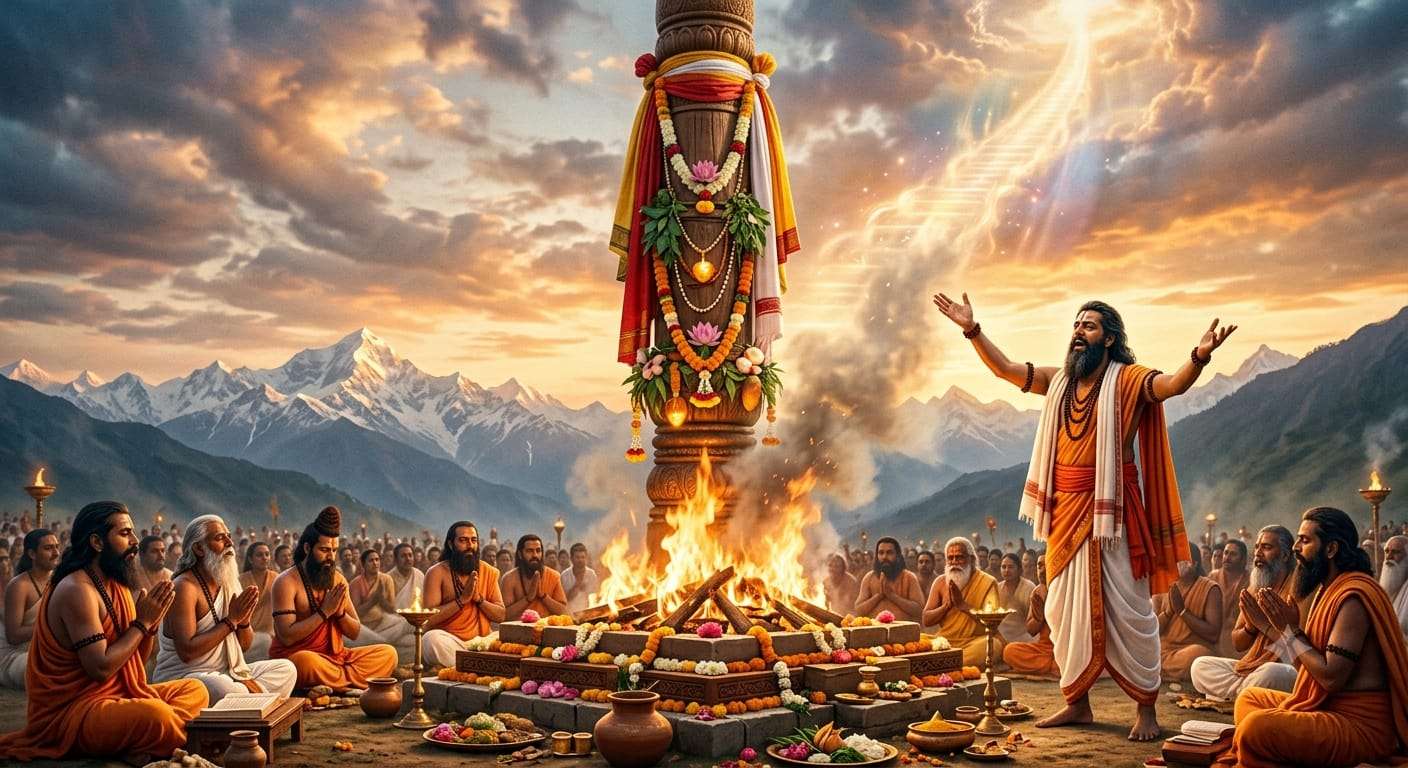
The sage Gouthama, born of the lineage of Rahugana, raises his voice in solemn praise within the measured rhythms of Pankti and Jagati chandas, composing hymns that resonate through the sacred expanse of the Rigveda. In a tranquil yet spiritually charged atmosphere, the seer contemplates the grandeur of Indra, whose might once shattered the cosmic obstruction of Vritra, thereby restoring the flow of waters and life. The hymn is not merely an act of praise but a conscious invocation, wherein the priests, through disciplined chanting, seek to invigorate the divine शक्ति of Indra, aligning human aspiration with cosmic force.
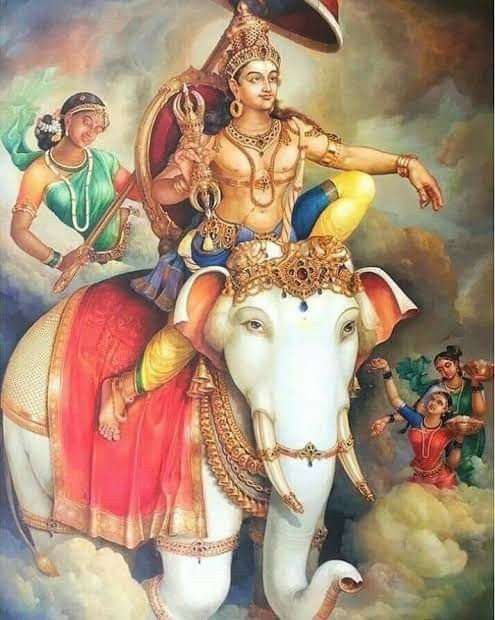
Indra is envisioned as the supreme warrior, whose strength is not isolated but reflected through the vigor of his hosts and the devotion of his followers. The seer expresses a worldview in which divine favor transforms the humble into the eminent; even the lowly, by sincere worship, rise to prominence under Indra’s grace. In this sacred economy, ritual action—particularly the offering of Soma—becomes the bridge between mortal effort and divine reward. Wealth, victory, and strength are seen as natural consequences of alignment with divine order, and the spoils of the unrighteous are rightfully redistributed to those who uphold sacred duty.
The imagery of Indra’s chariot, drawn by two powerful steeds, symbolizes control over dynamic forces. These horses are not mere animals but embodiments of disciplined energy, capable of subduing pride and disorder. The seer repeatedly urges Indra to harness them, to set forth into both minor and great battles, suggesting that conflict itself is a necessary aspect of maintaining cosmic equilibrium. The call to “slay the deserving” reflects not cruelty but the Vedic principle of restoring balance by removing that which obstructs righteousness.
Indra’s greatness is further magnified through his intimate association with Soma, the elixir of vitality and divine inspiration. Upon consuming Soma, his strength multiplies, his faculties sharpen, and his benevolent actions increase. This portrayal reveals an early understanding of transformation through sacred substances, not merely as ritual intoxication but as a symbolic elevation of consciousness. His formidable form—strong-jawed and radiant—is described as worthy of repeated vision, indicating the seer’s deep reverence for divine manifestation.
The hymn expands from the personal to the cosmic, presenting Indra as a universal architect who has established the pathways of wind and the constellations in the heavens. He is declared unparalleled—neither born in the past nor destined to arise in the future—thus affirming his unique sovereignty. This vision reflects a profound cosmological awareness, where natural phenomena are not random but governed by an intelligent and organizing principle embodied in Indra.
Simultaneously, the seer’s tone remains practical and grounded. He appeals for sustenance, cattle, protection, and prosperity, acknowledging human dependence on divine provision. The repeated request for a share of Indra’s inexhaustible wealth reflects an understanding of abundance as a flowing resource, to be distributed among those who live in harmony with sacred law. The ritual fire, oblations, and hymns together form a system of exchange, where devotion invites nourishment, and gratitude sustains the cycle.
The narrative also emphasizes ethical alignment. Those who praise Indra and perform sacrifices are enriched, while those who neglect him are deprived of their wealth, which is then reassigned to the devout. This reflects an early moral economy embedded within ritual practice, where righteousness ensures continuity and disorder leads to loss. The seer recognizes truth-speaking as a divine gift, granted through Indra’s influence, indicating that spiritual alignment refines not only material conditions but also inner character.
Toward the culmination, the hymn becomes almost poetic in its repetition of invocation—calling Indra to ready his chariot, to yoke his steeds, to come forth and partake of Soma. The imagery of the chariot filled with the elixir and moving across the heavens suggests the cyclic nature of rain, nourishment, and renewal. Indra’s descent is linked with rainfall and the bestowal of cattle, reinforcing the intimate connection between divine action and ecological balance.
Though the prayer appears simple in its requests, it is deeply structured, moving through layers of order and intention. It reflects a sophisticated way of living—rooted in present awareness yet oriented toward future abundance. The sage, through his vision, does not merely seek favors but unveils a cosmic framework in which nature, ritual, and human aspiration are harmonized. In invoking Indra, he symbolically calls upon humanity to harness the forces of nature with wisdom, discipline, and reverence.
Thus, the hymn stands as both spiritual invocation and proto-scientific reflection, were observation of natural cycles blends seamlessly with metaphysical insight. The universe is not seen as inert but as a living, responsive system, open to alignment through knowledge and devotion. In this grand vision, the sage becomes not only a poet of the divine but also a mediator of cosmic awareness, illuminating the path toward a life of sufficiency, harmony, and enduring abundance.