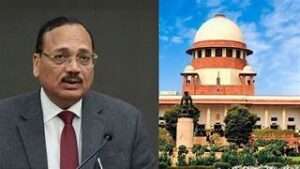
The latest hearings before the Constitution bench on the Sabarimala Temple entry case have once again exposed a fault line India has long refused to confront honestly: can a modern republic afford multiple, competing religious codes operating under the same Constitution? What began as a legal debate over women’s entry into the Sabarimala Temple has evolved into something far more fundamental—a test of whether constitutional morality can truly override faith-based practices when they clash with equality. A question posed by Justice Ahsanuddin Amanullah cuts to the heart of this dilemma. If a devotee approaches a deity with pure faith, why should birth, lineage, or biological factors determine access? Should the Constitution not intervene? It is a fair question. But it also opens a Pandora’s box that the judiciary alone cannot resolve—because the issue is no longer about one temple, one practice, or even one religion. It is about consistency. For decades, India has lived with a peculiar contradiction. The Constitution promises equality under law, yet permits different communities to operate under separate personal laws—each justified in the name of religious freedom. The result? Selective intervention. One faith’s practices are scrutinised, debated, and sometimes struck down, while others remain beyond the pale of reform. This asymmetry is not merely legal—it is political. When courts examine practices within Hindu traditions, they invoke constitutional morality, gender justice, and reform. Yet, when confronted with deeply contentious practices in other faiths—some of which raise serious questions about individual liberty and human dignity—the same urgency is often absent, constrained by political sensitivities and fears of backlash. This is not an argument against reform. It is an argument against selective reform. The framers of the Constitution never intended for religious freedom to become a shield against scrutiny. Article 25 of the Constitution of India guarantees freedom of religion—but it is explicitly subject to public order, morality, and health. In other words, faith was never meant to override fundamental rights. Yet, in practice, that balance has been inconsistently applied. The arguments presented by senior advocate V. Giri—that rituals form an essential part of religious practice and must align with the nature of the deity—are rooted in established jurisprudence. The concept of “essential religious practices” has long guided judicial reasoning. But here lies the problem: who decides what is “essential”? Courts? Clergy? Devotees?
The lack of a uniform standard has turned constitutional adjudication into a case-by-case negotiation with faith—often influenced as much by social pressure as by legal principle. This is precisely why the debate inevitably circles back to the need for a Uniform Civil Code. A Uniform Civil Code is not about erasing religion. It is about establishing a common legal framework where individual rights are not contingent on religious identity. It ensures that equality is not negotiable, and justice is not selective. More importantly, it removes the burden from courts to constantly arbitrate between faith and fundamental rights. Instead of firefighting individual disputes—whether at Sabarimala or elsewhere—the law would provide a clear, consistent standard applicable to all. Critics argue that such a code would infringe upon religious freedom. But that argument misreads the Constitution itself. Freedom of religion was never absolute; it was always subject to reform when practices violate fundamental rights. The real question, therefore, is not whether the Constitution should intervene in religious practices—but whether it should do so equally across all faiths. Because selective intervention breeds resentment. It creates the perception—fair or otherwise—that the majority’s practices are open to scrutiny, while minority practices are insulated. Such perceptions erode trust in institutions and deepen social divides. India cannot afford that. The judiciary has done its part by raising difficult questions and pushing the boundaries of constitutional interpretation. But the final resolution cannot come from courtrooms alone. It requires legislative clarity and political will. A Uniform Civil Code offers that clarity. It brings all citizens under one legal umbrella—not to homogenise belief, but to standardise rights. It ensures that faith remains a matter of personal conviction, not a determinant of legal privilege or disability. The Sabarimala debate, therefore, is not an isolated controversy. It is a symptom of a larger structural imbalance. If India truly believes in “equality before law,” then that principle must apply without exception, without hesitation, and without selective application. One nation cannot indefinitely sustain multiple standards of justice. One Constitution must mean one law—for all.