



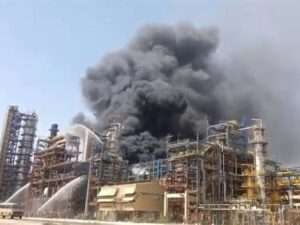
The recent fire mishap at the HPCL Rajasthan Refinery in Barmer—coming just a day before its scheduled inauguration by Prime Minister Narendra Modi—is not just unfortunate; it is deeply unsettling. Timing, in geopolitics and infrastructure, is rarely dismissed as coincidence so easily. When critical energy infrastructure is hit at such a sensitive moment, questions are inevitable: was it merely an accident, an act of sabotage, or part of a larger, emerging pattern in modern conflict?
This unease is amplified by recent rhetoric from across the border. Pakistan Army Chief Asim Munir—often projecting himself as a hardliner—has openly issued warnings that, in the event of escalation with India, Pakistan would not hesitate to target key economic assets, including major refineries such as those operated by Reliance. Such statements are not casual bluster; they reflect a strategic mindset where economic choke points are seen as legitimate targets.
This is not an isolated narrative. In the broader theatre of global conflict, similar threats have surfaced. During the ongoing tensions in West Asia, statements linked to circles close to former US President Donald Trump have echoed a dangerous normalization—the idea of striking critical energy infrastructure to cripple adversaries. The repeated mention of Iran’s vital oil hub, Kharg Island, as a potential target underscores how energy assets have moved from being collateral damage to deliberate objectives.
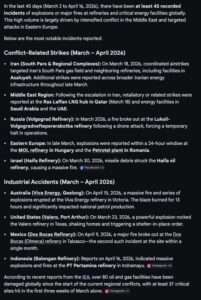
Placed against this backdrop, the Barmer refinery fire begins to look less like an isolated industrial mishap and more like part of a worrying pattern. Over the past few weeks, there have been multiple incidents—fires, explosions, operational disruptions—affecting energy infrastructure across continents. From Southeast Asia to Latin America, and even in relatively stable regions like Australia, refinery-linked accidents have made headlines with unusual frequency.
Of course, industrial accidents are not new. Refineries, by their very nature, handle volatile materials under high pressure and temperature. Even with the most stringent safety protocols, risks cannot be entirely eliminated. But what raises suspicion today is not merely the occurrence of accidents—it is their clustering, their timing, and their geopolitical context.
When dozens of such incidents occur in quick succession globally, it becomes difficult to dismiss them all as unrelated. The modern battlefield is no longer confined to borders or conventional military engagements. It has expanded into cyber warfare, economic disruption, and increasingly, strategic targeting of infrastructure that sustains national economies. Energy is at the heart of this ecosystem. Disrupt it, and you destabilize everything from industry to public morale.
Adding another layer of intrigue is the paradox playing out in global markets. Even as reports of refinery disruptions and energy infrastructure incidents surface with increasing regularity, energy stocks and related commodities have shown remarkable resilience—often even touching new highs. This raises an uncomfortable question: who benefits from this chaos?
Is it merely market dynamics reacting to supply concerns? Or is there a deeper orchestration where instability itself becomes a tool—not just of warfare, but of profit?
It would be premature, and perhaps irresponsible, to draw definitive conclusions without concrete evidence. Not every fire is sabotage. Not every explosion is part of a conspiracy. However, it would be equally naïve to ignore patterns simply because they are inconvenient or uncomfortable.
India, as one of the world’s fastest-growing economies with an ever-expanding energy footprint, cannot afford complacency. The Barmer refinery project is not just another industrial installation; it is a symbol of energy security and economic ambition. Any threat—accidental or otherwise—to such assets must be investigated with the highest level of scrutiny.
At the very least, this incident should serve as a wake-up call. Security protocols around critical infrastructure must be reassessed. Intelligence coordination—both domestic and international—needs strengthening. And most importantly, policymakers must recognize that in today’s world, wars may not always begin with missiles; they may begin with fires in places that power nations.
Because if these are merely coincidences, they are extraordinarily timed ones. And if they are not, then the world may already be witnessing a silent, shadowy form of warfare—one that targets not soldiers, but the very engines of modern civilization.


Very aptly pointed out by author about sabotage possibility A thorough investigation is the need of the hour. History tells us that the doors of the forts were always opened from inside. The role of sleeper cells inside the country cannot be ruled out. Look at what is happening TCS, Lenscart, etc. This is just tip of the iceberg. India’s growth, both economically & militarily under Modi’s government has become a reason for world envy. Every Indian should become a watchman and be careful of his surroundings and help the government on any abnormal activity observed anywhere. We need to strengthen the hands of our nationalist government.
yes.its timely caution.needs scrutiny and care at every sofisticated attempt by detractors..
appreciated your intiative.
Meanwhile at Port Homalin, Myanmar
Huge fire set a number of tankers carrying fuel in a devastating blaze which reports say a number of people have died in.
That’s Russia, India & Myanmar fuel & energy resource all catching fire in the last 24 hours.
Then go look up all the other countries just in the last seven days suffering similar instances – these aren’t all coincidences – a global energy crisis is being manufactured in real time