The son of Rahugana, the sage Gautama, stands as a seer of refined perception within the sacred corpus of Rigvedic hymns, composing his prayer to Agni in the measured cadence of Anuṣṭup chandas. In his vision, humility is not merely an ornament of devotion but its very foundation. He does not approach the divine with the pride of knowledge or the force of ritual mastery; instead, he adopts a posture of inner surrender, acknowledging the limitations of human capacity before the vastness of the cosmic principle embodied in Agni. Through this humility, his imagination expands beyond the ordinary bounds of thought, weaving together the human act of prayer, the celestial response, and the intricate web of universal interdependence into a seamless and luminous tapestry.
The sage confesses with profound sincerity that mortals lack the strength to draw the attention of Agni by their own merit. Their voices, though shaped into hymns, are fragile; their rituals, though carefully performed, are insufficient; their intellect, though striving, cannot fully comprehend or magnify the divine essence. This admission is not despair but a higher wisdom, for it reflects the Vedic insight that truth arises not from assertion but from recognition of one’s limits. In this spirit, the invocation of Agni becomes an act of calling rather than commanding, of inviting rather than compelling.
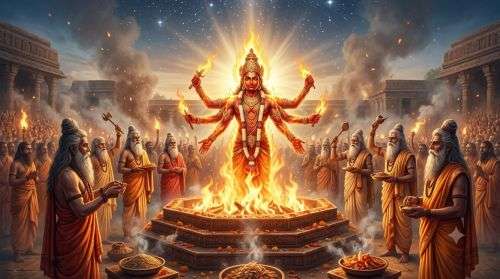
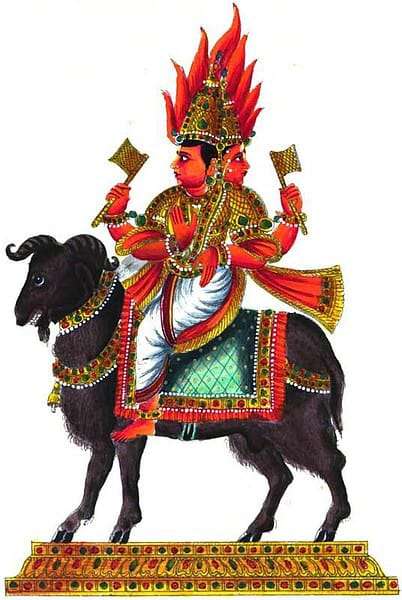
Agni is entreated to move of his own accord and take his sacred seat upon the altar, the meeting ground of heaven and earth. He is invoked as the summoner of celestial hosts, the one who bridges the realms by bringing the gods into the presence of men. Untouched by subjugation, unbound by any force, he is sustained and protected by the vast expanses of earth and sky. In this portrayal, Agni is not merely a ritual fire but a cosmic intelligence, an intermediary that harmonizes the seen and the unseen, the finite and the infinite.
The sage further beseeches Agni to create a favorable disposition among the gods towards the sacrificers, acting as a divine mediator who transforms human offerings into celestial acceptance. He is called upon to consume hostile and disruptive forces, to guard the sanctity of the yajña from calamities, and to ensure the uninterrupted flow of sacred action. In the ordered progression of the ritual, Agni is requested to bring Indra, the wielder of power, accompanied by his swift steeds, so that the rite may culminate in divine participation and blessing.
Agni is praised as the mouth of the gods, the luminous channel through which oblations ascend and grace descends. His flames are not merely physical but symbolic of transformation, carrying the essence of offerings into subtler realms. He is the bestower of progeny, prosperity, and continuity, sustaining both the physical and spiritual lineage of those who invoke him. Seated among the deities, he partakes in the sacred acts performed by priests, accepting even the अंतिम rites with equal sanctity, thus encompassing the entire spectrum of human existence from birth to departure.
In the memory of ancient tradition, Agni is the first priest, the कवि among the gods, who along with the wise Manu established the archetype of worship through oblation. He is the creator and sustainer of ritual order, truthful in essence and precise in action, employing even the simplest instruments, such as the wooden ladle, to uphold the grandeur of cosmic law. This union of simplicity and profundity reflects a scientific temperament inherent in Vedic thought, where precision, repeatability, and harmony with natural principles define the sacred act.
The sage contemplates the immeasurable greatness of Agni, acknowledging the disparity between mortal limitation and divine immensity. Yet, within this contemplation arises a paradoxical courage—the recognition that even the smallest offering, when aligned with truth, reaches the highest reality. Agni, as the immortal messenger, the knower of all that exists, becomes both the path and the guide, ensuring that the intentions of the sacrificer are conveyed to the divine assembly.
Agni is envisioned as the cause underlying all activity, the force that initiates creation and presides over dissolution. Like a compassionate friend, he grants wealth and sustenance to those in need, responding to sincerity rather than grandeur. The gods themselves seek his presence in rituals, for without him the sacrifice remains incomplete. To human perception, it is Agni who stands at the forefront, embodying the totality of the rite, and thus he is established as the chief among divine functionaries.
The sage concludes with an affirmation of the transformative power of yajña, where those who offer with faith are strengthened in both material and spiritual dimensions. The Gautama seers, masters of sacred chant and disciplined thought, are depicted as companions of Agni in this eternal exchange. Having partaken of the सोम, the elixir of immortality, in their communion with him, they elevate both themselves and the fire they nourish. Thus Agni, enriched by their offerings, becomes ever more radiant, and in his radiance, the cosmic order is sustained.
In this profound vision, the hymn stands as both spiritual revelation and rational insight, illustrating a universe governed by interconnection, reciprocity, and law. The humility of the seeker, the responsiveness of the divine, and the precision of ritual action together form a harmonious system that reflects not only devotion but also an early scientific understanding of balance and causality within the cosmos.