
Upadhyayula Lakshman Rao
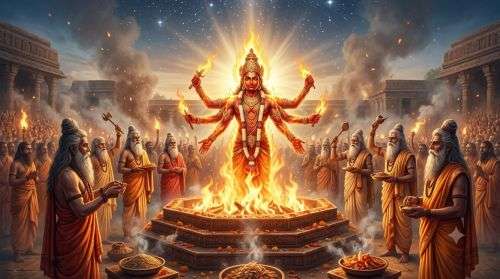
In the serene stillness of the sacred enclosure, the sage Gouthama, son of Rahugana lifts his consciousness into the rhythm of the Gayatri Chandas, invoking Agni with measured devotion and inner clarity. His mind, refined through discipline and contemplation, gently disentangles the complex web of divine attributes, rendering the act of prayer both simple and profound. What emerges is not merely a hymn, but a living bridge between the visible and the unseen, where the spiritual essence of ritual aligns harmoniously with the vast, ordered movement of the cosmos.
The sage’s insight penetrates deeply into the subtle correspondences that bind nature to the universal whole. With unwavering faith in tradition and the time-honoured principles of sacred rites, he affirms that the rituals performed are free from even the slightest trace of violence. Yet, within the human sphere, conflict persists. The patron, though devoted, is encircled by adversaries who conspire in secrecy. Their intentions are dark, their actions concealed; still, the sacred vibrations of the chant, though uttered from afar, are received by Agni, who alone discerns truth beyond distance and deception. In response, he bestows prosperity upon the patron, affirming the invincible power of righteous invocation.
The sage proclaims his steadfast commitment to the eternal practice of chanting hymns in praise of Agni, the primordial force who once overcame the restraining power that held back the waters, thereby releasing abundance into the world. Through every struggle, Agni has emerged as the harbinger of victory and wealth, and all beings born thereafter continue to revere him as the sustaining flame of life. As the divine messenger dwelling within the household of the patron, Agni transforms the ritual space into a radiant field of sacred presence, making it worthy of reverence and vision.
Born of strength and inexhaustible energy, Agni stands as the axis between offering and fulfilment. He sanctifies the oblations, carrying them with precision to the divine realms, ensuring that the bond between mortals and gods remains unbroken. Gentle in presence yet immense in power, he summons celestial beings to the ritual ground, enabling the sacred exchange through which prayers ascend and blessings descend. As the emissary of the divine, his motion is swift beyond perception; the chariot he commands moves with such subtle velocity that its sound dissolves into silence, symbolizing the unseen yet effective operation of cosmic forces.
Those who once stood helpless, devoid of means and recognition, have, through their devotion to Agni, risen into prosperity and renown. Nourishment, strength, and enduring vitality flow from his grace. To those who offer with sincerity, he grants a radiance that does not diminish and wealth that is not exhausted. The sage, in reverent humility, presents the oblations and intones melodious hymns, beseeching Agni to receive them directly, not as distant echoes but as offerings placed into the very heart of divine awareness.
Agni is luminous not merely in form but in wisdom. He is the knower of all paths, the silent witness to all actions, and the guardian of sacred knowledge. Among all relationships, none is closer than that which binds the devotee to Agni; among all rituals, none surpasses his worship; among all refuges, none is more secure. He stands as kin, as friend, as guide, and as companion to all who seek truth and sustenance.
In the culmination of the hymn, the sage entrusts Agni with the guardianship of the divine order itself. He is invoked to care for the celestial powers, to uphold the harmony between forces that govern existence, and to preside over the yajna as its eternal resident. In this vision, Agni is not merely a ritual fire but the conscious principle of transformation, the scientific and spiritual axis through which matter becomes energy, offering becomes grace, and human aspiration becomes cosmic fulfilment.