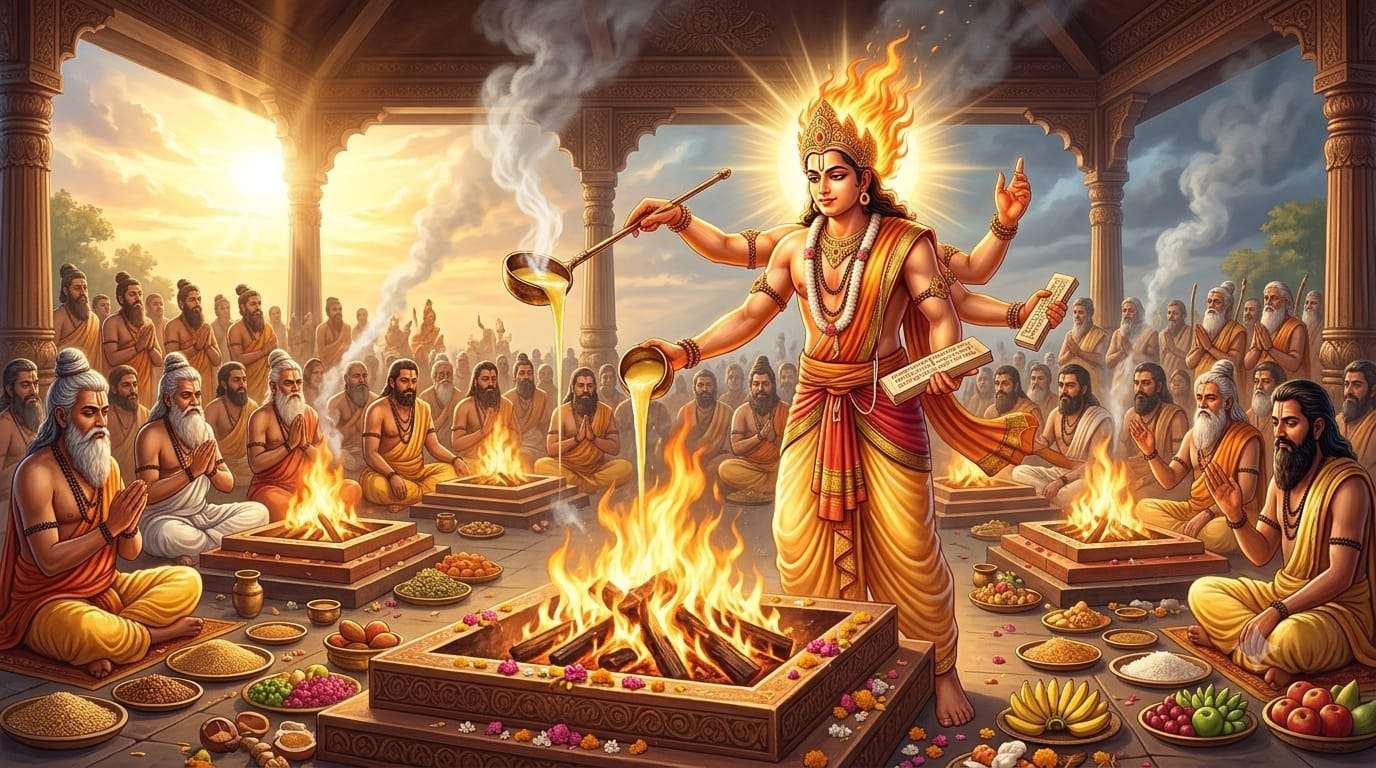
In the luminous dawn of Vedic contemplation stands the figure of Medhātithi, not merely as a supplicant, but as a seeker whose prayer is an act of intellectual churning. His invocation is neither a distortion nor an imaginative exaggeration of divine powers; rather, it is a disciplined alignment with the truthful spirit of the gods—especially that of Indra. What appears outwardly as a simple hymn unfolds inwardly as a profound endeavour to harmonize thought, word, and deed—the essential triad of Vedic ethics.
The Vedic seer never prays casually. Prayer is tapas of the intellect. When Medhātithi invokes Indra and Varuna, he approaches two complementary sovereigns. Indra, lord of dynamic force and victorious action, represents courage, expansion, and the breaking of limitations. Varuṇa, guardian of cosmic order (ṛta), embodies moral law, depth, and restraint. Both preside over vast kingdoms—one of outward conquest, the other of inward discipline. Their dual invocation symbolizes the Vedic aspiration to balance power with righteousness.
The prayer seeks protection—not merely physical security, but protection of consciousness. “Let our minds ever remain in your service,” the seer entreats. In Vedic understanding, the mind is both the battlefield and the altar. If the mind aligns with Indra’s strength and Varuṇa’s order, then society prospers. This is why the hymn boldly asks: “Make us prominent among donors.” Charity (dāna) in Vedic culture is not material extravagance; it is the expression of inner abundance. To be a foremost donor is to participate in the cosmic cycle of giving, reflecting the generosity of the gods themselves.
The offering of Soma occupies a central role. Soma is not merely a ritual libation but a symbol of inspired consciousness. When the seer declares that action-oriented Somas are prepared for the gods, he affirms that devotion must be accompanied by effort. The scholars sing hymns not as flattery but as acts of realization. Through chant, the vibrational bridge between mortal and divine is established.
The hymn gradually ascends toward the Lord of Divine Word—Brihaspati. In the Vedas, Bṛhaspati is the embodiment of sacred speech (Vāc), wisdom, and priestly authority. He is described as remover of illness, bestower of riches, and guardian against harsh words. This reflects a subtle psychological truth: words can wound more deeply than weapons. Hence the prayer seeks deliverance from “those who hurl harsh speech.” The Vedic sages understood that social discord begins with unrestrained language; thus, mastery of speech is mastery of destiny.
Brhaspati is also called the Lord of the Assembly (Sadasya). Without his presence, the yajna yields no fruit. The yajna itself is not merely a fire ritual but a structured cooperation of minds, intentions, and offerings. The Brahmana texts repeatedly affirm that ritual precision without intellectual clarity is barren. Therefore, the seer prays for intelligence (Medha). Intelligence here is not cunning but luminous discernment—the ability to perceive the unity behind multiplicity.
The reference to the son of Uśijā and Kakṣīvāntha signifies the honoured lineage of seers and craftsmen. The term “Kakṣaṇa,” interpreted as fingers, symbolically elevates skilled artisans. In Vedic society, craftsmanship was sacred. The construction of the fire altar, the decoration of ritual space, and the precise shaping of implements were acts of devotion. The Śulba Sūtras even demonstrate geometric sophistication in altar construction, revealing that science and spirituality were intertwined. By granting equal honour to the divine word and to skilled hands, the tradition acknowledged that wisdom must manifest in action.
The Vedic community also introduced the participation of diverse groups in sacred processions, reflecting a broad vision of life. Yet they recognized human frailty—illness, annoyance, sin, and harsh speech infiltrated society. These terms, drawn from lived experience, were distilled into prayer. Rather than despairing, the sages sought transformation through invocation. Spirituality was thus not escapism but engagement with reality.
In invoking Indra, Varuna, Soma, Dakṣiṇā Devī, and above all Bṛhaspati, the seer constructs a grand synthesis. Indra symbolizes heroic perseverance— “He who flourishes shall not perish.” Varuna ensures moral accountability. Soma inspires ecstasy of insight. Dakshina represents rightful offering and gratitude. Brhaspati unites them through the power of divine speech.
The narrative reveals a profound theology: the Veda itself is prayer. It is not merely scripture but a living force of knowledge. The sages visualized Brhaspati as the blazing head of wisdom installed at the heart of ritual fire. His brilliance equals the celestial realm; his presence ensures success. The gods grant him equal stature because without speech, even the gods cannot be praised, and without praise, the cosmic order weakens.
Thus, the hymn is not a fragmented appeal for material gain; it is an intellectual and spiritual architecture. It teaches that growth continues even after consumption—whatever remains is multiplied under divine guardianship. Victory is not mere conquest but alignment with cosmic law. Prosperity follows rightful oblation. Speech, when purified, becomes protection.
In its essence, this Vedic invocation proclaims a universal truth: human beings rise when their thoughts are disciplined, their words sanctified, and their deeds aligned with cosmic order. The prayer of Medhātithi is therefore timeless. It is the churning of consciousness seeking harmony with the vastness of existence—a reminder that true yajna is the inner offering of ego into the fire of wisdom.