Upadhyayula Lakshman Rao
The search for excellence, when viewed in its broadest and noblest perspective, was never in the Vedic mind a pursuit of individual triumph alone; it was a sacred endeavour directed toward the harmony of the cosmos and the welfare of society. The ancient seers of the Rigveda perceived the universe not as inert matter, but as a living order—ṛta—sustained by conscious forces. Ritual (yajña) was therefore not a mere ceremonial act, but a dialogue between humanity and divinity, an exchange of gratitude and grace. To enlarge the scope of such excellence was to invite more deities into the sacred rite, acknowledging the manifold powers that sustain life.
Foremost among the invited are the divine twins, the Aśvins—celestial physicians, radiant in youth and benevolence. They are described as the sons of Surya, born of light and movement. Their hands are long, ever-extended toward the sacrificial offering, eager to uplift and heal. Fair in form and tangible in presence, they are guardians of noble deeds. No righteous action escapes their notice; no sincere invocation fails to reach them. The soma elixir is prepared for them with devotion, for they delight in its vitality-bestowing essence. Though they preside over many realms, they are invoked as compassionate leaders of their domain, requested to accept prayer and humility alike.
The Aśvins are never solitary, for they embody the principle of dual harmony—body and mind, matter and spirit. The Veda proclaims that healing is not for bone alone, but for the human being endowed with thought, feeling, and aspiration. Thus, their treatment is both physical and psychological. They ride celestial steeds, symbols of swiftness and responsiveness, for a physician must arrive without delay. In this imagery lies an ancient value: service must be prompt, compassionate, and impartial. They refuse none who suffer. To invoke them is to affirm that society must care for the whole person—health of limb and clarity of mind alike.
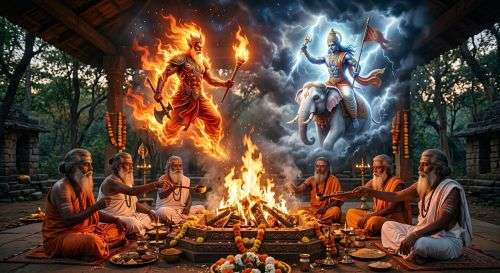
Then is invited the mighty Indra, sovereign of strength and luminous power. In the hymns of the Rigveda, Indra appears in multicoloured splendour, radiant in great hues of lightning and storm. The soma, purified by learned priests and sanctified through yajña, rests in golden vessels awaiting him. The Brahmins, masters of sacred chant, call him through Vedic hymns to come swiftly with his steeds. Indra’s acceptance of soma symbolizes the empowerment of righteous action. He is vigour in leadership, courage in adversity, and the force that breaks obstruction. In societal terms, he represents the strength required to overcome chaos and protect order.
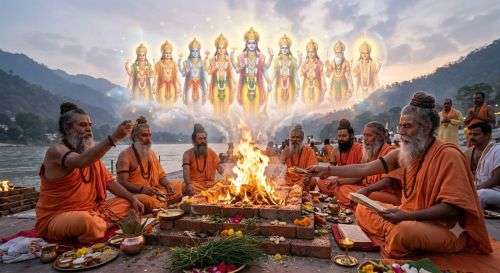
The Visvedevas—the collective deities—are also invoked. They are protectors and sustainers, imperishable and all-pervading. Free from malice, they witness all actions, bearing silent testimony to truth. Tradition speaks of them as numerous—ten principal forms such as Kratu (resolve), Daksha (skill), Vasu (abundance), Satya (truth), Kala (time), Kama (desire), Dhriti (steadfastness), Kuru (action), Pururava (illumination), and Madravasa (grace). They are described as sons of Dharma and Viswa, daughter of Daksha Prajapati, suggesting that cosmic order arises from righteousness united with universal consciousness. It is difficult to count nature’s forces; the Veda poetically speaks of 3,339 deities—an attempt not at arithmetic precision, but at reverent acknowledgment that reality is inexhaustible. Fire, wind, and space are visible; yet countless subtler powers operate unseen.
Agni, the sacred fire, stands as mediator between mortal and immortal. Through him offerings ascend; through him blessings descend. He grants rain, health, learning, and prosperity. In every household hearth and every sacrificial altar, Agni embodies transformation—the conversion of material into spiritual merit. Worship of Agni affirms growth, ascendance, and continuity of order.
Saraswati, radiant goddess of wisdom, is invoked to sanctify all actions. As the inspirer of eloquence and learning, she makes mortal activity meaningful. Sweet words uttered with sincerity become offerings in themselves. She bears the yajña, ensuring that merit corresponds to action. In the hymns she shines as the illumination behind thought. There is also the sacred river Saraswati River, upon whose banks many yajñas were performed. Though its physical stream faded with time, its spiritual current remains inward-flowing. At the confluence of Ganga, Yamuna, and the invisible Saraswati at Triveni Sangam, the symbolism is profound: visible knowledge and invisible wisdom meet in sacred unity. Saraswati thus signifies both external culture and inner enlightenment.
In this grand Vedic order, ritual is not superstition but structured gratitude. Each deity represents a dimension of life—health, strength, wisdom, resolve, time, truth. To “add more deities” to the ritual is not to multiply idols, but to expand awareness of interdependence. Society prospers when it honours all forces—physical and psychological, visible and invisible, material and moral.
The ancient seers understood that excellence arises when human endeavour aligns with cosmic law. Yajña becomes a metaphor for responsible living: offering before receiving, serving before claiming, purifying before possessing. The Aśvins teach compassionate healthcare; Indra exemplifies courageous leadership; the Visvedevas affirm moral plurality within unity; Agni demonstrates transformative effort; Saraswati inspires enlightened thought.
Thus the Vedic vision of well-being is holistic. It recognizes that prosperity without virtue is unstable, strength without wisdom is destructive, and knowledge without humility is barren. By invoking the divine in manifold forms, the ritual becomes a societal charter—a reminder that harmony among forces sustains civilization.
In seeking excellence, therefore, one must widen perception, deepen reverence, and harmonize action with the eternal order. For when the inner yajña is kindled and all divine principles are honoured, society flourishes under the unseen guardianship of cosmic law, and humanity advances in health, wisdom, and enduring peace.