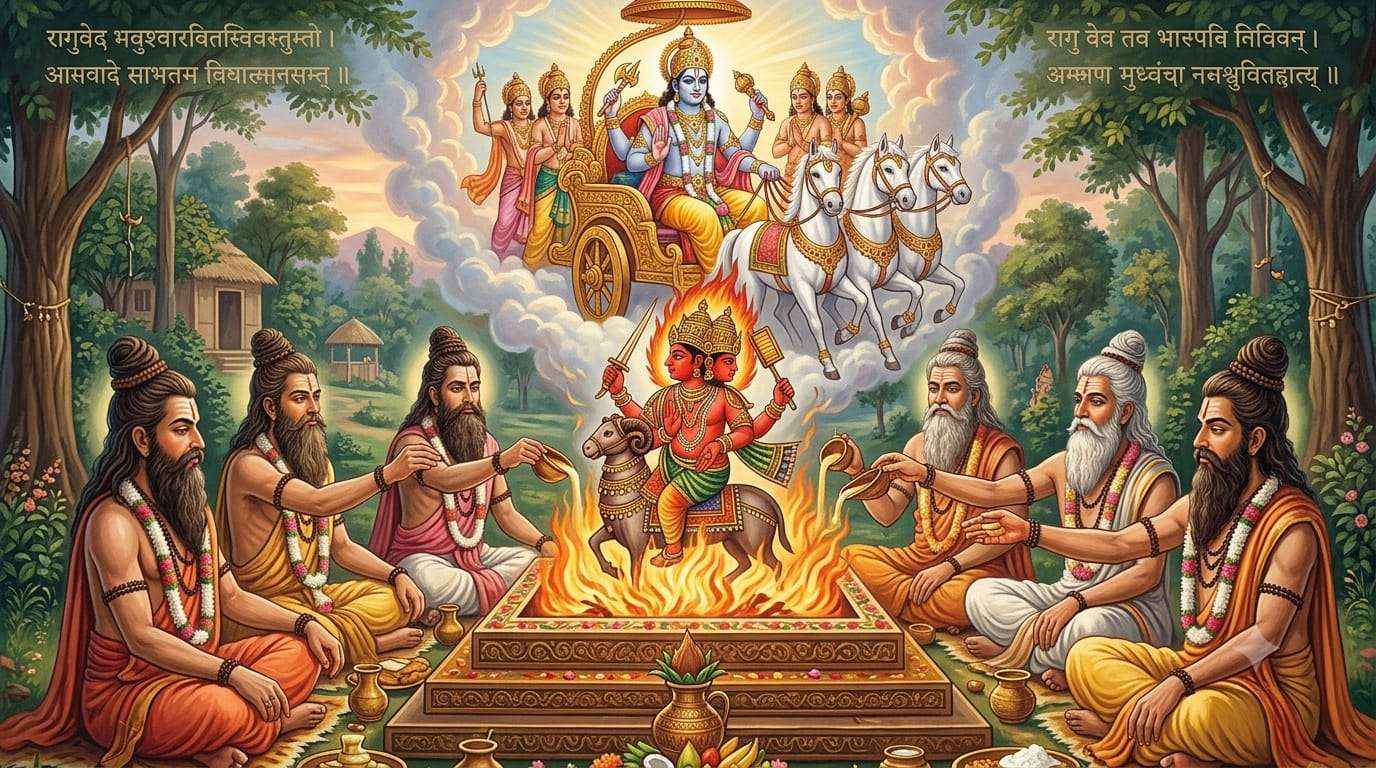
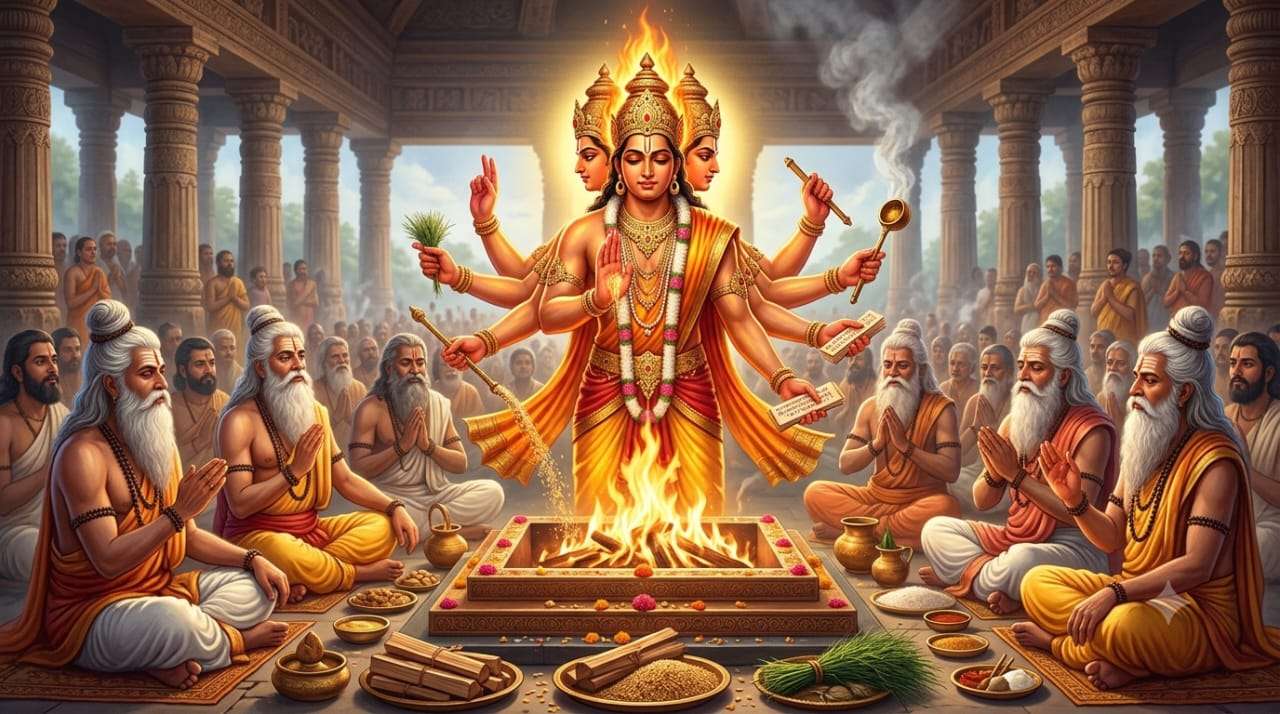
The wisdom of the Upanishadic seers emerges not as a rejection of Vedic depth but as its luminous distillation. The vast ritualistic and cosmological grandeur of the Vedas finds, in the Upanishads, a contemplative inward turn. What was once expressed through sacrificial fire, hymn, and cosmic invocation becomes refined into observation of nature, of life, of consciousness itself. The ancient gurukulas trained their young students not merely in recitation but in perception. The scholar was first an observer. He learned to see the world not as a collection of objects, but as a revelation of law.
At the heart of Vedic thought lies the doctrine of cyclic creation. Creation is not a singular event suspended in a remote past; it is a continuous unfolding. It does not pause, nor does it rest even for a moment. Each manifestation dissolves only to re-emerge in altered yet recognizably patterned form. The ocean evaporates, ascends as cloud, descends as rain, and returns to the ocean; yet the ocean is never diminished. The sprout becomes tree, the tree sheds seed, decays, and reappears as new life. Birth culminates in action; action generates merit and demerit; death closes one chapter, and rebirth carries forward subtle impressions. Nothing stands still, yet everything appears ever fresh.
This dynamic continuity is central to the spiritual civilization of Bharata. The spiritual ocean flows without interruption—new thoughts, new practices, new philosophical articulations, even new conceptions of the divine emerge. Yet this novelty does not contradict antiquity. It is regulated by the enduring spirit of the Vedic order. The Veda is not a static scripture but a living current. Flow is life; stagnation is decay. What appears subtle in doctrine vibrates with experiential force. The sages understood that preservation does not mean rigidity. It means sustaining the current while allowing its surface forms to shift.
The Vedic corpus itself reflects this principle of ordered diversity. The great seer Vedavyasa systematized the vast body of revealed hymns into four streams: Rigveda, Yajurveda, Samaveda, and Atharvaveda. This division was not arbitrary but analytical. Each mantra was examined, its meter and function discerned, and its place assigned with intellectual precision. Such an achievement is less an editorial act and more an act of preservation across millennia.
The Rigveda sings the qualities and cosmic functions of the deities; the Yajurveda elaborates ritual procedure and sacrificial order; the Samaveda transforms mantra into melody, rendering worship aesthetic and affective; the Atharvaveda extends sacred vision into everyday concerns. Though four in enumeration, they are known collectively as the “Trayi,” the tripartite wisdom—poetic hymn, sacrificial prose, and musical chant—indicating unity beneath structural differentiation.
Yet Vedic order extends beyond textual arrangement. It is epistemological. The Veda approaches truth through direct perception, indirect indication, and intuitive realization. That which appears to the senses—food, fire, sun—is recognized as the outer expression of deeper principles. The soul of fire (Agni) becomes the symbol of life-energy; the sun represents sustaining brilliance; mind governs continuity; thought becomes the vehicle of knowledge; knowledge culminates in supreme joy. Thus, the visible becomes a gateway to the invisible.
The sages did not construct ritual for propagation but for transformation. Their system addressed human need, directed conduct toward righteousness, and cultivated interior refinement. Their motive was not institutional expansion but moral reformation. They sought to awaken wisdom in the human brain—an ignition of insight rather than imposition of dogma. The incarnate truth cannot be grasped by the physical eye, yet sincere aspiration converts worship into knowledge. God manifests not to idle wishing but to disciplined longing.
In this framework, the sage stands as an archetype. Free from selfish motive, untainted by narrow interpretation, he resembles sun and moon, tree and river—agents of regeneration and continuity. Selfish distortions may temporarily obscure Vedic light, but they cannot extinguish it. The Veda is described as “Ananta”—without end. It flows beyond historical interruption.
The figure of Vedavyasa embodies this synthesis of contemplation and action. Tradition regards him as reformer, compiler, teacher, and even divine incarnation. His intervention ensured continuity of Bharata’s intellectual lineage. By crossing the limitations of literal interpretation and dwelling upon underlying principles, he rendered Vedic wisdom accessible for the welfare of humanity.
Critically examined, the Vedic order reveals three profound strengths. First, its cosmology is dynamic rather than static; it anticipates cyclical models of continuity that resonate even with modern ecological and cosmological insight. Second, its hermeneutic method allows layered meaning—ritual, symbolic, psychological, and metaphysical—ensuring adaptability across ages. Third, its ethical framework links cosmic order (ṛta) with moral order (dharma), integrating the universe and the individual.
However, the same flexibility that enables renewal also invites misinterpretation. Narrow readings can camouflage the universal spirit behind sectarian boundaries. Ritual without insight may harden into formalism. Yet the tradition itself contains mechanisms of correction: reinterpretation, commentary, and philosophical inquiry.
Ultimately, the Vedic vision affirms that the universe is not a mechanical accident but a conscious unfolding. Energy driven by thought becomes knowledge; knowledge illumines joy; joy reveals the ground of being. The sages’ labour was to make humanity participate in this rhythm. The Veda is not merely heard—it is lived. It is a current of regeneration and recreation, sustaining civilization through inner illumination.
Thus, the Vedic order stands as an eternal flow: diverse in expression, unified in essence; ancient in origin, ever new in manifestation; subtle in doctrine, profound in vibration; guiding humanity from perception to wisdom, from ritual to realization, from repetition to renewal.