



Arjuna expressed complete satisfaction upon hearing in detail the glory of Sri Krishna, and his heart was filled with gratitude for the compassionate effort by which the Lord had drawn him out of delusion. He understood that the removal of error is not itself the attainment of truth, but only one stage in the process of realising reality. With humility and reverence, the Pandeva prince acknowledged that Krishna had lovingly and thoroughly enlightened him. In modest words, Arjuna then prayed that, if the Lord deemed him worthy of seeing, he might be granted the vision of the universal form.
The Lord replied with majesty, bidding him behold countless celestial forms of varied colours and shapes. Yet Krishna didn’t need to assume any new form, for all that Arjuna needed was to perceive what already stood before him. The obstacle lay not in the object itself, but in the instrument of perception, which had not yet been attuned to its true purpose. Therefore, the Lord bestowed upon Arjuna a divine vision, enabling him to perceive the supreme yogic power by which the entire universe of multiplicity is sustained within the Lord’s own being.
The scene then shifts to Hastināpura, where Sañjaya reports to the blind king Dhṛtarāṣṭra the events unfolding upon the battlefield. Sañjaya harboured a faint hope that, on learning that the Lord of the universe stood with the Pāṇḍavas, the king might foresee the inevitable defeat of his sons and halt the impending catastrophe of war. The vision appearing before Sañjaya was no sight that mortal intellect could easily endure, for an ordinary mind would be overwhelmed by awe and terror before such immeasurable vastness. The total cosmos is not an object easily conceived by thought or grasped by understanding, and when it manifests itself in stark realism, even Sañjaya falters in speech.
Divine in garlands and robes, divine in fragrance and splendour, marvellous in every aspect, boundless and facing every direction, the Lord stood revealed, bringing the cosmic soul to the forefront of direct experience. Sañjaya described the universal form as dazzling in its own brilliance, almost blinding in divine glory, and this perhaps explains why more intimate details remain beyond expression. To convey this overwhelming radiance, he resorted to a powerful comparison, declaring that the splendour of that mighty Being shone like a thousand suns rising together in the heavens. The Upaniṣads describe the soul in similar language, yet through the words of Sañjaya the divine form of Krishna acquired a new majesty and luminous grandeur.
Within that divine form Arjuna perceived the entire world of manifold varieties gathered together and resting in one place. It was not that the universe had shrunk to the size of Krishna, but rather that Arjuna had attained the inner sense of unity required to perceive existence as one whole. Through the grace of Krishna, he recognised the entire universe within the very body of the divine principle, the supreme and all-comprehending intelligence itself.
Sañjaya reported that, upon beholding this transcendental vision, emotions of wonder and shuddering awe arose within Arjuna. Though physically distant from the battlefield, Sañjaya seemed capable not only of seeing the outward details of every warrior, but also of perceiving the inner movements of their minds and intellects. The wonder arising in Arjuna’s heart was as visible to Sañjaya as the trembling of his body and the hair standing erect upon his skin.
Arjuna, with folded palms and head bowed low, then spoke for the first time. Until that moment he had remained silent, overcome by emotion before the sweet yet terrifying divine form. Addressing Krishna as the Resplendent One, he affirmed the comparison of the Lord to the radiance of a thousand suns. Enumerating what he beheld, Arjuna declared that within the Lord’s body he saw all the gods and hosts of beings of every order, for even the limited human intellect, when illumined by divine grace, can glimpse the infinite majesty of the universal form.
He said that he beheld the boundless form on every side, with innumerable arms, stomachs, mouths, and eyes, and that he perceived neither beginning, nor middle, nor end. Thus, he described that eternal reality from which all names and forms arise, in which they exist, and into which they finally dissolve after their brief and transient play.
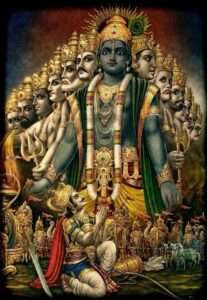
Continuing his account, the Pāṇḍava prince offered more details of what he comprehended within that incomprehensible divine magnificence. He saw the crown, the club, and the discus, the sacred insignia traditionally attributed to Lord Viṣṇu. He saw a mass of radiance shining everywhere, glowing like blazing sun and fire, difficult to behold and beyond ordinary comprehension. Though he described it as best he could, he perceived burning flames issuing from the Lord’s mouths, infinite arms extending in all directions, and a radiance that seemed to heat the entire universe.
By that form alone were the spaces between heaven and earth and all quarters of the sky completely pervaded. Beholding this marvellous and dreadful manifestation, Arjuna declared that the worlds themselves trembled before it, and he too felt shaken and overwhelmed. Earlier, he had harboured doubts regarding the outcome of the war, but now the Lord granted him a glimpse of the future awaiting the world.
Until this moment, Arjuna’s narration had described a static cosmic form, at once wondrous and terrifying, but now he began to speak of its movement and action. He observed hosts of deities entering into and disappearing within the universal form. Even the gods of heaven, the rulers of the phenomenal world, revered throughout the Vedic age, stood transfixed in astonishment before the immeasurable vision.
The Rudras, the Ādityas, the Vasus, the Sādhyas, the Viśvadevas, the Aśvins, the Maruts, the Gandharvas, the Yakṣas, the Asuras, and the Siddhas all gazed upon the terrible form of God in utter amazement. With increasing clarity Arjuna conveyed his experience, bringing it vividly before the minds of his listeners. He saw the entire universe terrified by that vast and majestic form, possessing many mouths and eyes, many arms and thighs, many stomachs, and fearsome tusks. He added with painful honesty, “So am I,” confessing his own trembling fear.
Though it pained his heroic heart to experience fear, Arjuna justified it by recognising that the terrible form was indeed the formless reality absorbing all things into itself. He declared that the vision touched the skies, blazed with countless colours, burned with fiery eyes, and consumed all things within its gaping mouths. The sight, he confessed, was capable of unnerving even the gods themselves.
Seeing this, Arjuna cried, “My heart quakes, and I lose my courage and peace.” It is significant that in this state of overwhelming fear the great warrior addressed the cosmic vision as Viṣṇu. Explaining further why even heroic hearts tremble before such reality, Arjuna admitted that he had lost all sense of direction and could no longer perceive the quarters of space. He recognised the vision as Time itself, the universal destroyer and consumer of all forms.
In that supreme moment of wonder, the astonished mortal realised that his physical strength, mental power, and intellectual subtlety were insignificant instruments before the infinite. The small ego dropped its veil of vanity and its armour of imagined strength, standing meekly surrendered before the cosmic power. Prayer alone remained as the refuge of the individual soul. Arjuna recognised the emptiness of all human pride in the presence of the supreme whole and humbly prayed, “Be gracious, O Lord, Thou art the refuge of the universe.”
The Lord then directly revealed how all beings and forces entered the inescapable mouth of Time and were swallowed by destruction. Arjuna saw all names and forms rushing into that terrible mouth. He beheld the sons of Dhṛtarāṣṭra, hosts of kings, Bhīṣma, Droṇa, and Karṇa, the son of a charioteer, all hurling themselves into the yawning jaws of annihilation. Though the sight frightened and disturbed him, it also gave him renewed confidence to face the future despite the numerical inferiority, limited resources, and fewer specialists within the Pāṇḍava army when compared to the mighty Kuru forces.
What Arjuna witnessed was in truth a glimpse into the future itself. In the universal form, where the Lord manifests as the totality of phenomena, a vision of oneness arises in which not only space contracts, but time itself becomes visible to understanding. It was, therefore no wonder that Arjuna saw the past merging into the present and advancing toward the future within that single vision.
When the entire universe was brought within the range of Arjuna’s sight, he could not absorb it in one single glance. Sañjaya continued narrating the state of Arjuna’s mind, thereby indicating his growing preparedness for the great war. Bit by bit he conveyed Arjuna’s words to the blind king, placing before him a vision that demanded reflection, discernment, and judgment.

