
Sanjaya, though outwardly calm, was inwardly uneasy at the king’s restless curiosity about the strength of the sons of Pandu, for in the depths of his heart he secretly wished for their defeat. “O Dhritarashtra,” he said, “Arjuna speaks to his brother thus: Though Narada’s words are true, know also our might and power. The mace of Bhima possesses strength beyond human measure; its transcendent force cannot be described, only experienced. The valour and resolve of Shikhandi, the brilliance of Dhrishtadyumna, and the chivalry of Drupada work wonders in battle. King Virata of Matsya, the Yadava warriors Satyaki and Chekitana, stand as heroes of the highest order on our side.
The young champions Abhimanyu and Ghatotkacha burn with fearless courage, and the sons of the Pandavas strike like thunderbolts, each irresistible in his own way. By your grace and that of Sri Krishna, my Gandiva is like a winged serpent, swift and deadly beyond measure. An elephant does not know its own strength, and so are you; even the gods cannot overcome you. Your enemies will be reduced to ashes by the fire of your wrath.” By such images he emphasized their vast resources, for as a serpent is swift and destructive, a winged serpent’s harm is beyond reckoning, and as the elephant is the mightiest on earth, gentle by nature yet irresistible when roused, so too is Arjuna’s power.
Dharmaraja then spoke to Arjuna, describing how the chief of the Kauravas had formed a human-shaped formation, a strategy praised even by the gods as a marvel of human ingenuity. He asked that a counter-plan be devised to meet such brilliance, and Arjuna summoned Dhrishtadyumna, instructing him to arrange the forces in the Achala formation. Dhrishtadyumna, as commander-in-chief, moved through all divisions and set the army in this immovable and formidable array, strong as a hill, capable of defense and sudden assault alike. At the forefront stood Dhrishtadyumna and Abhimanyu, with the twin warriors Nakula and Sahadeva beside them. On the northern and southern flanks stood Virata and Drupada with their hosts, while Bhima supported the formation. Dharmaraja mounted his chariot in the midst of the warriors, appearing like a mountain among elephants. The Brahmins blessed him, and he bestowed gifts and garments upon them. Shikhandi, guarded by Arjuna, stood poised for combat, while Dharmaraja waited in his chariot opposite Bhishmacharya, behind him the kings of Magadha, Sahadeva and Dhrishtaketu, eager to plunge into battle.
The army of the Pandavas resembled a silent ocean: chariots like islands, mighty elephants like hills, horses like waves, and the multitude of soldiers like crocodiles in the deep. The emblem of Hanuman upon Arjuna’s banner spread fear among the warriors, and the radiance and atmosphere of the Pandava host caused distress and strange dread in the Kaurava ranks. The commanders on both sides, clad in red, white, and black armor, appeared like mighty oxen amid herds of cows. Some groups crossed over to the Kauravas, and others to the Pandavas, driven by distrust and jealousy; this occurred on both sides. Children, women, and elders withdrew, while all men desiring victory joined one camp or the other for war.
Hearing Sanjaya’s words, the king asked a peculiar and irrelevant question: which side, Pandava or Kaurava, burned with greater enthusiasm? Sanjaya replied that both camps rivaled each other, neither less nor more, yet his keen observation revealed that the Pandava host appeared stronger, for it bore the universal power of Nara and Narayana. The energy of the Pandava elephants spread fragrance, while that of the Kauravas was dry and lifeless, and swarms of bees were absent from their camp. “O King Dhritarashtra,” he continued, “your son Duryodhana lacks the courage to begin the war and moves in confusion, while the Pandavas and Sri Krishna stand relaxed, as if they had come for play and sport.” Arjuna’s Devadatta and Krishna’s Panchajanya resounded in playful ecstasy, and the joy of their forces surged like waves. The Kauravas trembled at these conches, and ominous signs appeared, rain sprinkling blood upon their ranks, foretelling unavoidable defeat. Yet Bhishma, Drona, Ashwatthama, and Kripa, though daily convinced of the Pandavas’ victory, advanced to the battlefield, disregarded the portents, and ordered the trumpets and kettledrums to sound, as both sides charged with spirited resolve.
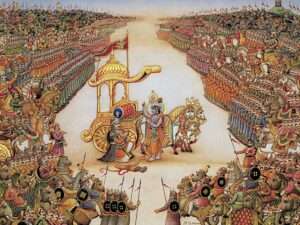
The two armies, once like smooth and serene rivers, transformed into a turbulent ocean. According to the laws of war, both sides took solemn vows: one who ceased fighting or spoke was not to be harmed; one who fell, dropped his weapon, fled in fear, or laid down arms was not to be attacked. After taking this oath, the forces, adorned in many-colored garments and ornaments, resembled a flower garden filled with tender leaves and blooming blossoms. They stood equal in courage, while the celestial beings grew curious to witness the coming moment, and the armies glowed with readiness. Then Ajathashatru Dharmaraja reached the battlefield, dismounted his chariot, removed his armor, folded his hands, and silently walked toward Bhishma.
Sri Krishna, the Pandavas, Satyaki, and the other kings, unaware of Dharmaraja’s intent, were startled and dismounted to follow him. His brothers, astonished at his laying aside his weapons, questioned him as he walked humbly forward. Bhima asked where he was going alone on foot while they stood ready; Arjuna reminded him of their carefully formed strategies; Nakula asked why he approached wicked enemies without fear; Sahadeva wondered why, at such a moment, he displayed humility instead of fiery resolve. Hearing them, Sri Krishna said he understood Dharmaraja’s purpose: he was going to salute the elders Bhishma, Drona, Kripa, and Shalya, and to seek their blessings and permission to begin the war, for ancient wisdom holds that victory follows the blessing of the venerable.
All eyes in the enemy ranks turned toward him as he advanced, followed by Arjuna and Krishna, while prominent warriors of the Kauravas watched in astonishment and whispered among themselves. Some wondered why Dharmaraja showed such humility, suspecting fear, yet others reasoned that he was no coward and must have a noble purpose in mind. They speculated how he, who never compromised his self-respect, would speak to Bhishma, how Krishna and Arjuna would appear, and how Bhima, Nakula, and Sahadeva would respond. Thus, curiosity spread as Dharmaraja crossed all strategic positions and reached Bhishma’s chariot, where he saluted him, touched his feet, and said humbly, “O venerable grandsire, you are our elder in every respect and worthy of reverence. Yet fate compels us to confront you in battle. I have come to seek your blessings and permission, for your grace will strengthen me to conquer my enemies.”
Bhishma replied, “It is good that you have come; I am pleased. Had you ignored me, I would have been angered and cursed you. I bless you to triumph over your foes and grant you a boon; ask anything except that I cease to fight, and it shall be yours.” Dharmaraja said, “Grandsire, you fight for Duryodhana, yet think of doing good to me. Tell me, O great warrior, the means by which you may be conquered.” Smiling, Bhishma said, “Even the gods cannot conquer me; what need then speak of men?” Dharmaraja replied, “That is why I sought your grace.” Filled with kindness, Bhishma said, “Only when I lay aside my weapons, softened by pure and humble prayer, will I be slain. Do not question further; it is not fitting now to speak of one’s defeat. Return, and come to me again.” Dharmaraja, content, sought leave and proceeded.
He then approached Drona, Kripacharya, and Shalya, saluting them with folded hands and touching their feet to seek their blessings. Drona said, “When you have Krishna with you, you need no other blessing, for where righteousness abides, Krishna is present, and where Krishna is, victory follows.” Dharmaraja asked how he might defeat him, and Drona replied, “So long as I bear weapons, none can kill me; but when I abandon arms and embrace fasting, then I may be slain. If a trusted person brings me tidings of unbearable sorrow, I will cast aside my weapons and become easy to defeat.” Dharmaraja then asked Kripacharya, who said, “I cannot be slain, yet I bless you with victory.” He went to Shalya and said, “You will guide Radheya; ensure that his spirit is drained away.” Shalya replied, “I have already promised you this and shall not violate it.” Dharmaraja then took leave and prepared to return.
Such was the unmatched character of Dharmaraja: before entering battle, he went to the enemy camp, sought the blessings of elders, and even asked them the means of their own defeat, a deed unheard of and unwitnessed in the annals of war. This wise, bold, intelligent, and deliberate act stands as a lesson for kings and warriors alike, a testament to righteousness united with strategy.