



When this Atman, which dwells in the body, gets detached and is freed from the body, what remains here (in this body). This is verily that.
There is a direct reference to death, and it says that Atman leaves the body. We must understand that it is the conditioned consciousness, the jiva, which leaves the body. The Shastras have defined Atman as all-pervasive. Atman is neither born nor dead. So the question of Atman leaving the body does not arise. Atman is the energising principle and is responsible for everything to function. Upon death, many people illogically attribute that Atman has left the body. Then we are going against the authoritative truth of the shastras that Atman is all-pervasive. Atman does not leave the body.
This concept of the theory of reincarnation is supported by the following laws. It is a theory because it cannot be proven. But it is not illogical. We can get to a logical conclusion based on these laws:
- Law of Indestructibility of matter
- Law of conservation of energy
- The parallelogram law of forces
- Law of causation
- Law of Karma
Law of indestructibility of matter:
When a person dies, it is impossible to assume that all his desires, vasanas, are fulfilled. We should not undermine the potency of a desire. It is very powerful. It is illogical to presume that these mental and intellectual forces vanish or disappear. It is important to question the inevitable loss of energy and the unfulfilled desires at the time of death. What happens to that energy?
As per the laws 1 & 2, science says energy can neither be created or destroyed. So the energy at death cannot vanish or disappear into nothing. It has to be accounted for. Desire is a driving force that makes you move from experience to experience. When one experiences E1, one will go to the next experience E2. Where we go, the next experience depends on the next desire. During the course of the day, you will have innumerable experiences because of innumerable desires.
Birth and death of each experience depend on the birth and death of each desire. In the same way, when you are born, there are desires and when these desires are fulfilled, you die. The desires with which you are born in the present life for fructification are called prarabdha vasanas. If these desires are not met, one will not die under any circumstances. Upon exhaustion, you move into the next birth, and thus we go on from birth to birth, fulfilling desires. This cycle of birth and death will continue until all your desires, vasanas, are annihilated.
Therefore, it is not wrong to say that desire is the cause and birth is the effect. The energy of unfulfilled desires at death drives into the next birth. So, the shastras say there is nothing abnormal in death. Death is nothing but being born into a new experience with a new embodiment. Your entire life is going on as per the desires you entertain. Life only dishes out what you are commanding in nature. Nature cannot give you what it wants. It only gives what you want. So be mindful of what thoughts and desires you are entertaining unknowingly and unconsciously.
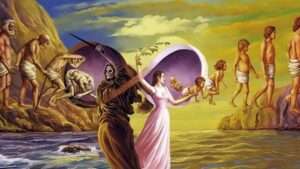
When we analyse birth, many impressions, distinct tendencies, expressions, and inclinations are gained. These tendencies start appearing as desires in the child. Even if there are 3 or 4 children/twins to the same parents, each child is distinct. The great Rishis, thinkers of the past, brilliantly audited the accounts of life. They have audited the invisible loss of tendencies at death and the invisible gain at birth. Both the energies have been connected, which is based on the fourth law – ‘law of causation’. Everything in this life is governed by the principle of cause and effect. This is a scientific deduction from the data available and thereby projects the theory of incarnation. Desire is an expression of ignorance, avidya. Antidote for ignorance is vidya, knowledge which dispels ignorance.
Eg: In a deep, dark cave, unexplored for generations, when you light a match, instantly the light dispels the darkness. Similarly, when one is plunged in maya or ignorance for generations, the first strike of vidya will dispel all the ignorance in a moment.
Law of conservation of energy:
When we talk of being born into an environment, it is the child who chooses the parentage. Child is the mental energy and parents are mere conducive environment. Mental energy in you chooses a particular environment for its manifestation. Parents should just facilitate the child to express their vasanas and not be an impediment.
There is a cosmic intelligence that controls each individual’s mental energies and facilitates choosing the conducive environment. It is like the accountant maintaining different people’s accounts and does not mix them up. The law of causation is impeccably operating. Every action has a cause and effect, and all the karmas of your actions you will incur. My action will not bear fruit for you. It is the cosmic intelligence that keeps account of it. Not just my cause and effect, but innumerable actions we are performing is all governed by some cosmic law. All these laws are governed by the supreme Lord, who is Brahman.
If it is the child who chooses the parent, why would a person be born poor when he desires to be born in a rich environment? A child is born in a slum / in a country going through war/countries where there is starvation, poverty, etc. Nobody wants to be born in such an environment, autistic or disabled, etc. This can be clarified based on the parallelogram law of forces. The law says one particular desire does not determine your destiny. I may not desire to be born into an environment of poverty, autism, a war zone, etc., but I am transported into that environment. Yet we say the child chooses the parents. The paradox is that one particular desire does not determine one’s destiny. It is a compound of all desires, which is destiny known as resultant desire, and that determines the environment (next birth), which is explained in the diagram below of the parallelogram law of forces.
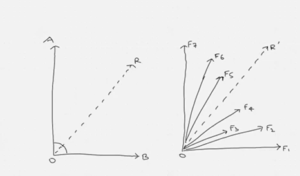
To begin with, in the 1st diagram, an object is at point O. Equal forces are operating in the direction OA and OB. The object goes neither in the direction of OA nor in the direction of OB but goes in the direction OR. Resultant of the forces acting on these two objects.
In the 2nd diagram, there are many forces on object O – F1, F2, F3, F4 so on to F7. There are many desires. Each has its own intensity, driving in its own direction. So the object O does not go in the direction of the forces acting on the object, but the resultant, which will be OR. You have to surrender to this law of the parallelogram of forces, which says the resultant force may not be in the direction of any of the forces acting on the object. This explains why we are born into an environment that is not to our liking or what we want. It’s because of the resultant desires. But this is the best for our growth or we deserve it. This answers the apparent paradox. If not for this law, you cannot justify or clarify.
Every desire you entertain may not be fulfilled. The desire you are entertaining at the point of death, that desire will influence the birth of your next environment. That thought will be the acting force that will define the direction you will be born. So, beware of what desire you are entertaining now. The fruits of your actions that are not fructified also influence your next birth.
Upanishads talk of infra-human and supra-human. Infra human, is you are born into a lower embodiment. A suprahuman is born as an evolved human being. Bad karmas are born as infra-human, and good karmas are born as supra-human.
If you are entertaining extremely tamasic vasanas, you will be born as a plant or animal that is extremely tamasic. If you are entertaining extremely rajasic vasanas, your actions are with malicious intent, unethical, cunning, abusive, cheating, and attached. If you die, you will be born as an animal where you have the licence to be cunning, as a fox or hyena, because it cheats and eats the prey of other carnivores. Nature will give you an environment where that particular desire of cunning nature is expressed.
Law of Causation:
At death, Atman cannot go anywhere because it is all-pervading. The gross body is very much there, immobile, lying in front of us. What could have been left is the subtle matter, which is constituted of the subtle body and causal body. The subtle body consists of mind and intellect, causal body consists of vasanas; together forms subtle matter. Subtle matter could have possibly left the gross body, which is responsible for death. The subtle matter has left the gross body because this particular embodiment is not conducive for the vasanas to express.
Definition of birth and death: Transference of the subtle and causal body from one gross body to another is death of the first and the birth of the latter.
Law of Karma:
What happens to the subtle matter during the trans migration, which is before it takes the next body? The Shastras say it might take a while before it finds an appropriate body or an environment. It is compared to a long sleep or a dream that you go through. When you go to sleep, the vasanas are waiting for you to wake up. It takes time, like the seed takes time to sprout. The seed may take 2 weeks or a month to sprout, roots to go down, and shoot to come up. Similarly, the desires in the form of a seed, when one dies, it takes time for it to manifest.
Therefore, all five laws support the theory of reincarnation, which is operating meticulously. So, do not entertain desires indiscriminately. Every desire defines your destiny in this birth and journey forward.


cosmic intelligence attributes?
could elaborate in depth.