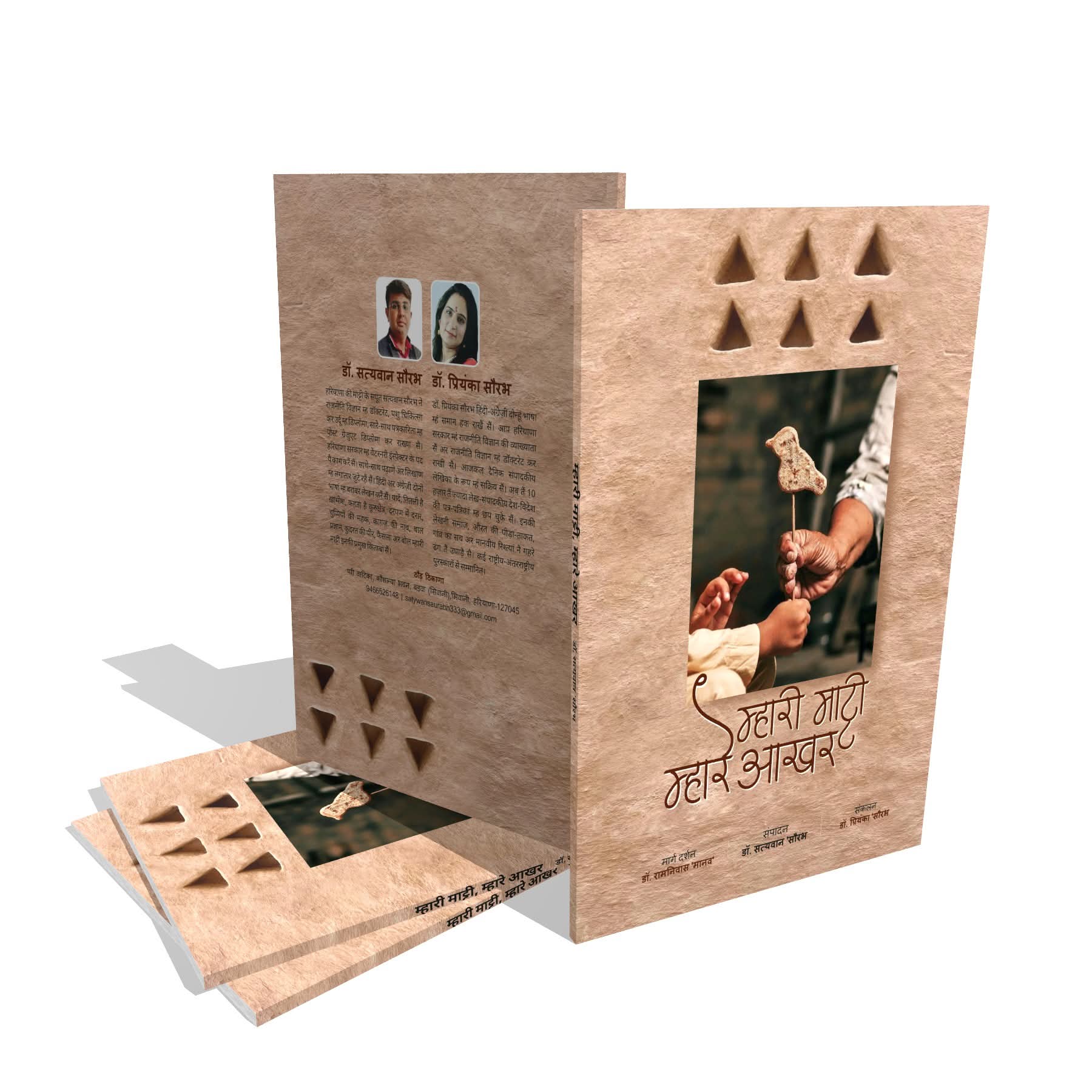
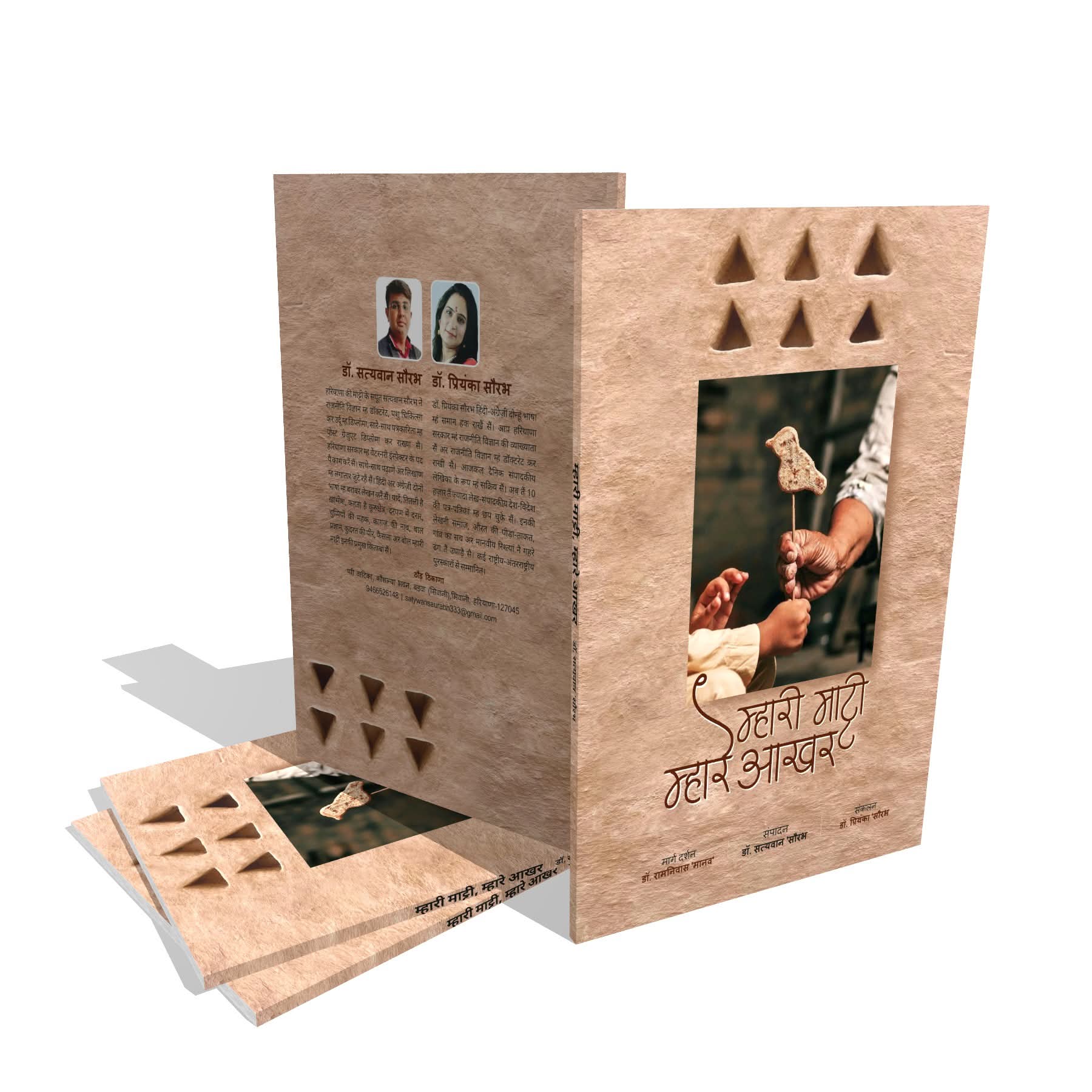
For the first time, “Mhari Matti, Mhare Akhar” brings together 33 Haryanvi short story writers from India and abroad. This unique collection of 99 short stories offers a vivid glimpse of Haryana’s soil, folk culture, and human sensibilities. This work is dedicated to the memory of Mr. Manumukt ‘Manav’, IPS, a youth inspiration. Published in 2026 under the guidance of Dr. Ramniwas ‘Manav’, compiled by Dr. Priyanka Saurabh, edited by Dr. Satyawan Saurabh, and with a cover designed by Surendra Bansal, this 121-page work is priced at ₹275. It is a must-have for lovers of Haryanvi literature.
Dr. Vijay Garg
The true strength of every language lies in its soil, and from that very soil its letters are born. “Mhari Matti, Mhare Akhar” is a collection of short stories that captures this sweet fragrance, not only bringing to the fore the vibrant Haryanvi dialect but also strengthening the influential literary genre that has become the most relevant in today’s fast-paced life—the short story.
This collection, edited by Dr. Satyavan ‘Saurabh’ and compiled by Dr. Priyanka ‘Saurabh’, includes a total of 99 short stories by 33 short story writers. This number is not just a statistic, but an indication of the emerging form of the Haryanvi short story. For a long time, Haryanvi literature was largely limited to folk songs, raginis, and storytelling, but this collection shows that this dialect is now making its strong presence felt in modern literary genres as well.
The defining characteristic of a short story is its brevity, but reading this collection, one feels that the words are few, yet the impact is profound. Each work is centered on a single event, emotion, or social situation, instantly engaging the reader. These stories are not only read, but also felt—and this is the greatest success of this collection.
The book’s greatest strength lies in its diverse subject matter. It explores life’s many shades—the sweetness of relationships, the harsh realities of society, the simplicity of rural life, and the complexities of changing times. “Tadakai Ki Maa” reflects the sensitivity of motherhood, “Izzat Ki Paribhasa” questions social norms, “Bahu Bihar Ki” exposes social prejudices, while works like “Mati Ki Sondh” and “Ghunghat Aur Ghadi” offer a vivid portrait of Haryana’s connection to its cultural roots.
The simplicity and straightforward nature of the Haryanvi language make these short stories even more impressive. There’s no artificiality or pretense in the language, but rather a natural flow that reaches directly to the reader. This collection reinforces the belief that the depth of literature lies not in the complexity of language, but in its sensitivity.
However, there is one aspect of this book that draws attention—the lack of linguistic uniformity. Since it includes works by many authors, different forms of Haryanvi emerge. In some places, the language is pure folk, while in others, the influence of Hindi is clearly visible. This diversity, on the one hand, makes the collection comprehensive, but on the other, it also lacks a uniform linguistic flow. Nevertheless, this should be seen as a natural condition of the evolving form of Haryanvi rather than a shortcoming.
Many of the works in this collection sharply attack social anomalies. Short stories like “Dogla,” “Kagzi Samaj Seva,” “Leader,” and “Crowd and Leader” satirize the hypocrisy, pretense, and hollow leadership prevalent in society. Works like “Daughter’s Honor,” “Lioness Mother,” and “Women’s Rights” effectively present women’s struggles, self-respect, and changing social roles. The hallmark of these stories is their straightforward portrayal of reality without unnecessary sentimentality.
An important aspect of this book is that it features both new and experienced writers. This not only maintains literary balance but also provides new writers with an opportunity to express themselves. This effort is also important because the emergence of new talent is essential for the development of any language.
Dr. Ramniwas Manav’s preface provides an ideological foundation for this collection. The clarity with which he presents the current state of the Haryanvi short story, its challenges, and its potential makes the reader realize the seriousness of this genre. Meanwhile, Surendra Bansal’s “Creative Enterprise Nai Sadhuwad” commends this effort and establishes it as a positive literary initiative.
Overall, “Mhari Matti, Mhare Akhar” is not just a short story collection, but an important document for Haryanvi literature. It attempts to fill a void where very little work has been done so far. This collection not only highlights current writing but also points to future possibilities.
Ultimately, it can be said that this book fully achieves its objective. It not only entertains readers but also inspires them to think, understand, and view their society from a new perspective. This is an invaluable work for lovers of the Haryanvi language, as well as for all those interested in the literature of Indian folk languages.
“Mhari Matti, Mhare Akhar” is indeed a remarkable literary effort that powerfully presents the fragrance of its soil and the power of its letters, which has the potential to give a new identity and a new direction to the Haryanvi short story.Top of Form