



Alekya Pratap
Prime Minister Narendra Modi is absolutely right—India’s women will not forget, and they will certainly not forgive.
As a woman and a committed karyakarta of the BJP, I unequivocally endorse every word spoken by the Prime Minister in response to the astonishing display of hypocrisy and irresponsibility by the Congress-led Opposition in the Lok Sabha last week. What unfolded in Parliament was not merely political inconsistency—it was a betrayal of Indian women.
The same Opposition that proudly supported the Women’s Reservation Bill in 2023 chose to oppose its logical and constitutional implementation when the moment of truth arrived. This is not just contradiction—it is calculated deception. It exposes a mindset that is comfortable making lofty promises but unwilling to translate them into reality when it truly matters.
What was even more disturbing was the conduct of certain members during the debate. At a time when the nation expected seriousness and statesmanship, what it witnessed instead was immaturity bordering on ridicule. One could dismiss such behaviour as the theatrics of an individual unwilling to rise above political frivolity. But what is far more alarming is the collective silence—and complicity—of senior Opposition leaders, including women members, who chose to vote against their own cause.
That moment, more than anything else, was a turning point. It made one thing abundantly clear: for the Congress and its allies, women’s empowerment is a slogan, not a commitment.
And let us not pretend this is new. The Congress party, repeatedly led by dynastic entitlement rather than democratic accountability, has suffered electoral rejection time and again since 2014. Yet, instead of introspection, it continues to rely on empty rhetoric, expecting applause for gestures devoid of substance. What happened in Parliament was nothing short of an insult to the very sanctity of India’s democratic institutions.
But India’s women are not passive observers anymore. They are informed, aspirational, and increasingly decisive. They have seen the difference between tokenism and transformation.
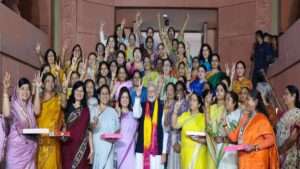
Under Narendra Modi’s leadership, women’s empowerment has moved from political speeches to policy execution. Schemes like Pradhan Mantri Ujjwala Yojana have provided clean cooking fuel to millions, protecting women’s health and dignity. Initiatives such as Jal Jeevan Mission have ensured access to drinking water at home, eliminating the daily drudgery and risk faced by rural women. The construction of toilets under Swachh Bharat Mission has restored dignity and safety to millions.
Beyond welfare, there has been structural change. Women are now serving in greater numbers in the armed forces, receiving equal opportunities, promotions, and recognition. The abolition of Triple Talaq has safeguarded the rights and dignity of Muslim women, offering them long-denied legal protection.
These are not symbolic gestures—they are transformative interventions.
The Opposition’s argument that the government should have implemented the reservation earlier conveniently ignores constitutional realities. The linkage of the Bill to census and delimitation is not an afterthought; it is an essential legal requirement. To feign ignorance of this, especially after having supported the Bill earlier, is either intellectual dishonesty or deliberate misinformation.
As a grassroots worker in Telangana, I now feel an even greater sense of responsibility. This is not just a political contest—it is a battle for awareness. Over the coming months, I will dedicate myself to reaching every woman, across every village and community, to explain the truth behind this betrayal.
Women must know who stood with them—and who stood against them.
The Congress and BRS may attempt to lure voters with short-term promises and financial incentives during elections. But women must ask: where were these parties when a historic opportunity to secure their rightful political representation was on the table?
Why did they hesitate? Why did they obstruct?
The answer is uncomfortable but clear: empowerment threatens entrenched political structures that thrive on control, not equality.
The BJP, on the other hand, has consistently worked to expand opportunities for women—not just within governance, but within society at large. It has created pathways, not patronage.
My mission is simple and unwavering: to ensure that no woman, whether educated or not, is misled by political propaganda. Awareness is the most powerful tool of empowerment, and it is time to use it.
I also believe that our outreach must transcend social and religious boundaries. Our Muslim sisters, too, have benefited from progressive reforms and deserve to be part of this larger movement of empowerment and dignity.
The coming months will be crucial. Women constitute a decisive segment of India’s electorate, and their voice will shape the political future of this nation.
This time, they will not be silent.
This time, they will respond.
And when they do, those who stood in the way of their progress will be held accountable—democratically, decisively, and unequivocally.
Top of Form



Ms Alekhya your article rightly points out the progressive measures adopted over a period of BJP in recent times.. social legislation for women advancement if further carried through enhanced political participation in policy making would have heralded the country into further horizons . The opposition is viewing the Act in the most narrowed perspective without bothering about national interests. Opposition today is existing only for the sake of opposing totally ignoring the qualitative appraisal of gender sensitisation. The logic of the CAA is totally abandoned carelessly without valuing the enormous benefit which it would have brought. Appreciate your efforts in reaching out to people for enhanced political legal clarity and to overcome unnecessary fears . 👍🏼