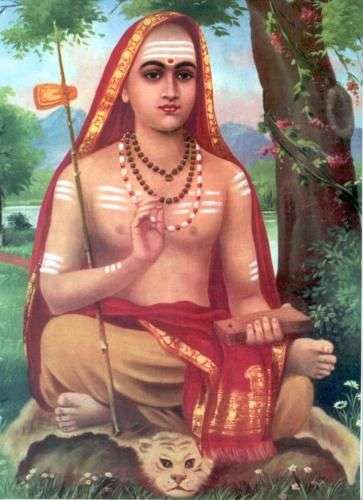
Today dawns as an unforgettable, invigorating, and deeply inspiring day for India—a day etched in the sacred annals of spiritual history as the birth of Adi Shankaracharya. On this auspicious occasion, heartfelt greetings are extended to all seekers and aspirants walking the path of knowledge and self-realization. May this day inspire deeper reflection on the profound contributions of that divine soul, whose wisdom illuminated the essence of truth and unity, and whose teachings continue to guide countless minds toward clarity and liberation. May his legacy awaken within us a spirit of inquiry, discipline, and an unwavering pursuit of the eternal. – EDITOR
U Lakshman Rao
Today is Shankaracharya Jayanthi
On the sacred dawn of Shankaracharya Jayanti, the mind turns not merely to remembrance, but to awakening—an awakening kindled centuries ago by Adi Shankaracharya, whose brief earthly span bore the weight of an eternal vision. In him, India beheld not only a philosopher, but a seer who perceived unity where others saw division, and permanence where others perceived change.
Born in the serene village of Kalady to Shivaguru and Aryamba, the child Shankara displayed an intellect so luminous that the Vedas seemed not learned, but remembered. Yet his life was not destined for scholarship alone. At an age when the world enchants most minds, he renounced it, embracing sannyasa with a clarity rare even among sages. Under the guidance of Govinda Bhagavatpada on the banks of the Narmada River, his insight matured into the resplendent doctrine of Advaita Vedanta.
This doctrine did not merely argue—it revealed. It proclaimed that the individual self (Atman) and the supreme reality (Brahman) are not two. The world, with its ceaseless flux, is not absolute but a veil—Maya—through which the One appears as many. In this vision, division dissolves, and the seeker awakens to an indivisible truth: that all existence is one, and that the knower, the known, and the act of knowing are unified.
Yet Shankara was not a recluse withdrawn into abstraction. He walked the length and breadth of India in his Digvijaya Yatra, engaging scholars, ascetics, and ritualists in profound debates. His celebrated encounter with Mandana Mishra was not a contest of victory, but a dialogue of transformation—where even opposition became a pathway to higher synthesis. Through reason, not force, he restored confidence in the authority of the Upanishads, the Brahma Sutras, and the Bhagavad Gita, binding them into a coherent spiritual vision.
His literary legacy reflects both intellectual precision and devotional depth. In works such as Vivekachudamani, Atma Bodha, and Tattva Bodha, he distilled the essence of self-realization into accessible clarity. In hymns like Bhaja Govindam, Nirvana Shatakam, and Saundarya Lahari, he revealed that devotion and knowledge are not opposing paths, but complementary movements of the same soul toward truth.
Understanding the diversity of human temperament, Shankara harmonized worship through the Shanmata system—uniting devotion to Shiva, Vishnu, Shakti, Ganesha, Surya, and Skanda. In doing so, he dissolved sectarian divisions and established a spiritual inclusiveness that preserved unity without erasing diversity. His organization of the Panchayatana form of worship further grounded this synthesis in daily practice.
To ensure the continuity of his vision, he founded four great monastic centers across the cardinal directions: Sringeri in the south, Dwarka in the west, Puri in the east, and Jyotirmath in the north. These were not mere institutions, but living beacons of wisdom, sustaining the transmission of Advaita across generations.
In an age when the Vedic tradition faced formidable challenges from Buddhism and Jainism, Shankara did not respond with rejection, but with renewal. He revitalized Sanatana Dharma through reasoned discourse, philosophical rigor, and spiritual experience—demonstrating that truth need not be defended by force when it can be illumined by knowledge.
The spiritual significance of his work lies not only in doctrine, but in transformation. By declaring the unity of Atman and Brahman, he shifted the axis of religion from external ritual to inner realization. He invited humanity to move from fear to understanding, from division to unity, from ignorance to awakening. His teaching is not bound to time; it is a living current that continues to flow through the consciousness of seekers.
Even today, in the rhythms of festivals, in the chants of monks, in the quiet inquiry of the contemplative mind, and in the vast gatherings like the Kumbh Mela, the influence of Adi Shankara endures. He did not merely interpret the scriptures—he reawakened a civilization to its deepest self.
Thus, his life stands as a luminous paradox: though he lived but thirty-two years, his vision transcends centuries; though he walked as an individual, he revealed the indivisible; though he spoke in words, he pointed beyond them—to the silence where all distinctions cease, and truth alone remains.