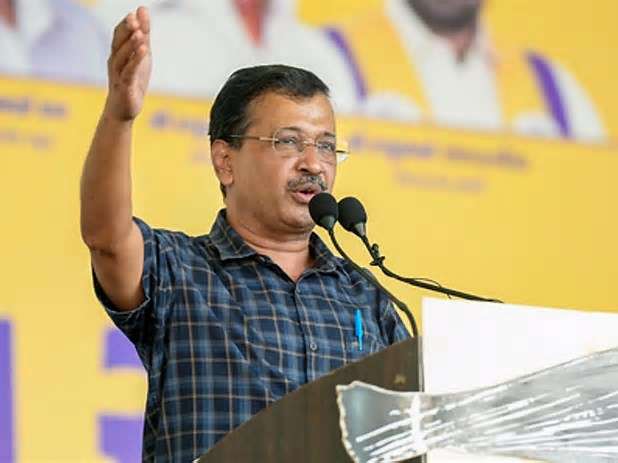
New Delhi: Delhi High Court judge Swarana Kanta Sharma on Monday refused to recuse herself from hearing the liquor-policy case as she rejected the pleas of AAP chief Arvind Kejriwal and others for her withdrawal.
In the pronouncement that lasted for more than an hour, Justice Sharma said a litigant cannot be allowed to judge a judge without any material, and judges cannot recuse themselves to satisfy a litigant’s unfounded apprehension of bias.
She added that a political leader cannot be allowed to damage an institution without any basis, as a personal attack on a judge is an attack on the judiciary itself.
“A judge cannot recuse to satisfy a litigant’s unfounded suspicion,” the Court said, adding that the courtroom cannot become a “theatre of perception.”
Addressing the broader implications, the Court remarked that even a powerful politician cannot be permitted to damage the institution without material to support allegations. It stressed that the same standard of fairness applies when accusations are made against a sitting judge, and that judicial functioning cannot be influenced by narratives constructed in recusal pleas.
Justice Sharma also dealt with the argument regarding the alleged conflict of interest arising from her children being empanelled as Central Government counsel. The Court held that such empanelment, by itself, cannot give rise to any presumption of bias unless a direct nexus with the present case is established–something that was not demonstrated. She further emphasised that while a judge takes an oath of office, their family members retain their independent professional rights, and litigants cannot dictate their career choices.
The Court rejected the contention that prior orders being set aside by the Supreme Court could be a ground for recusal, noting that higher courts assess judicial decisions, not litigants. It also pointed out that in instances cited by the applicant, including bail orders, the Supreme Court had not made any adverse observations on the High Court’s findings.
Dealing with allegations related to participation in certain events, Justice Sharma clarified that such engagements were professional and not political in nature. She observed that many judges participate in similar events and that mere attendance as a speaker or chief guest cannot be construed as ideological bias or give rise to apprehension of prejudice.
The Court further noted that contradictory stands had been taken during arguments, while it was claimed that the judge’s integrity was not in doubt, recusal was still sought on perceived bias. It was observed that such a position effectively places the judiciary itself on trial.
“While an accused can prove innocence, he cannot attempt to portray a judge as tainted,” the Court remarked.
Justice Sharma highlighted that the plea had created a “catch-22” situation if the Court recused, it would validate the allegations; if it did not, the outcome could still be questioned. Such tactics, the Court said, cannot be allowed as they risk undermining both the judge and the institution. It warned that yielding to such pressure could open floodgates and create a perception that judicial outcomes can be influenced.
Emphasising judicial duty, the Court stated that it had, in the past, recused or transferred cases where a real conflict existed, even without a request. However, it clarified that judicial functions cannot be surrendered on mere apprehensions or public criticism.
“The robe this Court wears is not so light,” Justice Sharma observed, adding that the Court would stand up not only for itself but also for the institution.
The judge also reflected on the responsibility of the office, noting that her silence and fairness had been put to the test, but she chose to decide the matter to uphold institutional integrity rather than take the “easier path” of recusal. She reiterated that truth does not lose its force merely because falsehoods are repeated, whether in court or on social media.
Concluding the judgment, the Court held that the recusal plea lacked merit and dismissed it, observing that accepting such applications would amount to legitimising unfounded allegations against judges and could ultimately lead to “justice being managed” rather than delivered.
The case arises from the Delhi Excise Policy 2021-22 matter, where the CBI has challenged the discharge of Arvind Kejriwal, Manish Sisodia and others. With the recusal plea now rejected, the High Court is set to proceed with the matter on the merits.