



King Janamejaya, eager to comprehend the ancient struggle in all its depth, questioned Vaishampayana about the Pandavas and the Kauravas, asking how, driven by fierce desire to surpass one another, they strove to attain their chosen ends, how the war arose, and how it unfolded step by step. The sage rejoiced at the king’s earnest curiosity, for he perceived in it a noble wish to draw from the past those inspiring principles that could guide righteous governance in the present. He therefore began to explain that on the sacred field of Kurukshetra both armies raised their tents, while Sanjaya, endowed with divine perception, illumined the king with all that transpired in the court of Duryodhana as well as in the opposing camp. Hearing of these events, the blind king lamented bitterly the pride and wicked deeds of his son, whose actions had led them all toward ruin.
At that moment the knower of past, present, and future, the sage Vyasa, arrived before King Dhritarashtra and spoke with compassion: “My son, the war is breaking forth, heralding a time of calamity that will bring destruction upon kings and their hosts. Do not grieve over this inevitable course of events. If you wish to behold the battle, I shall grant you divine sight.” Dhritarashtra replied with sorrow, “I cannot bear to witness this fratricidal conflict, but I can hear of it. That alone will suffice for me.” Vyasa then bestowed divine vision upon Sanjaya and instructed him to report faithfully every event as it occurred upon the battlefield. By Vyasa’s grace, the blind king gained the power to perceive these distant happenings through Sanjaya, who was endowed with transcendent abilities: he could move swiftly across the field, no weapon could harm him, he could read the minds of others, see celestial beings clearly, and hear their voices distinctly.
After granting these gifts, Vyasa said to Dhritarashtra, “Do not be overwhelmed by grief. War is a play of destiny, and through it the burden of the earth is lightened. I shall proclaim the glory of the Kurus and the Pandavas.” He then described the terrible omens that had arisen: the sky thundered without clouds and violent winds surged; elephants and horses shed tears; animals gave birth to birds, cows bore wild creatures, and women delivered five children at once, who played and laughed upon birth; dark clouds spread at dawn and dusk; the moon bore inverted spots; the flags on the houses of the Kauravas emitted smoke; weapons burned in their racks; and countless other portents foretold the destruction of multitudes. “Your own people and many kings will perish,” Vyasa declared. “Why cling to a kingdom that is not cherished by noble minds? This path leads only to sorrow.”
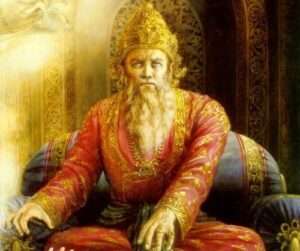
Dhritarashtra replied with folded hands and a trembling heart, “O revered sage, you have spoken to me with affection and have advised me of my duty. I have long attempted to restrain my son and have made every effort to prevent this catastrophe, but he has crossed all bounds. I lack the strength to command him. If you know that I am free from fault, that alone is a blessing to me. There is nothing more I can do.” Seeing the king’s helplessness and despair, Vyasa asked whether there was anything further he could say. Dhritarashtra then requested, “Tell me, O sage, what signs indicate victory in war.” Vyasa answered that auspicious omens include sacred fire spreading holy fragrance in all directions, circling to the right; gentle breezes that bring comfort to all beings; and kettle drums sounding clear and melodious. “Victory,” he said, “does not depend on the number of warriors, but on the grace of the Divine. Hence the elders teach that conflict is never good.” Having spoken thus, he departed.
Thereafter, Dhritarashtra, feeling a hot wind, turned to Sanjaya and said, “From ancient times, kings have fought for land, staking their lives. They regard land as a sweet gift of the Divine. You are deeply connected with sages and possess knowledge of all that occurs in the world. Tell me now of the nature of the earth and its wonders.” Sanjaya replied, “I shall describe to you, O king, the earth and its qualities according to my understanding. All moving beings—humans, animals, and other creatures—and all unmoving entities—hills, mountains, rivers, oceans, forests, and plains—are born, grow, and perish upon the earth, which is their common ground. Sound is the quality of the sky; air possesses sound and touch; fire has sound and touch; water has sound, touch, and flow; and earth possesses sound, touch, smell, and flow. Thus, the earth contains all the qualities of the five elements and is therefore supreme among them.”
“O King Dhritarashtra,” Sanjaya continued, “to the south of Mount Meru lies a vast region known as Sudarshana, immeasurable in both length and breadth. There stands a great jamun tree, whose fruits fall to the ground with thunderous sound. Their juice flows as a stream, encircles the tree, grows into a river, passes through the sacred lands of Uttarakuru, and finally merges into the ocean. This river is called Jambu, and the lands along its course turn into gold; it is known as the golden river. This region is known as Jambudvipa, encircled by the salt ocean. On the south and west sides, the ocean flows with powerful currents, while on both sides the Himalaya and Nishada mountains, the abodes of the gods, rise in splendor. These mountains shine with black and white peaks, and the dwellings of the gods upon them gleam with golden radiance. The foundations of these mountains descend to immeasurable depths, and their height and length defy all measure.”
“In the center of the earth, upon Mount Meru, gods and celestial beings move freely. In the clefts and ridges of the mountain, Shiva, with his consort Parvati, plays in joy, sustaining the vibrations of the universe, which are the very life of all animate and inanimate creation. There dwell many celestial clans: some are singers, some dancers, some players of the veena, violin, mridanga, and other sacred instruments. I shall, O king, narrate to you the divisions of Jambudvipa, its regions, villages, and ancient lore.” Thus, Sanjaya’s account of the earth flowed like sweet nectar of knowledge into the heart of Dhritarashtra, even as the world stood on the brink of war.

