



Sanjaya said to the blind king that your son, under the guise of courteous inquiry, was pressing the grandsire into distress by urging him to recount his past exploits, not with pure intent but to test his strength and stir his pride. The son of Ganga, feeling inward unease, found no pleasure in narrating his own glory to gratify the prince of coarseness, Duryodhana. His countenance bore dissatisfaction, his glances were suspicious, his smiles were hollow, and his questions strayed into irrelevance, disturbing the composure of the elder. Yet bound by duty, he restrained himself and listened while Duryodhana discoursed on the affairs of war with valiant tribal leaders, relying closely upon Karna, Shakuni, and Dushasana.
Then a sudden confusion seized the prince’s mind, and turning toward the grandsire he said, “O mighty warrior, how many days will you require to destroy the forces of the Pandavas, leaving none behind?” Sanjaya remarked that he was offering false hope, desiring victory yet not the lives of the sons of Pandu. All present heard this and regarded your son with suspicion. He continued, “Dronacharya, Kripacharya, Ashwatthama, and Karna, in how many days will you wipe out the forces of Kunti’s sons?” Ignoring the lighter tone of the question, the son of Ganga replied, “You seek to measure our strategic intelligence and combat skill against that of the enemy. It is proper that such matters be weighed, and it is my duty to dispel your doubts. Be attentive.”
Bhishma then declared, “The measure of my power and the force of my vow are such that I shall slay one thousand trained and courageous charioteers each day. Until Arjuna’s arrows pierce every inch of my body and I fall upon the ground, I shall massacre the bold warriors of the enemy. During my period of command, I intend to destroy between one thousand and ten thousand warriors daily. I am capable of guiding, planning, and controlling eleven Akshauhinis to the point of victory. With my mastery over divine weapons, I can sever the entire army of the sons of Pandu within thirty days.”
Duryodhana then turned toward Drona, Kripa, and Karna and asked them to declare their powers. With a smile heavy with meaning, Dronacharya said, “O King, I am an aged teacher of archery and warfare. I shall fight until the last measure of my strength and energy is spent. Your grandsire, full of affection, may take one month to shatter their forces; I may require more than a month for the same task.” The sage Vaishampayana narrated to King Janamejaya that after Bhishma and Drona had spoken, Kripacharya said, “By my skill and mastery of archery, I shall require sixty days to destroy the forces fighting for the sons of Kunti.”
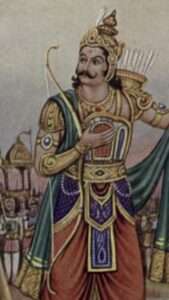
Duryodhana then looked toward Ashwatthama, who declared, “Within ten days, I shall drown the Pandava host in pools of blood and mire of flesh and bone, and nothing will remain thereafter.” Karna, having heard them all, said, “Relying upon divine weapons, my mastery of archery, and my immense personal strength, I shall blaze like a towering fire and wipe out the ocean of Pandava forces, including the sons of Pandu, in less than ten days.” Immediately, Bhishma burst into laughter and said, “Son of a charioteer, is that enough? You may speak whatever you wish, for none here will contradict our king. But hear my words of truth. The Gandiva of Arjuna will dazzle your eyes with its brilliance, and the twang of its string will shatter your ears; only then will you cease proclaiming such superfluous boasts of strength and courage. Until you face reality, you speak in this manner.”
Thus Bhishma, scornful toward Karna, at the same time cast a cooling shadow upon Duryodhana’s enthusiasm, warning him not to rely on promises that could not be fulfilled. As a veteran of war, he sought to correct the situation, lest it descend into fragile and false estimates of the enemy’s power. Sanjaya said to Dhritarashtra that Dharmaraja, learning of all this through his spies, gathered his brothers and said, “Our messengers have returned from Duryodhana’s camp. The wicked Duryodhana questioned Bhishma, Drona, Kripa, and Karna as to how many days they would take to destroy our forces. Bhishma said one month, Drona more than a month, Kripa two months, Ashwatthama ten days, and Karna, in his pride, claimed five days.”
Then Dharmaraja said, “They have declared their strength and methods; Partha, in how much time will the Kuru forces be destroyed by your command and power?” Arjuna replied, “Bhishma, Kripa, Drona, and the others are skilled and strategic, capable of deploying their resources methodically to draw the highest performance from their armies. Yet the heart of the matter lies in fulfilling the oaths given to their king, a task beyond their measure. Set aside fear and steady your mind. If you wish to know the depth and height of my strength, listen. Empowered by the divine grace of Krishna, my courage can shatter even the three worlds in a moment, like the dissolution at the end of time. You may wonder how victory can be gained with such ease.”
“The Lord Shiva, pleased with my valor in battle, granted me the devastating and unrestrainable weapon Pasupata. That divine missile abides with me always, awaiting command to strike its target. I need not struggle greatly to destroy the enemy. The might of this celestial weapon is unknown to Bhishma, Drona, Kripa, and Ashwatthama, and Karna knows nothing of it at all. Yet such a weapon of universal ruin should not be used lightly for destruction. By rightful combat, skilled use of arms, and courageous conduct, our chivalry and valor will be known to the world. This is my resolve.”
“Keeping this invincible reserve aside, do not underestimate the power of our warriors: Bhimasena, Nakula, Sahadeva, the sons of Draupadi, Satyaki, Virata, Drupada, Shikhandi, Dhrishtadyumna, Uttamaujas, Yudhamanyu, and Ghatotkacha. All these stands with us, universal heroes each in his own right. It is not fitting to recount every individual strength. You do not know your own might, like the elephant that is unaware of its own power. Even the gods with their celestial hosts cannot endure battle against you. Truly, you are not prone to anger; if it should arise, none can foretell what will become of your foes. Victory shall come to us with ease.”
Sanjaya concluded to Dhritarashtra, as narrated by Vaishampayana to King Janamejaya, that thus the strength, power, and courage of both sides were discussed, and that the events which followed unfolded with profound and indescribable impact upon society at large and upon individuals in particular.

