For decades, generations of Indians have been taught to view their land as a passive corridor of history—a mere recipient of waves of migration, invasions, and cultural impositions. The persistence of the Aryan Invasion Theory in textbooks reinforces this narrative, reducing India to a footnote in the grand story of human origins. But modern genetic science tells a radically different—and deeply inconvenient—truth.
Far from being a transit zone, India emerges as one of the earliest and most critical hubs in the story of modern human dispersal out of Africa. Evidence from the Human Genome Project and subsequent population genetics studies points to India not just as a waypoint, but as a foundational population center for all non-African humans.
The story begins roughly 75,000 to 55,000 years ago, when early Homo sapiens exited East Africa. Crossing the Bab-el-Mandeb strait into the Arabian Peninsula, they followed a southern coastal route along present-day southern Iran before entering the Indian subcontinent—most likely through the Gujarat coastline. This migration carried with it key genetic markers: mitochondrial DNA haplogroup M and Y-chromosome haplogroup F. These markers would go on to shape the genetic destiny of much of the world.
What happened next decisively alters how we must view India’s place in human history. From this early settlement zone, humans branched out in two major directions.
One stream moved westward between 45,000 and 35,000 BCE, spreading into Iran, Central Asia, and eventually Europe. This migration is associated with mitochondrial haplogroup U and Y-DNA haplogroup R1. Genetic studies of ancient Near Eastern populations reveal what scientists call “basal Eurasian ancestry,” along with a discernible genetic trail linking populations from India to Europe.
The second stream moved eastward between 50,000 and 40,000 BCE, dispersing into Southeast Asia, China, and beyond into Oceania. This wave carried mitochondrial haplogroups M and R, along with Y-DNA haplogroups C and K2b. These lineages are still visible today among East Asians, Papuans, and Aboriginal Australians, underscoring the profound and lasting genetic imprint of these early migrations.
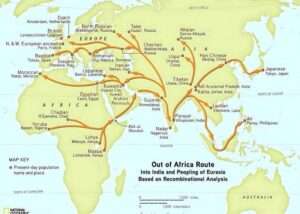
In stark contrast stands the so-called “Northern Route,” or Levantine pathway, which passed through the Sinai Peninsula into the Levant and further into Eurasia around 100,000 BCE. Once considered a plausible route for early human dispersal, it is now widely regarded by geneticists as a failed migration. The early human populations that took this path left behind no enduring genetic legacy. There is no continuity between those ancient Levantine humans and present-day Eurasians. Crucially, the defining haplogroups—M and N in mitochondrial DNA, and C, D, and F in Y-DNA—are entirely absent in these early fossils.
Instead, all non-African humans today trace their ancestry back to haplogroups M and N, and Y-DNA lineages C, D, and F—whose oldest surviving branches are found not in the Levant, but in India, Southeast Asia, and Oceania. Ancient DNA evidence further reinforces this conclusion: Eurasian genomes do not match the genetic signatures of the 100,000-year-old Levantine populations.
Moreover, the well-documented genetic bottleneck in human history—occurring roughly 60,000 to 70,000 years ago—aligns far more convincingly with the southern dispersal model than with the northern route. The Levantine migration, at best, represents an early exploratory phase of Homo sapiens expansion—one that ultimately ended in extinction or assimilation, possibly through interaction with Neanderthals.
The implications are profound. The southern route, as mapped and popularised by the Human Genome Project and subsequent research, is not just a theory—it is the strongest, most evidence-backed model of human dispersal out of Africa. And at its heart lies India.
The question, then, is unavoidable: why does this narrative remain absent—or worse, contradicted—in mainstream education? Why are outdated frameworks like the Aryan Invasion Theory still privileged over robust genetic evidence?
Correcting this is not about nationalist pride; it is about intellectual honesty. India was not a passive recipient of history—it was a crucible where the earliest non-African human populations took root, diversified, and set forth to populate the rest of the world.
To continue teaching otherwise is not just an academic oversight. It is a disservice to truth itself.