To attempt to encapsulate Asha Bhosle in a few words would be an injustice—not merely to the artist, but to the very idea of Indian womanhood she so effortlessly embodies. If one were to gather every interview she has ever given, every anecdote she has shared, every reflection she has offered, what would emerge is not just the portrait of a legendary singer, but the complete, evolving narrative of a woman who lived, adapted, created, and soared on her own terms.
She is not merely a voice; she is a living, breathing tribute to the Indian woman—complex, resilient, expressive, and unapologetically multifaceted.
There are moments in her singing where one can almost see global influences blending seamlessly into her artistry. When she rendered the iconic Do Lafzon Ki Hai Dil Ki Kahani for Zeenat Aman in the film The Great Gambler, there was an unmistakable aura—an echo of the timeless elegance of Sophia Loren. It wasn’t imitation; it was interpretation. Through her voice, she transported listeners into a cosmopolitan world, capturing the pulse of a city that never sleeps.
In another dimension altogether, when she sang Raat Ke Humsafar picturised on Sharmila Tagore in An Evening in Paris, one could feel the quiet yearning for liberation—the emotional undercurrents of a woman seeking space, identity, and freedom. And then came the electrifying rebellion of Dum Maro Dum from Hare Rama Hare Krishna—a song that didn’t just challenge conventions, but shattered them. Through her voice, the spirit of defiance found its most compelling expression.
What stands out most profoundly is that she was never apologetic about her choices. Whether it was lending her voice to cabaret numbers or to deeply classical compositions, she never viewed her art through the narrow lens of societal approval. For her, every song was an opportunity to experiment, to express, to elevate. It was never about a frantic commercial rat race; it was about doing justice to the emotion, the character, the moment. Her vocal creativity was not just technical brilliance—it was emotional intelligence at its peak.
Even in an industry that often boxed women into categories, she refused to be confined. She remained sublime and soulful, navigating genres with a grace that few could emulate. From ghazals to folk, from classical ragas to peppy pop, from playback singing to live performances—she was, and remains, a seamless fusion of tradition and modernity.
Beyond the microphone, what defines her is her deeply human side. She gave immense importance to relationships—across generations, across hierarchies. Age, status, or gender never dictated her warmth. In an era where digital platforms like Instagram and Facebook are flooded with thousands of aspiring singers showcasing their talent, one cannot help but marvel at how she remained endlessly giving—never tired of sharing her journey, her insights, her experiences through interviews.
She remained young at heart—forever curious, forever evolving.
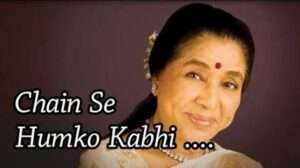
But perhaps one of the most poignant reflections of her character lies in the story behind Chain Se Humko Kabhi. She sang it in a state of deep personal grief, pouring raw emotion into every note. When the song went on to win accolades, she chose not to accept the award. The music director O. P. Nayyar received it on her behalf. What followed was a quiet distancing—yet, remarkably, she never spoke ill of him, nor of the relationship that had once been so significant.
That silence was not indifference; it was wisdom.
She understood something that many spend a lifetime learning—that relationships, like music, are ultimately soulful. They transcend ego, conflict, and time.
To call her merely a singer would be to diminish her essence. She is a philosopher in spirit, a nurturer in her personal life, a performer par excellence, and above all, a luminous human being. A great mother, a timeless artist, and a radiant presence—she is, in every sense, a divine “koyal” whose voice continues to echo across generations.
In a land like India, blessed with thousands of gifted singers, she stands apart—not because she is the loudest, but because she is the deepest.
She is not just a legend; she is an experience.
In the truest sense, she is a “Gandharva”—a celestial being who descended upon earth to enchant, to move, and to elevate us through her music.
And long after the applause fades, her voice will remain—eternal, evocative, and profoundly human.