The Global Premise: Demographic Decline as a Real Estate Thesis-Killer
The most durable real estate bull market in modern history was, at its foundation, a demographic story. Post-war baby booms created large generational cohorts that progressively moved through the property cycle — from renting in their twenties, to first-home buying in their thirties, to upgrade buying in their forties and fifties. The demand was structural, not cyclical, and it validated the old mantra that land always appreciates.
That era is over — not universally, not simultaneously, but irreversibly — across the world’s most prominent economies.
The Population Pyramid as a Leading Indicator
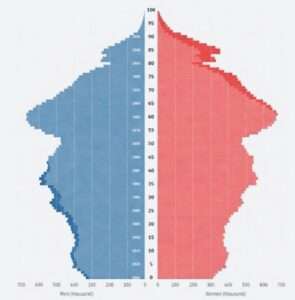
Germany’s population pyramid tells the story with uncomfortable clarity. The cohorts above age 50 are wide and deep; the cohorts below age 30 are narrow and shrinking. The visual is not merely a snapshot of age distribution — it is a forward-looking projection of demand. Fewer 25-to-35-year-olds means fewer first-time buyers. Fewer first-time buyers means fewer sellers trading up. The entire transactional ladder slows, and with it, price discovery weakens.
| Germany is not the exception. It is the preview. |
The pattern repeats with varying intensity across Spain, Italy, Poland, South Korea, Taiwan, Japan, and China. What differs is timing and speed, not direction. The demographic headwind is structural.
The Mechanism: How Demographics Move Property Markets
The transmission is four-stage:
- Fewer births today → smaller household-formation cohorts 25–30 years hence → reduced first-home demand.
- An aging population → net household reduction as elderly consolidate or exit the market via estates → inventory supply increases without commensurate demand.
- Municipal tax bases, dependent on transaction volumes and rising valuations, face fiscal stress → reduced public services → negative feedback loop into desirability and values.
- Developer and financial sector confidence erodes → reduced new construction → eventual undersupply at the premium end, oversupply at the entry/mass-market level.
| Japan already showed the preview: empty villages, abandoned homes, and regional hollowing that no stimulus has been able to reverse. Italy moves through the same arc in slower motion. |
The critical insight here is not simply that demand falls — it is that the expectation of perpetual price appreciation, which has been the primary justification for treating residential real estate as a compounding asset, is fundamentally impaired. In demographic decline, residential property transitions from an appreciating asset to what is best described as a claim on a shrinking population and a weakening municipal balance sheet.
- India’s Exception — And Its Limits
India occupies a fundamentally different position in this global picture. With a median age of approximately 28 years and a population of 1.4 billion still moving through its household-formation peak, India retains the demographic engine that drives property cycles. The India bull case for residential real estate — particularly at Tier 1 — rests on this structural foundation, and it is legitimate for the medium term.
However, the bull case contains within it a critical segmentation that is insufficiently appreciated by most investors: not all Tier 1 Indian cities carry the same demand profile, and the divergence is becoming structurally important.
The Two Indias Within Tier 1 Real Estate
A city like Mumbai or Delhi carries demand rooted in broad-based economic activity: manufacturing, government, trade, retail, logistics, finance, and services. The demand base is diverse, resilient, and relatively insulated from any single sectoral shock.
Bengaluru, Hyderabad, and Pune — and to a substantial degree Noida’s tech corridors and Chennai’s OMR — operate on a different logic entirely. Their residential demand is a derivative of one sector: the global technology industry, particularly its interface with US-based hyperscalers, SaaS enterprises, and IT services outsourcing.
This creates a structural concentration risk that is routinely underpriced.
III. The Silicon Valley Dependency: India’s Tech Cities Under the Microscope
The Demand Construction
In Bengaluru’s Whitefield, Sarjapur Road, and Hebbal corridors, or in Hyderabad’s HITEC City and Financial District, the demand-side equation is broadly as follows:
- Employment is concentrated in IT services (TCS, Infosys, Wipro, HCL), global capability centres (GCCs), and product-oriented tech firms (Flipkart, Google India, Microsoft, Goldman Sachs tech units).
- Compensation in these roles — particularly for mid-to-senior talent — has been significantly above general wage levels, enabling EMI-to-income ratios that sustain premium apartment purchases in the Rs. 80 lakh–3 crore range.
- Developer pipelines in these corridors have been calibrated to this buyer base: large-format apartment projects, gated communities, club amenities — all priced to a buyer earning Rs. 25–50 lakh or above annually.
The Dependency Is Singular and Non-Trivial
This demand chain traces back, in a surprisingly direct way, to US corporate capital expenditure decisions. When US technology companies hire, expand, or open new GCC mandates, Bengaluru and Hyderabad benefit directly through employment, compensation flows, and ultimately, property transactions. When they pause hiring, freeze headcount, or restructure global delivery footprints, the chain reverses.
| The Bengaluru or Hyderabad luxury apartment market is not underwritten by India’s demographic dividend. It is underwritten by the health of the US technology sector’s capex cycle. |
What the Current Cycle Is Showing
Between 2023 and 2025, a meaningful restructuring has played out across global technology: large-scale layoffs at Meta, Google, Amazon, Microsoft, and tier-2 SaaS firms; a recalibration of GCC expansion plans in India from aggressive greenfield to steady-state; and a nascent shift in AI-driven automation that is beginning to compress back-office headcount requirements — precisely the functions that historically drove Indian IT employment.
The property market’s response has been a fragmented one: premium segments in well-located precincts have held, buoyed by residual demand from the prior hiring cycle. But inventory absorption in new launches has slowed, developer payment cycles have elongated, and residential rental yield compression relative to cost of acquisition has become materially visible in secondary data.
- REIT Implications: Structural Versus Cyclical Risk
Indian REITs — Mindspace, Brookfield India Real Estate Trust, Embassy Office Parks — are predominantly commercial real estate vehicles, not residential. However, the distinction matters less than it initially appears when evaluating tech-city concentration risk.
The Office-Residential Feedback Loop
India’s listed REITs derive the substantial majority of their Net Operating Income from office space leased to technology companies or GCCs in exactly the cities under discussion: Bengaluru, Hyderabad, Pune, and Mumbai BKC. The occupancy and rental rate assumptions embedded in current REIT valuations assume continued absorption of Grade-A office space by this tenant base.
If GCC formation slows materially, or if AI-driven productivity gains translate into structural downsizing of per-employee square footage (as is beginning to occur in some US enterprise re-leases), the NOI trajectory of Indian office REITs faces a genuine headwind — not a catastrophic one in the short term, but a meaningful one over a 5-10 year horizon.
| Risk Factor | Severity | Timeline | Mitigant |
| GCC expansion slowdown | High | 3–5 Years | Diversify tenant mix; hospitality/data centre REITs |
| AI-driven office space compression | Medium | 5–8 Years | Shorter lease durations; flex-space allocation |
| Interest rate sensitivity on NAV | Medium | 1–2 Years | Favours falling rate environment (positive in India) |
| Residential demand erosion in tech corridors | Medium | 3–7 Years | Tier 2 city diversification; plotted dev. exposure |
| Municipal fiscal stress in tech hubs | Low | 7–10 Years | Monitor BBMP/GHMC budget trends as lead indicator |
| FII selling pressure on listed REITs | Medium | Cyclical | Track DXY correlation; dollar-hedge if applicable |
The Yield Math Is Unforgiving
Embassy Office Parks currently trades at a distribution yield of approximately 6.5–7.5% on trailing distributions. In an environment where 10-year G-Sec yields remain in the 6.8–7.2% range, the risk-adjusted premium for illiquidity, concentration, and sectoral exposure is thin. REITs only justify their valuation premium when the underlying cash flow growth rate is credibly above the risk-free rate — and that assumption becomes contested if tenant demand flattens.
The inverse is also true: if Indian rates fall materially (as the current RBI trajectory suggests), REIT NAV re-ratings can provide meaningful capital appreciation, and the sector becomes more attractive on a relative basis. The rate sensitivity is therefore a double-edged variable, and the medium-term direction of Indian monetary policy is the single most important REIT-specific macro input.
- The Differentiated View: What Still Works in Indian Real Estate
The analysis is not uniformly bearish on Indian real estate. It is precision-bearish: targeting specific segments and geographies where the assumptions are wrong, while identifying where the structural case remains intact.
| ✔ CONSTRUCTIVE
Affordable & Mid-Segment Residential Demand driven by broad-based India income growth and urbanisation. Not dependent on tech employment premium. Industrial & Warehousing REITs PLI-driven manufacturing relocation, e-commerce logistics, cold chain — a structural play on India’s real economy, not its software export economy. Tier 2 City Residential (Emerging) Infrastructure improvement and remote-work normalisation is broadening demand to Pune outskirts, Coimbatore, Indore, Lucknow — cities where valuations have not yet front-run fundamentals. |
✖ CAUTIOUS
Premium IT-Corridor Residential (Rs. 2Cr+) Demand is a derivative of tech employment premium. Vulnerable to GCC cycle, AI automation, and US capex compression. Office REITs (Pure Bangalore/Hyderabad) Valuation premium to G-Sec is thin. Tenant concentration in GCCs is a structural risk on a 5+ year horizon. Rate trajectory is a wildcard both ways. Global Demographically-Declining Markets Germany, Italy, Spain, Japan, South Korea, China residential — avoid long-horizon capital allocation. These are value traps, not value plays. |
- The Invictus View: Portfolio Implications
For HNI and qualified investor portfolios with Indian real estate exposure, we draw five practical conclusions from this analysis:
- Segment, Don’t Aggregate
India residential is not a monolith. Direct exposure to affordable and mid-market segments in cities with diversified economic bases retains its structural validity. Exposure to premium IT-corridor apartments above Rs. 2 crore in tech-dependent cities should be evaluated through a concentration-risk lens, not as a generic India property play.
- REITs: Monitor the Tenant Register
REIT investments in the Indian listed space should be assessed by tenant mix diversification — the ratio of GCC/pure-tech tenants versus domestic financial services, pharma, manufacturing, and government tenants. REITs with higher non-tech tenant diversification carry structurally lower demand-side risk over a 5–10 year horizon.
- Industrial and Logistics REITs Deserve Structural Overweight
India’s real estate opportunity set includes more than office and residential. Warehousing, data centres, healthcare real estate, and industrial parks are not predicated on the tech employment premium. They are predicated on India’s manufacturing and consumption trajectory — a considerably more durable foundation.
- Global Allocation: Avoid Demographic Traps
For clients with global real estate exposure (direct or through global REITs), the analysis recommends a clear bias against demographically-declining markets. The old principle — land always rises — was never universal. It was demographic-context-dependent. In markets where births persistently undershoot replacement, the expected-return case for residential property is permanently impaired.
- Watch the AI-GCC Interface Closely in 2026–27
The most important lead indicator for Indian tech-city property demand over the next 18–24 months is not RBI policy or developer inventory levels — it is the pace at which AI-driven automation is translating into GCC headcount guidance in India. If large GCCs begin communicating flat-to-declining India headcount targets, the demand assumptions underpinning current prime residential launches in Bengaluru and Hyderabad will require material revision.