At bauma CONEXPO INDIA 2026, Brokk will arrive with a proposition that may look slightly mischievous in a construction-equipment market where bigger machines still tend to attract the bigger conversations. Its demolition robots are small enough to make a conventional excavator look almost theatrical, but that is hardly the comparison Brokk is interested in. For fifty years, the Swedish company has been building machines for places where size can become a disadvantage, access turns into an engineering problem and putting an operator close to the work is increasingly difficult to justify.
India happens to have plenty of those places. They are inside tunnels, behind walls, beneath roads, within metro systems, around cement plants, in underground mines and inside ageing industrial facilities where getting a conventional machine to the worksite can become half the job. Two Brokk 500 robots already working on the Rishikesh–Karanprayag Rail Project give the proposition something more useful than another market forecast: an actual Indian application. The machines are being used to excavate cross passages, bringing remote-controlled demolition into one of the country’s more demanding infrastructure environments.
That does not suddenly turn Brokk into a mainstream equipment manufacturer in India. It does something more useful for a specialist company: it shows that an Indian project is prepared to use the technology where conventional equipment is not necessarily the easiest answer.
Awkward Work
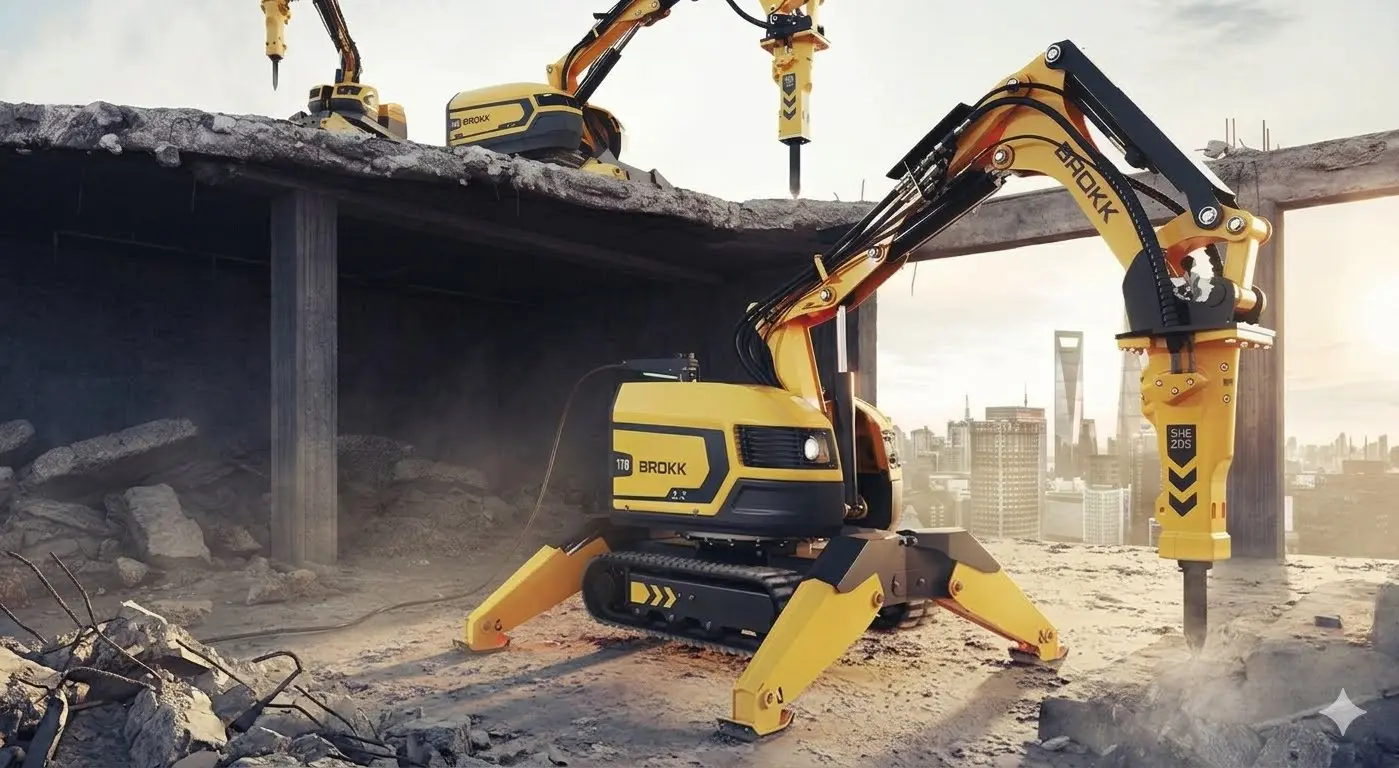
There is a reason Brokk machines can look slightly underwhelming when mentally parked beside a 20-tonne excavator. They were never designed to win that contest. A Brokk robot is remotely operated, compact and built to work in confined or hazardous environments, keeping the operator away from the immediate demolition zone.
The Indian range runs from the Brokk 170 and 200 through the 300 and 500 to the substantially larger 900, alongside specialised pedestal-boom equipment. Their usefulness becomes clearer when conventional equipment is expensive to position, difficult to manoeuvre or uncomfortable to operate safely. In a tunnel, the first question may not be whether an excavator can break the rock. It may be whether the excavator can get through the opening in the first place.
The same problem turns up in industrial demolition, cement plants, underground construction and redevelopment in increasingly crowded cities. A machine occupying less space but delivering concentrated demolition power can begin to look rather different when the alternative involves temporary access, shutdowns or people working too close to the action.
Indian Proof
The Rishikesh–Karanprayag Rail Project is therefore important to Brokk for reasons that have little to do with the number of machines involved. Brokk India’s General Manager Manmohan Krishan announced the delivery and commissioning of two Brokk 500 robots for cross-passage excavation, with safety and productivity highlighted as key benefits.
For a specialist machine, that kind of reference can travel a long way. Contractors considering unfamiliar equipment tend to want to know where it has worked, under what conditions and whether someone else was willing to trust it with a difficult job. A major rail project provides a rather better answer than a demonstration video.
Market Reality
The timing is interesting because India’s broader construction-equipment market is hardly overflowing with reasons for another category to expect an easy ride. FY26 ended at 136,995 units, down from 140,191 in FY25, while domestic demand remained under pressure and exports increased 31.5 percent. Q4 brought some relief, with a 4 percent recovery and stronger contributions from earthmoving, road construction and material processing equipment.
For Brokk, however, the entire CE market is not really the target. Its opportunity sits in a much narrower group of jobs where access, safety and downtime can matter more than the versatility normally associated with a conventional excavator.
That makes tunnelling and underground infrastructure particularly interesting, which also explains the company’s effort to recruit people with experience in civil infrastructure, tunnelling and hydro projects across India’s major markets.
Pune Presence
Brokk India was established as a dedicated company in Pune in 2023, and the move gives the Swedish manufacturer something more substantial than a sales address. There is a General Manager, sales support and service capability, with recruitment focused on people who understand the infrastructure markets in which these machines are likely to work.
For specialised capital equipment, service is part of the product whether manufacturers like the description or not. A demolition robot deep inside a tunnel is of little comfort to a contractor if the people supporting it understand the catalogue but not the application. The customer is buying steel, hydraulics and attachments, certainly, but also the assurance that somebody understands the machine when it is hundreds of kilometres from the showroom and the project schedule has no patience for downtime.

Swedish Depth
Brokk brings considerable industrial depth to India. Its headquarters remain in Skellefteå in northern Sweden, around 300 kilometres south of the Arctic Circle, where the company designs, tests and manufactures its demolition robots. Brokk says the group generates more than SEK 1.6 billion in revenue through more than 20 sales companies.
Its parent Lifco provides another layer of scale. The group ended 2025 with SEK 28.3 billion in net sales, 275 operating companies across 37 countries and an EBITA margin of 22.4 percent. Brokk sits within Lifco’s Demolition & Tools business area.
That matters because the Indian operation is not trying to establish the technology from scratch. The product, application knowledge and global business infrastructure already exist; India now has to prove how much room there is for them locally.
Real Rival
The competitive picture is not empty either. Husqvarna Construction’s DXR range is already marketed in India for demolition, tunnelling, mining and industrial applications, giving contractors another established route into remote-controlled demolition.
The contest is unlikely to be settled on a trade-show floor. Contractors will look at productivity, uptime, attachments, service support and, inevitably, the capital cost. Brokk’s fifty-year history gives it credibility, but longevity alone does not make a specialist machine part of a contractor’s fleet.
Product Momentum
The global product cycle suggests that Brokk is still putting money and engineering effort into the category. The Brokk 130+ arrived in 2025, followed in January 2026 by the Brokk 110+ with SmartPower+ technology.
That continuing development could matter in India if the application base widens beyond demolition into tunnelling, mining, industrial maintenance and other restricted-access work. The opportunity does not require every contractor to own a robot. It requires enough difficult jobs to make owning or deploying one commercially sensible.
Sensible Bet
For now, Brokk’s Indian investment remains commercial rather than manufacturing-led. There is no evidence in the supplied material of a major Indian factory commitment. What is visible is a dedicated company, a Pune sales and service operation, specialist recruitment and machines already working on a major infrastructure project.
That may be the sensible order of events. Before committing substantial manufacturing capital, Brokk needs to find out just how large India’s appetite is for equipment designed around the jobs conventional machines find awkward.
Price Catch
The price comparison will remain difficult. A contractor can put a remote demolition robot beside a conventional excavator and reasonably ask why the specialist machine should occupy fleet space when the excavator can perform several different jobs.
The answer becomes less straightforward when the alternative involves dangerous manual work, costly temporary access, lengthy shutdowns or a machine that simply cannot enter the space.
The Opening
That is where Brokk’s presence at bauma CONEXPO INDIA 2026 becomes more interesting than another robotics demonstration. It is not really about replacing the excavator. It is about taking on the jobs where the excavator’s celebrated versatility suddenly becomes rather less useful.
And India has already started giving Brokk some of those jobs.