Upadhyayula Lakshman Rao
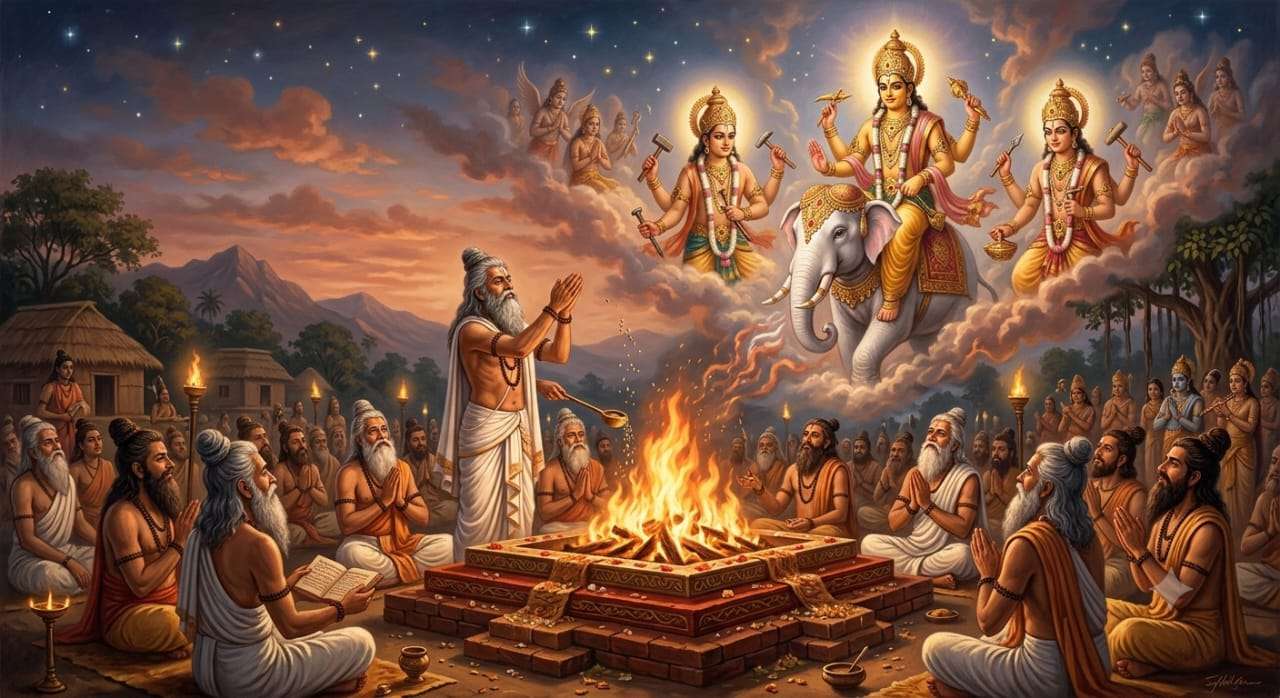
In the ancient vision of the Vedic seers, the sage Parāśara stands as one who perceived existence not as fragmented, but as a seamless continuum woven of spirit and matter. In his contemplations upon Agni, expressed through the cadence of the Rigveda and shaped in the expansive rhythm of Virat Chandas, his insight rises beyond ritual into the subtle architecture of the cosmos. His prayer is not merely an invocation; it is an exploration—where poetic utterance assumes the precision of a coded truth, each word interlinked, each line unfolding layers of meaning that deepen endlessly into the fabric of reality.
Agni, in Parāśara’s vision, is born in the forests, kindled within the silent friction of wood, yet destined to become the beloved of humankind. He is the divine messenger who carries oblations from the earthly realm to the celestial, transforming material offerings into subtle essence. The seer beholds him as both tangible flame and invisible principle, a force that mediates between seen and unseen worlds. Kings and patrons revere him for his clarity and power, for his voice is not merely fire’s crackle, but a resonance of order, logic, and cosmic authority.
Agni welcomes those who approach with sincerity, granting fortune and opening pathways to divine communion. He summons the gods and faithfully delivers offerings, preserving the sacred cycle of exchange between mortals and the divine. The oblations, once offered, are not lost; they are concealed within hidden caverns of existence—subtle reservoirs where energy is conserved, transformed, and re-emerges. Thus, Agni is not destruction alone; he is continuity, the unseen keeper of transitions, joining even with waters, revealing his presence within all elements.
The seer further perceives a profound paradox: Agni, though revered by the gods, also inspires awe within them. For the very forces that sustain the universe—those divine intelligences that uphold order—recognize in Agni a primordial potency. They themselves assume his form, merging into fire as the principle of transformation. Just as the sun sustains heaven and earth, Agni too bears both realms, holding space itself through the truth of incantation and the precision of sacred sound.
Agni is described as the devourer of all, yet this consumption is not mere annihilation. It is a process of renewal. He consumes the forests, the towering trees, and even the seeds within fruits, only to release their essence into new cycles of existence. Grass, the sustenance of animals, and water, the life of all beings, are under his subtle protection. He dwells even in the deepest caverns, in hidden recesses where ordinary perception cannot reach, moving silently where even cattle dare not wander. To know Agni in these depths is to understand the concealed forces that govern life itself.
Those who meditate upon Agni, who perform yajna with awareness and chant hymns with disciplined intent, align themselves with this universal principle. The seers who compose and compile praises are not merely poets; they are discoverers of laws, interpreters of a cosmic language. Their reward, granted by Agni, is not only material wealth but insight—an understanding of the interconnected threads that bind existence. Fire in the household becomes the same fire in the cosmos, omnivorous and impartial, sustaining life while reshaping it.
In this vision, Agni becomes the cause of movement, the impulse behind change, the energy that resides even within waters—suggesting an early intuition of hidden forces, subtle energies that modern inquiry might liken to latent heat or molecular motion. The seer’s prayer, though expressed in simplicity, reflects a profound scientific temperament: an observation of processes, cycles, transformations, and conservation within nature. Each element, each action, forms part of an intricate network, where the smallest unit holds the potential to reveal the vastness of the universe.
Thus, the hymn of Parāśara unfolds as a luminous thread, connecting the minute with the infinite. When the subtle world is perceived—when the hidden caverns of existence are understood—the universe no longer appears static, but ever-expanding, advancing in silent and imperceptible strides. Agni, as both symbol and reality, stands at the heart of this vision: the eternal mediator, the transformer, the bearer of continuity. In contemplating him, the seer does not merely worship; he discovers, and in that discovery, reveals a cosmos alive with intelligence, rhythm, and boundless unity.