


With the announcement of the election schedule for five states, the political spotlight has sharply turned towards the South—particularly Tamil Nadu and Kerala—where entrenched political equations are facing an unusually volatile test. What makes this electoral cycle different is not merely anti-incumbency or alliance arithmetic, but the emergence of disruptive forces and a perceptible churn in voter loyalties that could redraw the region’s political map.
Tamil Nadu: A Cracking Dravidian Fortress?
For decades, Tamil Nadu politics has revolved around the Dravidian duopoly—the Dravida Munnetra Kazhagam (DMK) and the All-India Anna Dravida Munnetra Kazhagam (AIADMK). While early poll projections remain divided, with some giving a marginal edge to the DMK-led alliance and others backing the AIADMK combine, the entry of actor-turned-politician Vijay has added a layer of unpredictability that neither camp can comfortably ignore.
Vijay’s political plunge is being viewed through two contrasting lenses. Optimists within his camp—largely driven by a younger political think tank—believe he could trigger a silent electoral wave. Skeptics, however, draw parallels with Kamal Haasan, whose political foray failed to translate star power into electoral success. Complicating matters further is the shadow of a Central Bureau of Investigation (CBI) probe into a tragic incident at one of Vijay’s rallies that reportedly claimed around 40 lives—an issue that could dent his credibility at a crucial juncture.
Yet, dismissing Vijay outright may be politically naïve. His appeal cuts across urban youth and sections of marginalized voters, particularly segments of SC/ST and minority communities—traditionally seen as leaning towards the DMK. This is precisely why his rise is viewed as a bigger threat to the DMK than to its arch-rival AIADMK.
BJP’s Quiet but Significant Surge
A notable undercurrent in Tamil Nadu is the gradual rise of the Bharatiya Janata Party (BJP). Historically peripheral in the state, the BJP has, in recent years, managed to secure a vote share hovering around 10–11 percent. While this may not immediately translate into seats, it represents a structural shift in a state long resistant to national parties.
Issues such as the “Deepam temple row” and accusations of perceived anti-Hindu positioning by the DMK have the potential to trigger micro-level polarization. Even a 2–3 percent swing in such a tightly contested environment could prove decisive. Interestingly, Vijay’s own political messaging—perceived by some as leaning towards minority appeasement—may also provoke a counter-consolidation among Hindu voters, thereby indirectly benefiting the BJP-AIADMK axis.
Amit Shah’s Calculated Gamble
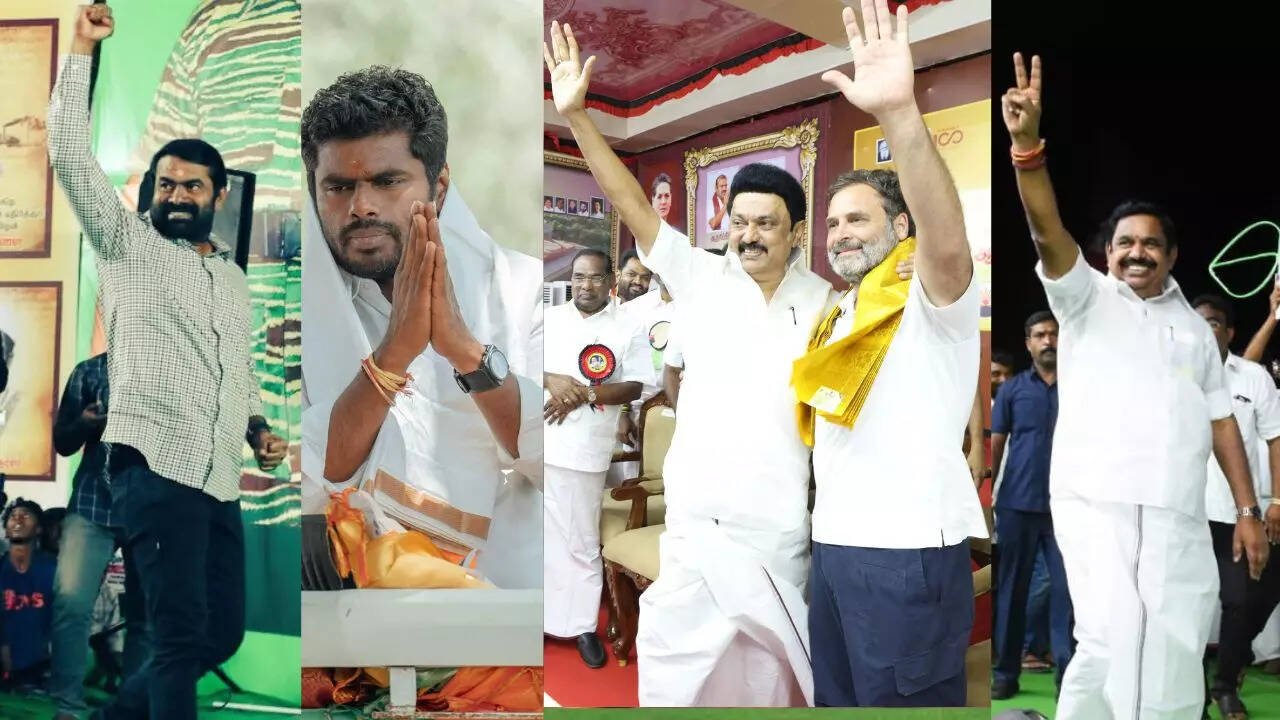
Sources within political circles suggest that Amit Shah, the BJP’s chief strategist, has played a long game in Tamil Nadu. While there were initial attempts to bring Vijay’s party into a pre-poll alliance, the plan was reportedly shelved in favour of a more nuanced strategy: allow Vijay to cut into the DMK’s vote bank.
The message to Edappadi K. Palaniswami (EPS), the AIADMK chief, is believed to be clear—focus attacks on the DMK-Congress alliance, avoid direct confrontation with Vijay, and keep post-poll options open. If Vijay’s party manages to secure 30–40 seats—a scenario not entirely implausible—the AIADMK-BJP alliance could potentially rope him in, even offering a Deputy Chief Minister’s post as part of a power-sharing arrangement.
Such a strategy, if successful, could fundamentally weaken the DMK and alter Tamil Nadu’s long-standing bipolar political structure.
Kerala: Signs of a Three-Way Contest?
If Tamil Nadu presents a story of disruption within a two-party system, Kerala may be inching towards a three-cornered contest. A recent survey by Mathrubhumi has sparked intense debate by projecting a possible hung assembly, where neither the United Democratic Front (UDF) nor the Left Democratic Front (LDF) secures a clear majority.
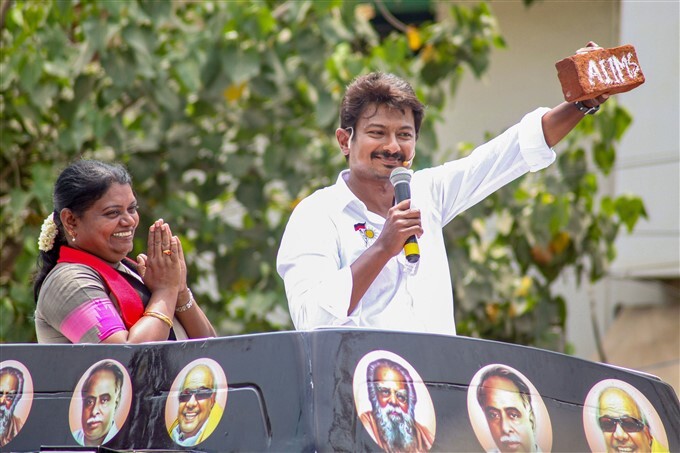
What has truly raised eyebrows is the projection for the BJP—placing it in the range of 15–20 seats, a figure that significantly exceeds previous expectations. While such projections must be treated with caution, they do indicate a shifting political mood in a state traditionally dominated by bipolar alliances.
Several factors appear to be contributing to this churn. Allegations surrounding temple-related financial irregularities, disenchantment with what critics describe as minority appeasement politics by the Congress-led UDF, and growing grassroots work by the BJP and its ideological affiliate, the Rashtriya Swayamsevak Sangh (RSS), are gradually altering the electoral landscape.
Changing Social Coalitions
Kerala’s evolving political narrative also includes subtle shifts within Christian communities, sections of which are reportedly reassessing their political alignments amid concerns over rising radicalism and identity politics. The BJP, led nationally by Narendra Modi, has made conscious outreach efforts, including direct engagement with Church leaders, positioning itself as a governance-focused alternative.
Simultaneously, in urban pockets like Thiruvananthapuram—where the BJP has already demonstrated electoral viability in civic polls—the party appears to be consolidating a base that could translate into legislative gains.
A Region in Transition
What unites the electoral narratives of Tamil Nadu and Kerala is a deeper structural shift—voters are no longer bound by rigid ideological or identity-based loyalties. Aspirational politics, governance expectations, and identity assertions are intersecting in new ways, making outcomes far less predictable than in previous elections.
The Dravidian stronghold in Tamil Nadu shows signs of stress, while Kerala’s bipolar equilibrium may be loosening. The rise of new political actors, strategic recalibrations by national parties, and evolving voter behaviour together point towards one conclusion: South India is entering a phase of political transition.
And in such a moment, surprises are not just possible—they are inevitable.

