


In the high-stakes theatre of Indian politics, relevance is often currency. And when authority begins to wobble, noise becomes a substitute for power. Karnataka Chief Minister Siddaramaiah’s decision to amplify a vague, unverified news report about Andhra Pradesh Chief Minister N. Chandrababu Naidu’s alleged concerns over the Viksit Bharat Guarantee for Rozgar and Ajeevika Mission (Gramin) Act is not just a political statement—it is a calculated act of self-preservation.
At a time when his own continuance as Chief Minister hangs under a cloud, Siddaramaiah appears less interested in the architecture of cooperative federalism and more invested in inserting himself into a national narrative. His party’s internal “cat and mouse” game—marked by the alleged two-and-a-half-year rotational understanding with Deputy Chief Minister D.K. Shivakumar—has reduced the Chief Minister’s chair to a revolving door. In such a climate, every national controversy becomes a ladder to political relevance.
The timing of Siddaramaiah’s intervention is revealing. Both Houses of Parliament passed the VB-G RAM G Act, replacing the two-decade-old MGNREGA, amid Opposition protests. The bill received presidential assent. The legislative process, at least procedurally, was complete. Yet Siddaramaiah chose this moment to cite a “report” claiming that an NDA ally—the TDP supremo and Andhra Pradesh Chief Minister—had privately raised concerns with the Centre over funding patterns and state burdens.
The first and most glaring question remains unanswered: where did this “leak” come from?
Naidu’s party was part of the parliamentary arithmetic that allowed the bill to pass. If the concerns were genuine and consequential, Parliament—not a selectively amplified newspaper article—was the constitutional forum to raise them. By endorsing a rogue headline on his official ‘X’ handle, Siddaramaiah blurred the line between political critique and political speculation.
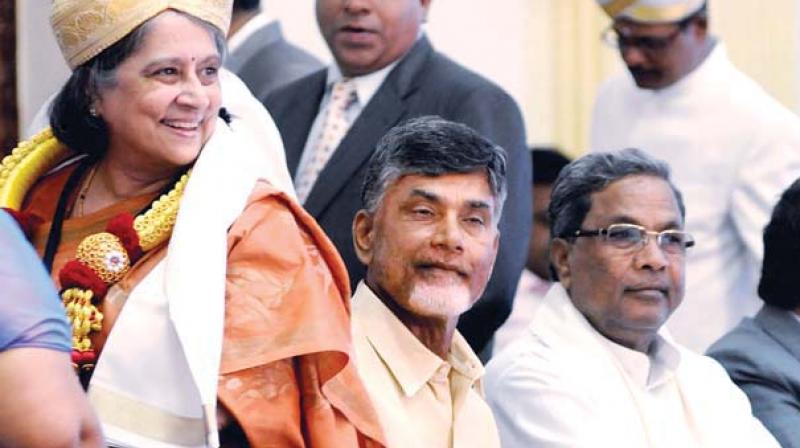
His argument is structured around a dramatic contrast: MGNREGA as a “legal right with assured central funding” versus VB-G RAM G as a “negotiated arrangement” that shifts fiscal burden onto states. On paper, this framing is designed to cast the Centre as eroding federal guarantees and Opposition-ruled states as victims of a partisan funding regime.
By invoking a supposed “rupture” within the NDA, Siddaramaiah attempts to project himself as a national disruptor rather than a state leader battling internal party fragility. It is a classic tactic: when authority at home weakens, manufacture a confrontation with power at the Centre.
His claim that “bargaining power rather than law” may now determine access to funds is heavy with insinuation but light on evidence. The assertion rests entirely on the premise that Naidu privately sought “alternative financial support”—a premise drawn not from official communication, parliamentary record, or formal statement, but from a media report Siddaramaiah chose to elevate into a political flashpoint.
The Karnataka Chief Minister is not merely critiquing a law. He is building a narrative in which he casts himself as the defender of federalism against a supposedly coercive Centre, while simultaneously positioning himself as a voice that can expose “cracks” within the ruling alliance. In doing so, he seeks to transcend the uncertainty of his own political future by embedding himself in a national ideological battle.
Yet the irony is hard to miss. Siddaramaiah calls for concerns to be raised “openly in Parliament,” even as he himself relies on off-record claims and second-hand reporting to fuel his argument. The demand for transparency is undercut by the method of his own intervention.
The VB-G RAM G Act may well deserve rigorous scrutiny. Its funding structure, statutory guarantees, and implementation mechanisms are legitimate subjects for debate. But when those debates are driven by political survival rather than policy clarity, the line between analysis and opportunism begins to blur.
In the end, Siddaramaiah’s statement reads less like a constitutional alarm and more like a political flare—shot skyward to remind both his party and the nation that he is still in the game. In Karnataka, his chair may be uncertain. In Delhi, his voice seeks permanence.
And in that tension lies the real story: a Chief Minister fighting not just a law, but the slow erosion of his own political relevance.
