


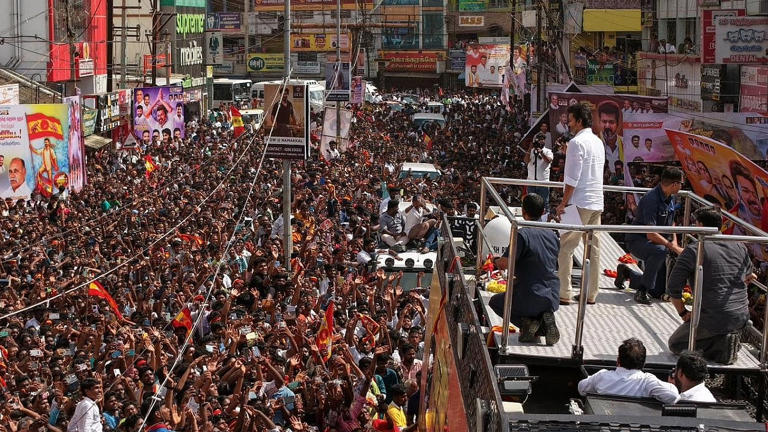
In any functioning democracy, the right to assemble is not a favour granted by the state—it is a constitutional guarantee. When that right is selectively denied, especially in the heat of an election season, it ceases to be a law-and-order issue and becomes a direct assault on the integrity of the electoral process. The controversy surrounding the Tamil Nadu police denying permission to actor-turned-politician Vijay of the Tamilaga Vettri Kazhagam to hold a rally in Perumbur is not an isolated administrative decision—it is a troubling signal.
Vijay’s allegation that the district police are acting as agents of the ruling Dravida Munnetra Kazhagam raises a larger and uncomfortable question: how neutral is the state machinery when political stakes are high? More importantly, if permission was indeed cleared by the Election Commission, on what grounds can local police overrule or obstruct it?
This is not merely about one rally. It is about the creeping normalisation of bureaucratic gatekeeping to control political momentum. Tamil Nadu, long celebrated for its politically aware electorate, now risks sliding into a pattern disturbingly reminiscent of what has unfolded in West Bengal under the Trinamool Congress—where opposition rallies often face logistical hurdles, administrative delays, and outright denial, forcing repeated interventions by the Election Commission of India.
The question that now confronts Tamil Nadu is stark: how many more such hurdles will the state police erect before the Election Commission is compelled to step in decisively, as it did in West Bengal—transferring officials, tightening oversight, and effectively taking control of election administration?
The timing of this controversy is telling. Vijay’s political entry is not being viewed as a fringe development. Unlike Kamal Haasan, whose electoral foray failed to translate into votes—with his party struggling to retain deposits—Vijay appears to have struck a chord, particularly among Gen Z voters. His appeal, amplified by a carefully cultivated public image and a massive fan base, is now translating into a tangible political force.
For the DMK, led by M. K. Stalin, the arithmetic is becoming uncomfortable. The ruling alliance is projected to command around 39 percent vote share, with allies contributing another 3–4 percent. On paper, that looks stable. But elections are rarely decided on paper—they are decided on shifts. A 5–6 percent erosion in DMK’s vote base, potentially siphoned by TVK, could prove decisive in a tightly contested scenario.
On the other side, the All India Anna Dravida Munnetra Kazhagam-led alliance, with the Bharatiya Janata Party as a significant partner contesting a record number of seats, is projected to consolidate a combined vote share of around 35–39 percent. Pollsters even suggest the BJP could secure 15–20 seats, riding on its independent vote base and alliance arithmetic.
Now enters the wildcard—TVK. Even a conservative estimate of 8–10 percent vote share could translate into 15–20 seats in a fragmented mandate. More optimistic projections of 15–20 percent vote share, though arguably exaggerated, underline one undeniable reality: Vijay is no longer a political experiment; he is a variable that can alter outcomes.
And that is precisely why the denial of a rally becomes politically loaded. When a rising challenger is denied space—literally—it fuels the perception of insecurity within the ruling establishment. It also risks backfiring. Indian voters have historically shown a tendency to rally behind those perceived as victims of state overreach.
If Tamil Nadu’s authorities believe that restricting rallies can contain political momentum, they are misreading both history and the electorate. Such actions do not weaken opposition—they legitimise it.
The Election Commission now faces a critical test. Will it wait for a pattern to emerge, or act pre-emptively to ensure a level playing field? The precedent from West Bengal shows that delayed intervention often comes at the cost of public trust.
Tamil Nadu stands at a crossroads. It can either uphold its democratic legacy or drift into a model where administrative discretion shadows electoral fairness. The denial of one rally may seem minor—but in the larger scheme, it could well be the first crack in the foundation of a free and fair election.
