


Telangana is preparing for one of its most ambitious exercises in future planning: the Rising Telangana Global Conclave, where Chief Minister A. Revanth Reddy and his team will unveil the Telangana Rising Vision Document 2047 on December 9. It is a moment that deserves recognition. For a state still shaping its identity in the national imagination, articulating a 20-year economic and social roadmap is not merely a bureaucratic ritual — it signals seriousness, aspiration, and accountability.
And make no mistake, the draft vision is both expansive and commendable. Spread across eight substantive chapters, it outlines nothing short of a transformational blueprint: a $3 trillion economy by 2047, deep-tech-driven growth, strategic regional planning, inclusive empowerment of women, youth, and farmers, strengthened human development indices, and a bold commitment to a net-zero future. Any government willing to think beyond the next election cycle deserves applause.
At the heart of this document lies an audacious economic aspiration: contributing 10 percent to India’s GDP by 2047. Telangana wants to emerge not merely as a participant in India’s growth story, but as a driver. Its roadmap hinges on sharpening Total Factor Productivity, attracting global talent back home, and setting the stage for rapid expansion in AI, quantum computing, aerospace, cybersecurity, biotechnology, defence, and next-generation manufacturing. Alongside this, the government’s emphasis on MSMEs, tourism, media, entertainment, and exports indicates a well-rounded strategy to unlock both scale and diversity.
The vision also recognises that development must be spatially balanced. Through a three-tier spatial model — the Urban Core, Peri-Urban Zones and Rural Telangana — the state seeks to orchestrate a cohesive development framework. Hyderabad, already a global technology hub, is positioned to become a nerve centre for Industry 4.0, GCCs, and high-end manufacturing. The Peri-Urban belt will become a bridge between urban prosperity and rural opportunity. Rural Telangana, meanwhile, is reimagined as a centre of sustainable livelihoods built on agri-tech, livestock development, forest economies, handicrafts, and eco-tourism.
Equally significant is the emphasis on Human Development. A government that speaks of biobanks, digital health, primary care expansion, geriatric medicine and last-mile health access is, at the very least, thinking in the right direction. The Net Zero chapter further reinforces a responsible approach — envisioning decisive shifts in energy systems, green infrastructure, circular economy initiatives, and nature-based climate solutions.
Finally, the vision’s strong focus on youth, women, and farmers underscores a belief that real development is participatory, not paternalistic.
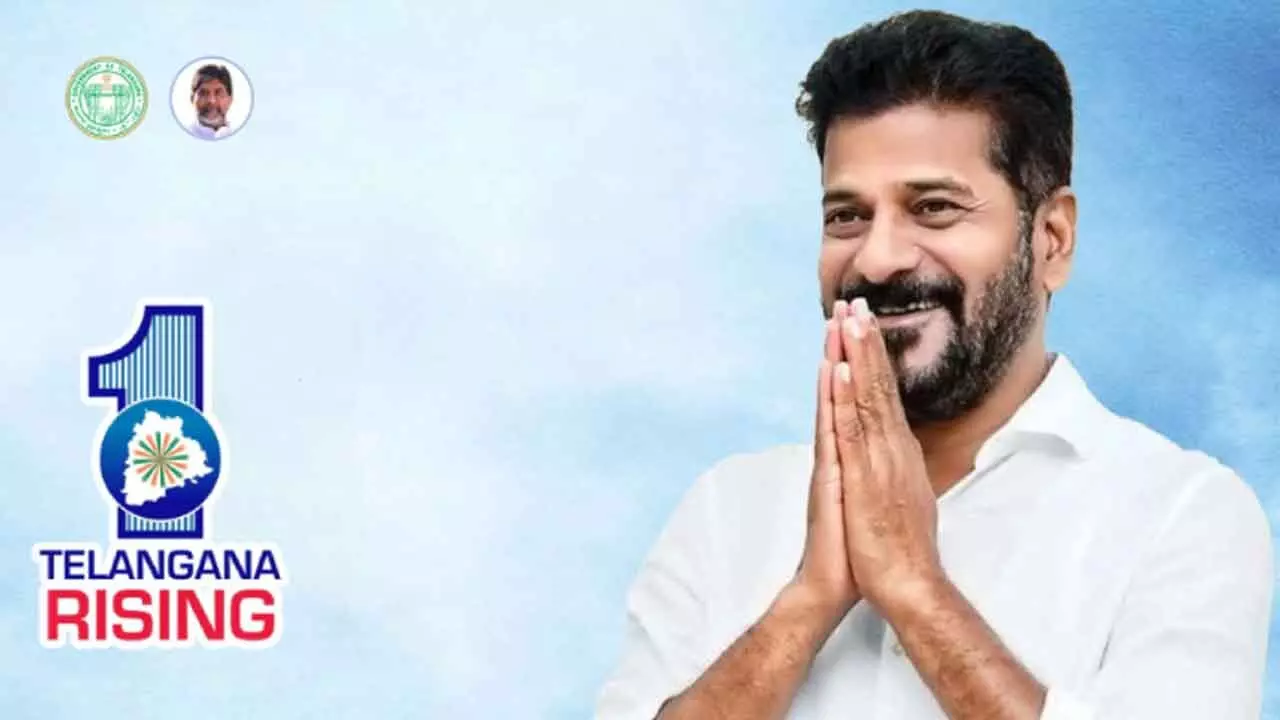
All of this deserves appreciation. Telangana is dreaming big — and it is dreaming with data, structure and intent.
But this is where the contradiction begins.
For a vision to inspire confidence, the leadership presenting it must inspire dignity. It is here that Chief Minister Revanth Reddy’s recent conduct threatens to overshadow his government’s promising blueprint. Personal behaviour is not a private matter when one occupies the highest executive office of the state. His words, tone, and demeanour carry the weight of Telangana’s image — nationally and globally.
Unfortunately, the Chief Minister’s avoidable controversies, public outbursts, and episodes of undignified behaviour risk diluting the seriousness of the very objectives he is championing. A government can invest in innovation, attract global investors, and organise high-profile conclaves — but investors and citizens alike also evaluate the credibility, stability, and maturity of the leadership.
An equally troubling issue is his party’s growing habit of selective criticism of the Hindu majority, often ridiculing revered Gods and Goddesses with disturbing regularity. A state that speaks of inclusive development cannot simultaneously allow cultural insensitivity to flourish under its watch. Mocking the faith of the majority is no sign of progressiveness; it is simply another form of bigotry, wrapped in political convenience.
Telangana’s development cannot be built on economic ambition and social discord at the same time. If the Chief Minister wishes to see his Vision 2047 taken seriously — not just today but across the next two decades — he must rein in these tendencies. The future of the state cannot depend on political theatrics but on political maturity.
Revanth Reddy has the platform, the plan and the opportunity. All he needs now is the discipline and dignity to match them. Only then will Telangana’s Rising Vision truly rise — not just on paper, but in the hearts and confidence of its people.


