The vision of the Veda is not confined to ritual utterance nor limited to ceremonial fire; it descends into the intimate chambers of daily life and elevates every ordinary act into sacred participation in cosmic order. The seers of the Atharva Veda, the Rigveda, the Yajurveda, and the Samaveda did not compose hymns for temples alone; they structured a complete discipline of living. The Veda is a mechanism of undiminishing value — a perennial training of the human personality, harmonizing body, speech, mind, and spirit with ṛta, the cosmic order.
In the Vedic model, the day is not a casual succession of hours; it is a measured sacrifice. From the first glimmer of dawn until the surrender of consciousness into sleep, time is divided with precision, and instruction is woven into rhythmic threads of mantra. These verses are not merely spoken; they are lived. By chanting them, the practitioner does not merely repeat sound — he assumes sanctity. Sound becomes force; rhythm becomes transformation.
At daybreak, even the cleansing of teeth and tongue is sanctified. The use of medicinal twigs — drawn from trees endowed with healing potency — is not a mechanical act but a sacred exchange. Before a leaf is plucked, before a twig is cut, the aspirant must pause and recite verses of apology and reverence. In the spirit preserved in the Atharva Veda, the seeker declares:
“You and I are both creations of the Divine. The Great Power ordains our destinies. I possess no inherent right to harm you, for that right belongs to the Creator alone. Yet for the sake of preserving this body in health, so that I may fulfill my duties to the universe, I seek a small portion of your strength. Permit me.”
This prayer is not a symbolic sentiment; it is ecological philosophy in its most refined form. It lays the foundation for the preservation of nature, centuries before environmental ethics found academic language. The Vedic student does not dominate nature — he enters into a covenant with it.
The same sanctity pervades bathing. Before re-entering worldly duty, the aspirant withdraws into solitude for svādhyāya — sacred self-study. Here the chanting refines intention: “May I be guided to speak truth. May anger be sacrificed. May selfishness be relinquished. May anxiety dissolve.” In these moments, education penetrates beneath intellect into character. Discipline becomes interior fire.
Thus, the Vedic system does not produce mere reciters of hymns; it fashions integrated beings. The rhythm of the mantra enters the bloodstream. The student becomes aligned with truth not by compulsion but by internal transformation. Every gesture — eating, speaking, working — becomes calibrated toward righteousness.
The Upanishadic sages carried this discipline further into luminous introspection. The profound teachings of the Brihadaranyaka Upanishad, the Chandogya Upanishad, and the Katha Upanishad emerged from young mendicants whose minds burned with inquiry. They inherited the fiery ritual spirit of the Veda, yet refined its outer structure into inner realization.
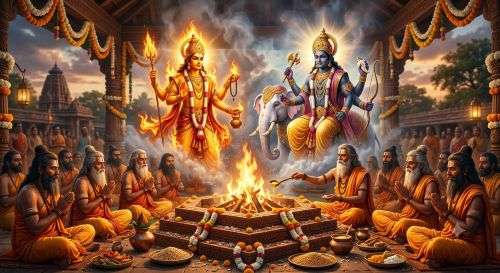
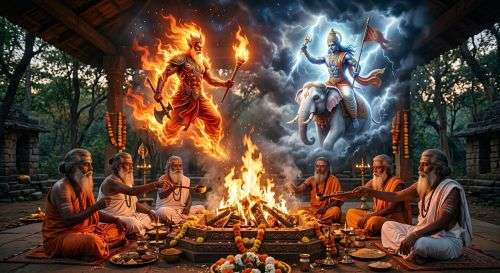
The shape and model of yajña — sacrifice — underwent a sublime transformation. The altar moved inward. The priest became the self. The offering was ego. The fire was awareness. No external horse was required for the Aśvamedha; instead, the cosmic horse was contemplated in meditation. The Upanishadic seer declares: the dawn is the head of the sacrificial horse; the sun its eye; the wind its breath; fire its open mouth; the year its soul. Thus, ritual was not abandoned but universalized.
This was a revolutionary inwardization. No altar stood of brick and clay; austerity became the altar. No external priest mediated between man and cosmos; contemplation bridged the gulf. No sacrificial animals were bound; passions were restrained. Penance, meditation, and contemplation became the supreme instruments.
Yet this transformation was not rejection — it was refinement. The ritual fire did not die; it was interiorized. The dynamic energy of the Veda flowed into the Upanishads as a deeper current. Vedic education, therefore, is not static tradition but living continuity — ever youthful, ever renewing itself in each generation of seekers.
Each Upanishad unfolds a deeper dimension of unity between life and the universe. The individual is not an isolated fragment but a vibrating note in the cosmic symphony. To chant is not merely to produce sound; it is to align with the primordial rhythm. To live rightly is to participate consciously in universal order.
Thus, the true model of Vedic education is not mechanical chanting, nor intellectual accumulation. It is absorption of spirit — dynamic, rhythmic, transformative. It trains the body through discipline, the speech through truth, the mind through contemplation, and the soul through realization.
Such education produces not professionals but sages; not consumers but custodians; not restless seekers of power but harmonized participants in cosmic law. It awakens reverence before plucking a leaf, restraint before speaking a word, clarity before acting, and humility before the infinite.
In this grand design, life itself becomes yajna. Every breath is an offering. Every dawn is a renewal. Every act, when sanctified by awareness, becomes participation in the eternal rhythm of the universe.
This is the undiminishing mechanism of the Veda — ancient yet ever new, rooted yet dynamic, inward yet universal — a discipline that shapes humanity not merely to survive in the world, but to live in conscious harmony with the Whole.