


When the United States eliminated Iran’s Supreme Leader, Ayatollah Ali Khamenei, it crossed a threshold that even its fiercest critics in Tehran had not imagined. Targeting the head of a sovereign state is not a routine counter-terror strike; it is a geopolitical earthquake. Washington may argue self-defence, deterrence, or preemption. But when a superpower assassinates a sitting leader and simultaneously proclaims itself a global peacemaker, the contradiction is impossible to ignore. U.S. President Donald Trump has often claimed he “ended eight wars,” including easing tensions between India and Pakistan — describing them as two nuclear nations on the brink. That narrative is, at best, an exaggeration. India has repeatedly and categorically rejected any third-party mediation. Ceasefires and de-escalations along the Line of Control have historically emerged from bilateral military backchannels, not foreign arbitration. To retroactively claim credit for preventing a nuclear confrontation that neither side publicly acknowledged as imminent stretches diplomatic storytelling beyond credibility. The killing of Khamenei will not be judged by rhetoric but by consequences. And the early signs are troubling. Iran has reportedly struck back — partly damaging a U.S. warship and targeting American assets across the Gulf, including sites near Dubai. Whether these strikes escalate into a sustained campaign remains to be seen, but Tehran’s response signals one thing clearly: the Islamic Republic does not intend to fold. Iran’s political system, designed with layers of clerical and military succession, appears prepared to replace its Supreme Leader without systemic collapse. This was not a decapitation of a fragile regime; it may instead harden resolve. Washington now faces a pivotal choice: pull back and frame the strike as a one-off deterrent action, or double down and risk a wider regional war. Escalation would be perilous. Iran’s asymmetric capabilities — proxy networks, cyber warfare, maritime disruption in the Strait of Hormuz — can inflict sustained economic and strategic costs. A broader conflict would endanger global energy markets and destabilize already fragile Gulf states. Even U.S. allies would hesitate to openly support a prolonged campaign triggered by the killing of a sovereign leader.
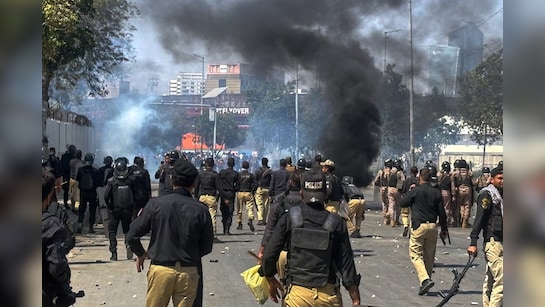
Complicating matters further is Pakistan’s contradictory posture. Though the U.S. often describes Pakistan as a trusted ally, anti-American protests reportedly erupted in Karachi, including attacks on U.S. diplomatic premises. These actions were allegedly encouraged by supporters of the controversial self-promoted army chief as Field Marshal, Asim Munir, whose domestic standing has weakened. Such violent street reactions expose the fragility of Washington’s alliances in the region. Public sentiment in Pakistan often diverges sharply from official diplomatic language. Contrast this with India. Protests against Khamenei were witnessed in several Indian cities, including Jammu and Kashmir and Lucknow, but they were largely peaceful — expressions of opinion rather than orchestrated violence. That difference matters. It reflects not just political culture but state response and public discipline. India’s strategic posture has remained cautious: safeguarding its energy interests, protecting diaspora populations in the Gulf, and avoiding rhetorical entanglement in a conflict not of its making. The broader question is moral as much as strategic. Can the United States credibly champion a rules-based international order while unilaterally eliminating the head of another sovereign nation? Even adversarial leaders operate within international law frameworks that discourage targeted political assassinations and regime changes. If this precedent stands uncontested, it risks normalizing leadership decapitation as an acceptable tool of statecraft. That would be a dangerous evolution in global norms. At the same time, Iran is not an innocent actor. Its regional footprint — from Lebanon to Yemen — has long unsettled neighbours and adversaries. But responding to destabilization with regime-targeted force may ignite the very inferno Washington claims it wants to prevent. So, what next? If the U.S. truly seeks de-escalation, it must open diplomatic channels immediately — directly or through intermediaries — and signal limits to further military action. Strategic restraint now would project strength more effectively than additional strikes. Escalation may satisfy short-term optics but risks long-term entanglement. The world is watching whether this is the beginning of another endless war — or the moment Washington chooses to step back from the brink. Peace cannot be declared while missiles are still in flight.


