


Tamil Nadu is once again at the centre of a religious confrontation — and not by coincidence. The escalating battle over the Karthigai Deepam ritual at Thiruparankundram Hill has turned into a direct clash between the Hindu majority’s centuries-old religious practices and a DMK government whose ideological hostility toward Sanatana Dharma is a matter of public record.
This is the same party whose senior leaders have compared Sanatana Dharma to “dengue” and vowed to “eradicate” it. Today, that sentiment is bleeding into governance.
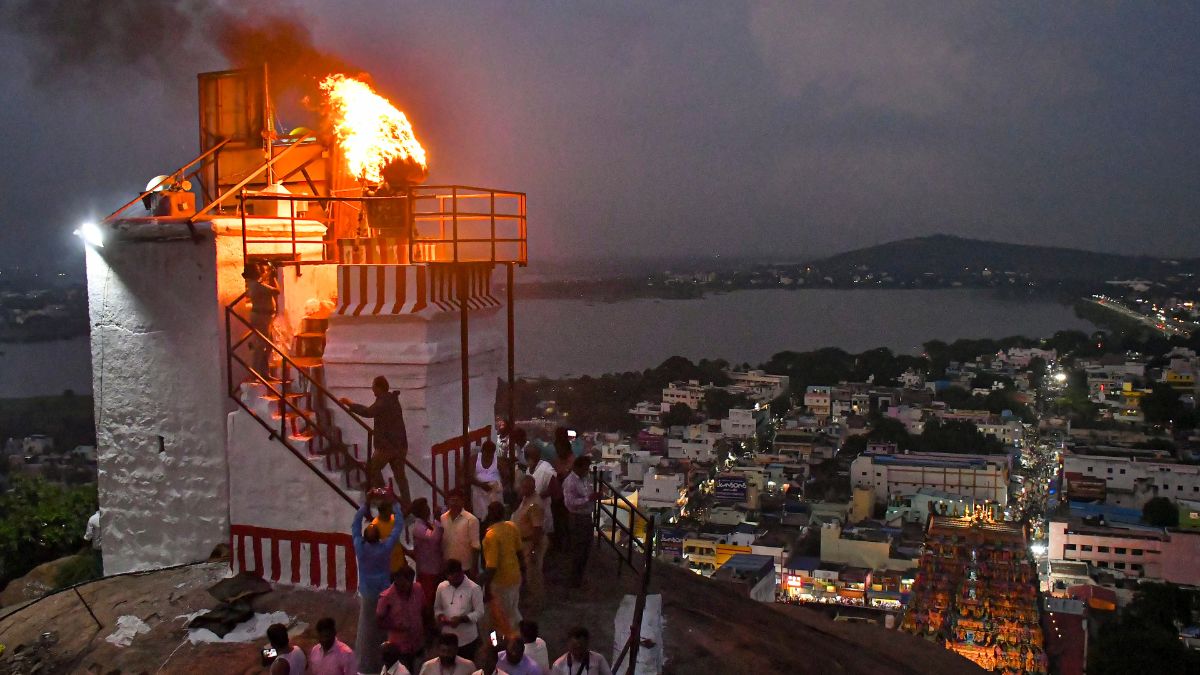
On December 1, Justice G.R. Swaminathan of the Madurai Bench permitted Hindu Tamilar Katchi founder R. Rama Ravikumar to light the ceremonial Deepam at the Deepathoon pillar atop Thiruparankundram Hill.
But on December 3 — the day of Karthigai Deepam — Tamil Nadu authorities blocked the ritual. Ravikumar filed a contempt petition, following which Justice Swaminathan authorised him and ten devotees to perform the lamp-lighting under CISF protection. Yet the police stopped them again at the foothills, claiming the state had filed an appeal.
This raised an uncomfortable but unavoidable question:
Can the executive defy a judicial order simply because it does not like it?
A Sacred Hill with an Established Legal Past
Thiruparankundram is not an ordinary hill. It is one of the Arupadai Veedu — the six sacred abodes of Lord Murugan. The site includes a rock-cut temple of great antiquity and a dargah.
Ownership disputes stretch back to 1920. A civil court, and later the Privy Council, ruled that the hill belongs to the Subramaniaswamy Temple, with limited exceptions for specific dargah-linked areas.
That judgment did not regulate ritual practices.
The dispute over the Deepam’s location began only in 1994. In 1996, the Madras High Court ruled that the lamp should “ordinarily” be lit at the traditional site near the Uchipillaiyar Kovil mandapam. That remains the only binding directive on the ritual.
Instead of facilitating the court-permitted ritual, the state government escalated the confrontation. It rushed to:
- Appeal to the Supreme Court against the contempt proceedings
- File a separate appeal before a High Court division bench
The Supreme Court has admitted the plea, and the division bench will hear the case on December 10.
This legal turbulence, however, was only the prelude.
Meanwhile, the DMK MP Kanimozhi dramatically upped the stakes by submitting an impeachment notice against Justice G.R. Swaminathan to Lok Sabha Speaker Om Birla. Over 120 MPs reportedly signed it, with Priyanka Gandhi Vadra and Akhilesh Yadav present during the submission.
This is one of the rarest and gravest constitutional steps. Impeachment is meant for proven, serious misconduct — not for rulings that displease a state government or its ideological allies.
The timing — when the judge’s orders are already under judicial review — makes the move appear less like a constitutional exercise and more like political intimidation.
The comparison may seem uncomfortable, but the echoes are unmistakable.
Ayodhya began as a dispute over faith, heritage, and historical claims — dragged into conflict by political agendas and administrative hostility.
Thiruparankundram has all the elements:
A centuries-old Murugan temple, a dargah on the same hill, clear historical precedence of the temple, and a government perceived as hostile to Hindu rights. Even the Madras High Court recently dismissed sweeping Wakf Board claims over temple lands across Tamil Nadu, reaffirming the primacy of evidence and judicial scrutiny.
In this climate, the DMK’s aggressive resistance to a Hindu tradition, combined with the impeachment attempt, risks turning a local ritual dispute into a national confrontation.
Interestingly, RSS Sarsanghchalak Mohan Bhagwat appealed for peace and an amicable resolution. Many interpret this as:
- A call to trust the judiciary as the matter moves to higher benches
- A subtle indication that Hindus must stay united, especially with elections approaching, given the DMK’s moves against a sitting judge and its clampdown on a traditional ritual
Both interpretations carry weight.
While some political groups routinely threaten street violence and challenge constitutional bodies, Hindus have historically chosen legal and democratic paths.
But what happens when even court orders become hostage to political hostility?
Today, Tamil Nadu is witnessing:
- Executive defiance of judicial directions
- Restriction of a religious ritual followed for generations
- A sitting High Court judge facing impeachment over an inconvenient order
- A government using constitutional weapons to target perceived ideological adversaries
If this trajectory continues, Thiruparankundram may well become another Ayodhya-like reckoning — a reminder that majority religious rights, too, are constitutional rights, not political dispensations.
The judiciary must be allowed to function freely.
Devotees must be allowed to practise their faith without interference.
And the Constitution must not become a toolkit for political vendetta.
Only then can Tamil Nadu step back from the edge it is dangerously approaching.


