



There is something almost poetic about the Congress party’s latest outrage. Prime Minister Narendra Modi’s scheduled visit to Israel on February 25 has sent sections of the “grand old party” into a predictable fit of moral panic. One would think the Prime Minister was planning to relocate Seva Path (new address from South Block) to Tel Aviv rather than engage in strategic diplomacy.
Leading the charge, as usual, is Congress general secretary and communications in-charge Jairam Ramesh. In his latest tweet, he questioned the timing and optics of Modi’s Israel visit, implying that it signals insensitivity to wider geopolitical tensions. The tone was familiar — part moral sermon, part political sniping, and entirely predictable.
Yet outrage has long replaced introspection in Congress politics.
After repeated electoral setbacks and shrinking national footprint, one would expect a serious course correction. Instead, the party appears trapped in a loop where every foreign visit by Modi becomes a pretext for domestic point-scoring. The inability to defeat him at the ballot box has morphed into a reflexive need to question every handshake abroad.
Let us deal with the substance.
India–Israel ties are not an invention of Modi. Diplomatic relations were formally established in 1992 under a Congress government. What has changed in the past decade is not the existence of the relationship but its confidence and visibility. Under Modi, India shed the old hesitations that treated engagement with Israel as something to be conducted in whispers.
When Modi visited Israel in 2017 — the first standalone visit by an Indian Prime Minister — it marked a shift from diffidence to clarity. Defence cooperation, agricultural technology partnerships, water management collaboration, and counter-terror intelligence sharing have since deepened. For a country facing cross-border terrorism and water stress, these are not ideological luxuries; they are strategic necessities.
To question engagement with Israel per se is to question a bipartisan policy that has endured for over three decades. If Jairam Ramesh’s concern is about balance in West Asia policy, the record shows that India has maintained relations across the spectrum — from Israel to the Gulf nations to Iran — based on national interest rather than ideological posturing.
That recalibration owes much to External Affairs Minister S. Jaishankar, whose articulation of “India First” diplomacy has given coherence to foreign policy. The results are measurable. India has signed trade agreements, strengthened defence partnerships, evacuated citizens from conflict zones with precision, and asserted itself in multilateral forums with confidence.
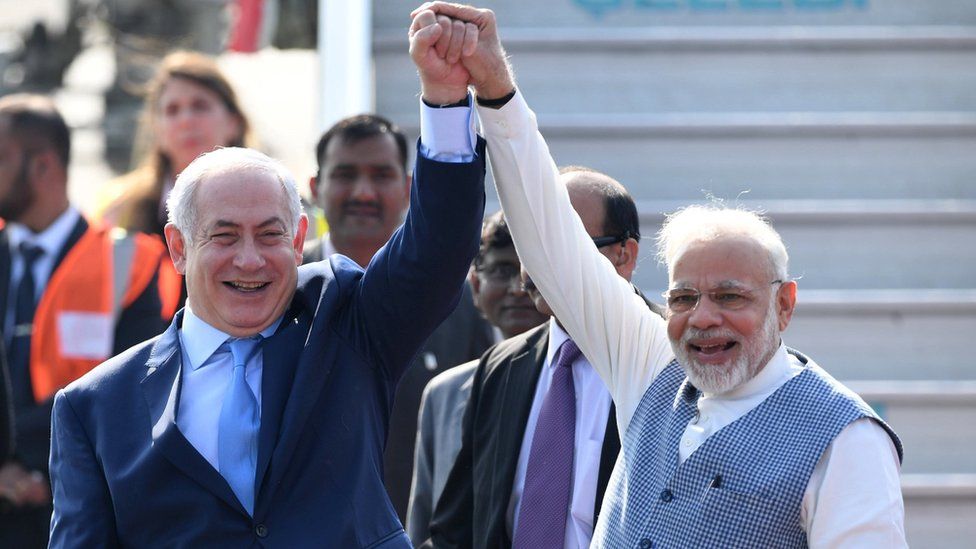
Contrast this with the Congress era’s often apologetic diplomacy — cautious to the point of paralysis, anxious about international opinion, and perpetually worried about domestic vote-bank optics. Under Modi, foreign policy has moved from performative neutrality to pragmatic engagement.
The irony is rich. The same party that once established relations with Israel now treats a prime ministerial visit as a provocation. The same leaders who defended decades of strategic ambiguity now bristle at strategic clarity.
Criticism in a democracy is healthy. But criticism divorced from context becomes theatre. Jairam Ramesh’s tweet may earn applause within echo chambers, but it does little to explain how disengagement from Israel would serve India’s security, technology needs, or economic interests.
Take the larger picture. India today engages simultaneously with the United States, Russia, Israel, the Gulf, Europe, and the Global South without being trapped in Cold War binaries. It buys oil where necessary, weapons where required, technology where beneficial, and goodwill where possible. That is not ideological drift; it is strategic maturity.
Meanwhile, Congress appears unwilling to confront a harder truth: personal hostility toward Modi is not a substitute for policy articulation. The obsession is no longer ideological; it is psychological. Every diplomatic outreach becomes a canvas for domestic resentment.
History offers lessons. When senior Congress leader Mani Shankar Aiyar mocked Modi as a “chaiwala” and later made controversial remarks abroad, the fallout strengthened Modi’s narrative of elitism versus aspiration. Political condescension has repeatedly boomeranged.
The current outrage over Israel risks a similar miscalculation. Indian voters are not naïve. They understand that foreign policy is about national interest, not social media signalling.
If Congress wishes to rebuild credibility, it must move beyond reflexive opposition. Question policies, by all means. Offer alternatives. Present a coherent West Asia strategy of your own. But reducing diplomacy to tweet-length indignation only reinforces the perception of a party unwilling to evolve.
Modi’s visit to Israel will be judged by outcomes — strategic cooperation, economic benefit, and diplomatic balance. That is how foreign policy should be assessed.
Outrage may trend for a day. National interest endures far longer.


