



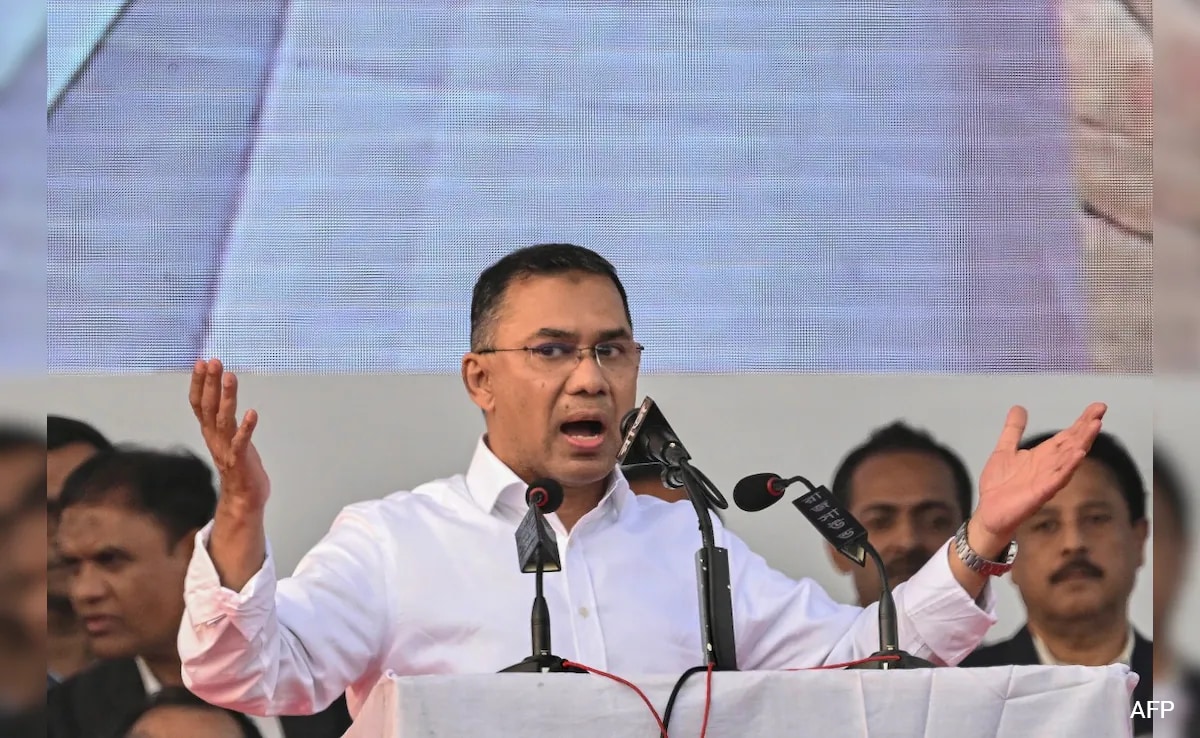
The sweeping electoral victory of the Bangladesh Nationalist Party has fundamentally altered Bangladesh’s political landscape. At the center of this shift stands Tarique Rahman, who returned from nearly two decades of exile just before the passing of his mother, former Prime Minister Khaleda Zia.
Crucially, the caretaker administration led by Muhammad Yunus withdrew the legal cases that had once defined Rahman as a fugitive. Cleared of convictions, he re-entered national politics not as an accused absentee but as a vindicated contender — and now as the dominant political force.
The immediate question is unavoidable: Does BNP’s victory restore healthier relations with India, or does it reopen strategic uncertainty?
As far as India, its response was guarded. The External Affairs Ministry, which is monitoring closely the election results, chose to adopt ‘wait and watch’ how things are likely to pan out in next couple of days. “India is in no hurry. Let us wait how the BNP, which swept the polls going to behave,” was the response of a MoE spokesperson.
Meanwhile, a confident Rahman has publicly promised that there will be no politics of revenge. That pledge now faces its first moral examination.
If Yunus’s interim government could withdraw cases against him, will Rahman reciprocate by withdrawing politically motivated cases against Sheikh Hasina foisted by the Yunus caretaker government? Will he lift restrictions or bans on her party and guarantee her safe political participation?
Bangladesh’s political history has been trapped in cycles of retaliation between the BNP and the Awami League. Each transition of power has often meant prosecution, exile, or marginalisation of the other side. If Rahman truly intends to break that cycle, this is the moment.
Failure to do so would suggest continuity disguised as change.
Yunus: Marginalised or Empowered?
Another pressing question is the future role of Muhammad Yunus. His caretaker government’s decisions — including the withdrawal of cases against Rahman — enabled BNP’s resurgence. Yet Yunus also adopted rhetoric that raised eyebrows in New Delhi, including statements interpreted as hostile toward India’s strategic interests.
Particularly alarming were references to India’s vulnerable Siliguri Corridor — the so-called “Chicken’s Neck” — which connects mainland India to its northeastern “Seven Sisters” states. Any suggestion of strategic pressure there inevitably triggers security concerns in New Delhi.
Will Rahman distance himself from such rhetoric? Or will he allow Yunus to remain influential in shaping foreign policy?
If Yunus continues to play a political role, Rahman must clarify whether Bangladesh’s strategic compass will tilt toward confrontation or balance.
India-Bangladesh Relations: From Dependency to Parity?
Under Sheikh Hasina, Dhaka maintained close alignment with India. Security cooperation deepened. Insurgent safe havens targeting India’s Northeast were dismantled. Connectivity projects flourished.
BNP historically had a more strained relationship with India, particularly during its 2001–2006 tenure. Rahman now promises a relationship based on “mutual respect” and “equality,” rejecting what BNP supporters describe as excessive proximity under Hasina.
That, framing matters.
Bangladesh is India’s largest trading partner in South Asia. Cross-border energy cooperation, rail links, river transport and digital connectivity have grown significantly over the past decade. Neither country benefits from regression.
However, Rahman has signalled tougher positions on:
- Teesta river water-sharing
- Border shootings involving India’s Border Security Force
- Migration and infiltration
These are legitimate sovereign concerns. But tone will determine trajectory. Assertive negotiation differs from antagonistic politics.
The China–Pakistan Question
Bangladesh, like many South Asian nations, engages economically with China. That in itself is not extraordinary. The issue becomes strategic if Dhaka reorients security partnerships in ways that undermine India’s interests.
More sensitive is any overt political warmth toward Pakistan. The memory of 1971 remains foundational to Bangladesh’s identity. Pakistan’s military crackdown on Bengalis led to mass atrocities before India intervened militarily to secure Bangladesh’s independence.
Any perception that Dhaka is drifting into a China–Pakistan axis aimed at balancing India would immediately strain relations. Rahman must therefore walk a careful line: sovereign diversification without strategic provocation.
Another flashpoint could be the status of Sheikh Hasina if legal proceedings continue in absentia. If BNP aggressively pursues extradition from India, bilateral ties could face friction. Extradition is not merely political; it involves treaty obligations, humanitarian considerations and judicial review.
Rahman must weigh domestic political satisfaction against long-term diplomatic stability.
Can BNP Deliver Stability?
BNP’s victory reflects voter fatigue with prolonged political polarization. But sweeping polls bring responsibility.
Bangladesh’s economy faces inflationary pressures, external debt obligations and export competitiveness challenges. Political instability would deter investors and weaken its manufacturing-driven growth model.
For India, stability in Bangladesh is not a luxury — it is a strategic necessity. The 4,000-kilometer border makes security interdependence unavoidable. Cooperation against extremism and insurgency has been one of the strongest pillars of bilateral trust over the past decade.
If Rahman preserves that security architecture while negotiating harder on economic and water-sharing issues, relations could evolve into a more balanced, mature partnership.
If, however, rhetoric about the “Chicken’s Neck” resurfaces or strategic flirtation with anti-India blocs intensifies, mistrust will return quickly.
Tarique Rahman has been given what few exiles receive — political redemption through the ballot box.
He can now prove that his return marks institutional evolution rather than partisan revenge.
He can choose reconciliation over retaliation.
Balance over brinkmanship.
Sovereignty without hostility.
For Bangladesh, this election is about democratic reset.
For India, it is about strategic recalibration.
Whether BNP’s victory becomes a bridge — or a fault line — depends entirely on what Rahman does next.


Very cautiously analysed article. If BD gets closer to Pak with an aim to intimidate India, it will boomerang for both the Muslim countries. In fact it will be suicidal for Bangladesh in doing so. Hope sweeping win will not make the rulers heady and arrogant. Wisdom is the need of the hour for BD in a precarious situation the country finds itself right now, though a shade better than Pakistan