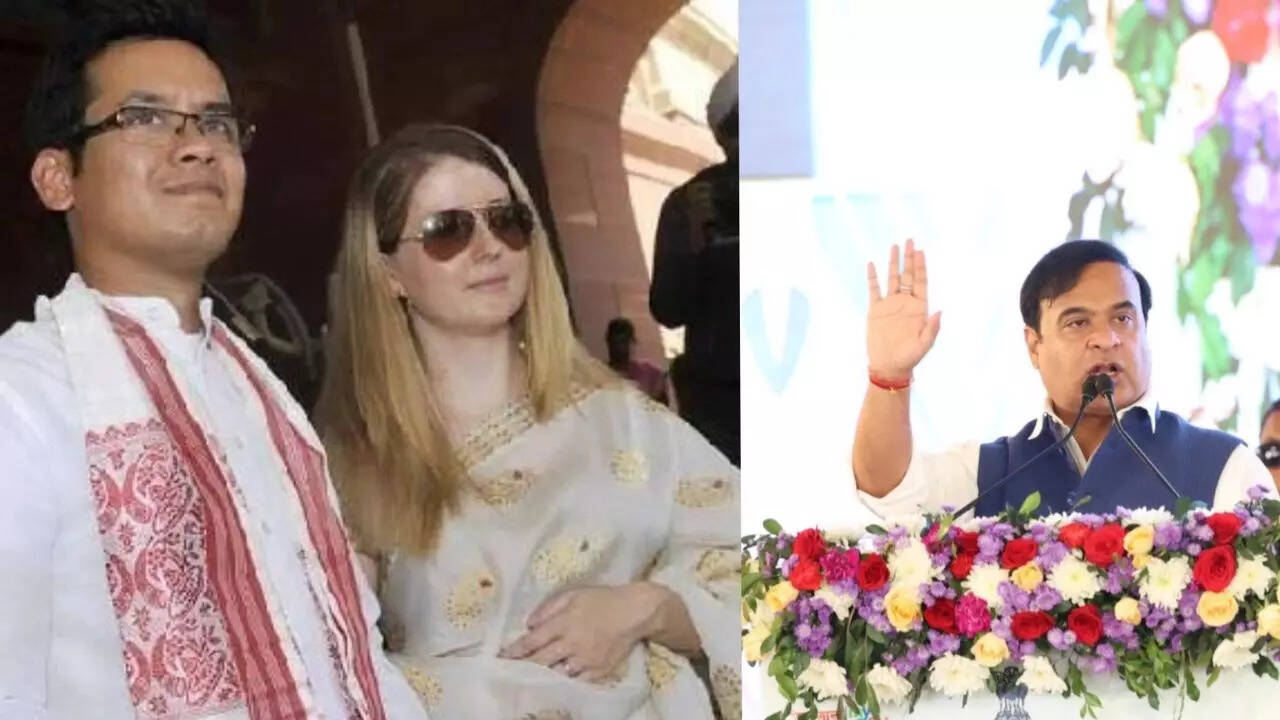
By any measure, Assam Chief Minister Himanta Biswa Sarma’s nearly hour-long press briefing on the findings of a Special Investigation Team (SIT) has pushed the Congress MP Gaurav Gogoi into the eye of a political and national-security storm. The Chief Minister did not merely trade in insinuations; he chose to publicly outline what he described as documentary evidence gathered by the Assam Police SIT regarding the alleged links of Gogoi’s British-born wife with Pakistan-based institutions, including individuals said to be associated with Pakistan’s Inter-Services Intelligence (ISI).
Gogoi’s immediate response—threatening legal action against the Assam government—may play well as a political counterpunch, but it does little to address the substance of the allegations now placed before the public.
At the heart of the controversy lies the SIT’s claim that Gogoi’s wife was, at various points, on the payroll of Pakistan-linked organisations and was engaged with entities that, according to Assam Police, have documented connections to Pakistan’s intelligence ecosystem. These are not charges framed in a courtroom yet, but they are not casual accusations either—at least as per the Chief Minister’s assertion that the SIT’s findings are “clinching, irrefutable, and backed by documentary proof.”
Crucially, Sarma went on record to say that the evidence gathered would withstand legal scrutiny, a statement he would not make lightly, given the political and legal consequences of being proven wrong.
One of the most troubling assertions made during the briefing related to Gogoi’s own presence in Pakistan. According to Sarma, the Congress MP is alleged to have spent nearly a month there and had reportedly told local media that the visit coincided with his wife’s stay in Pakistan. However, the SIT claims to have evidence suggesting that during the same period, his wife was actually in New Delhi. If true, this discrepancy raises serious questions: Why was the explanation offered to the media inconsistent with verifiable travel records? And what was the precise nature and purpose of the MP’s extended stay in Pakistan?
These are not questions that can be brushed aside as political vendetta, especially in a country that has endured decades of cross-border terrorism and intelligence warfare.
To be fair, it must be stated clearly: allegations are not convictions. Neither Gaurav Gogoi nor his wife has been found guilty of any offence by a court of law. Political leaders are entitled to the presumption of innocence, and reckless conclusions would be both unjust and irresponsible. Yet, public accountability demands that when allegations intersect with national security, silence or legal threats alone are insufficient responses.

What strengthens the gravity of the issue is the Assam cabinet’s reported decision to hand over the matter to central agencies. This move, the Chief Minister argued, is essential because central agencies possess greater jurisdiction and capacity to seek cooperation and verification from foreign institutions and governments—something a state police force cannot effectively do on its own. If the allegations are baseless, a central probe would logically exonerate Gogoi. If they are not, the nation deserves to know.
This is where the Congress MP’s strategy appears weak. Announcing legal action without simultaneously offering transparent explanations—travel records, timelines, or clarifications—creates an impression of deflection rather than confidence. Courts are indeed the right place to settle such matters, but public representatives also owe answers to the citizens who elect them.
The political implications are undeniable. Gogoi is not a fringe figure; he is a prominent Congress MP and the son of former Assam Chief Minister Tarun Gogoi. Any suggestion—however preliminary—of proximity to hostile foreign actors naturally invites heightened scrutiny. Crying “political conspiracy” may be instinctive, but it cannot substitute for verifiable rebuttal.
Chief Minister Sarma, for his part, has put his credibility on the line by openly endorsing the SIT’s work and praising its officers for gathering what he described as legally robust evidence. If these claims unravel, the blowback will be severe. But if they hold, the episode will raise uncomfortable questions not just about one MP, but about political vetting, accountability, and national security vigilance.
In the end, holding threats of legal action takes no one very far. What the situation demands is clarity, cooperation with investigators, and faith in due process. If Gaurav Gogoi is innocent, a transparent probe—state or central—will vindicate him. If not, the law must take its course, regardless of political pedigree.
In a democracy, no accusation should become a verdict without trial. But equally, no serious allegation touching the nation’s security should be dismissed as mere politics. The truth, when tested in law, will speak for itself.