



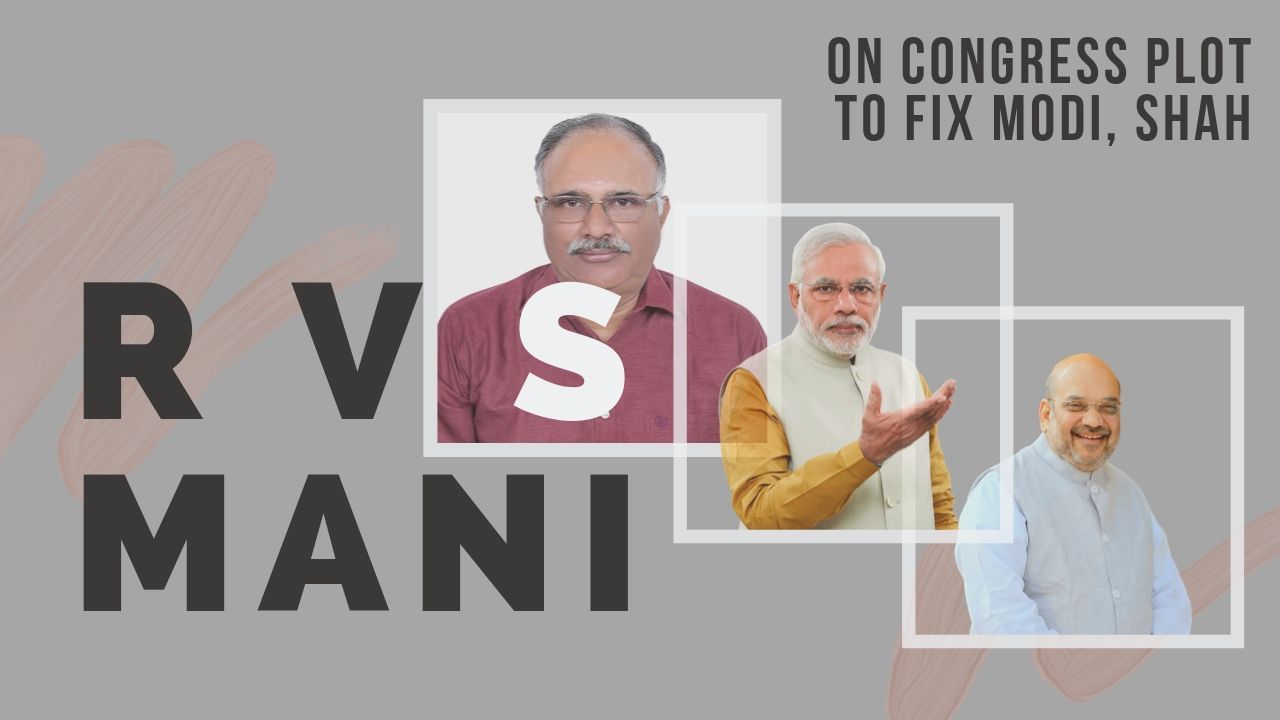
The Opposition’s furious reaction to the Modi government honoring R.V.S. Mani, a former senior officer in the Ministry of Home Affairs (with G.M. Pillai then serving as Home Secretary and P. Chidambaram as Home Minister), with a Padma award reveals less about the man himself and more about the fragility of a political narrative that has long gone unquestioned. Mani is not being attacked for any failure in public service. He is being targeted for something far more unsettling to his critics: what he chose to write after retirement.
In his memoir, A Life in the Indian Police Service, Mani lifts the curtain on one of the most contentious chapters in India’s internal security discourse—the emergence of the so-called “saffron terror” theory during the UPA years. His account is not polemical. It is bureaucratic, precise, and damning in its simplicity. Mani states that he was pressured by the political leadership of the time to sign and endorse reports that pushed a predetermined narrative, even when, in his assessment, the available evidence did not conclusively support it.
That revelation alone should have triggered a serious institutional debate. Instead, it has triggered a political tantrum.
Let us be clear about who Mani is—and who he is not. He was not a political appointee. He was not a television pundit. He was a career civil servant inside the Home Ministry, part of the machinery that processed intelligence inputs, investigative reports, and internal security assessments at the highest levels. His job was to evaluate, not evangelize. To record, not to campaign.
In his book, Mani recalls how the push to frame certain terror incidents through a communal lens came from the top of the political hierarchy. He writes of being asked to put his signature on drafts that, in his view, overstated the role of Hindu organizations while downplaying unresolved investigative gaps. His refusal, he suggests, was met with professional sidelining—transfers, isolation, and a clear message that compliance, not caution, was the preferred administrative posture.
This is where the name P. Chidambaram enters the picture.
As Home Minister during a crucial phase of this period, Chidambaram was the political face of the internal security establishment. Publicly, he advanced the “saffron terror” line in speeches and statements, framing it as a necessary corrective to what he described as a narrow understanding of extremism. Privately, Mani’s account suggests, the bureaucracy was being nudged to align paperwork, language, and official records with that political framing.
These are not casual allegations. They strike at the heart of how a democracy should handle national security: evidence first, narrative later—not the other way around.
Yet, instead of answering the substance of these claims, the Opposition has chosen to attack the symbolism of the Padma award itself. The argument goes like this: Mani is being “rewarded” for writing a book that flatters the current regime and embarrasses the previous one.
That line of attack conveniently sidesteps the real issue. If Mani’s account is false, distorted, or selectively edited, where is the factual rebuttal? Where are the files, the memos, the internal notes that prove the investigative process was entirely insulated from political influence? Why has the response been rhetorical outrage rather than documentary evidence?
The irony is striking. The same political voices that routinely invoke freedom of expression and institutional independence now appear deeply uncomfortable when a former insider uses that freedom to document dissent from within the system.
The Padma award, in this context, has become more than a civilian honor. It has become a lightning rod for a deeper conflict over historical memory. One side wants the UPA-era security narrative preserved as settled truth. The other is forcing open the archives of lived administrative experience and asking uncomfortable questions about how that truth was constructed.
Mani’s book does not claim to be the final word. It is one man’s record of what he saw, heard, and was asked to do while serving in the Home Ministry. But in a democracy, such records are not dismissed—they are examined, debated, and, if necessary, challenged with facts.
By choosing to vilify the messenger instead of interrogating the message, the Opposition risks confirming the very suspicion Mani raises: that certain narratives were not just defended politically, but protected institutionally.
In the end, this controversy is not about a medal pinned on a retired officer’s chest. It is about who controls the story of a critical decade in India’s fight against terror—those who held political office, or those who worked behind the scenes to turn political direction into administrative action.
And perhaps that is precisely why R.V.S. Mani’s words, and now his recognition, have struck such a raw nerve.


