



There was a time when the Nobel Peace Prize stood as a moral lighthouse in a stormy world — a symbol of conscience rising above convenience, principle towering over power. Today, that lighthouse flickers. And with the extraordinary spectacle of Venezuela’s opposition leader Maria Corina Machado “presenting” her Nobel Peace Prize medal to U.S. President Donald Trump, the world is left asking an uncomfortable question: has the most prestigious peace award been reduced to a political prop in a global power game?
The moment was rich in symbolism and poor in dignity. Machado, hailed by the Nobel Committee last December for “keeping the flame of democracy burning amid a growing darkness,” walked into the White House and handed her medal to a man who has spent years clamouring for the same honour. She called it recognition for Trump’s “unique commitment to our freedom.” Trump, never one to miss a moment of self-congratulation, announced to the world that he had been “presented” with a Nobel Peace Prize — as if history itself had finally bent to his will.
But history doesn’t bend. It records. And what it records here is not a triumph of peace, but a farce of optics.
Let’s be clear: Nobel rules are unambiguous. Once awarded, a prize cannot be transferred, shared, or revoked. It belongs, permanently and irrevocably, to the person named by the Nobel Committee. Machado did not — and could not — give Trump a Nobel Peace Prize. What she handed him was a medal. A symbol. A theatrical gesture dressed up as a moral endorsement. Yet symbolism is powerful. And this is where the real damage lies.
The Nobel Peace Prize has always been political. It is awarded in a political world for political acts. But it has traditionally aspired to rise above transactional politics. It has honoured those who bridged divides, ended wars, freed prisoners of conscience, and challenged tyranny at personal cost. When a laureate turns that honour into a bargaining chip — a token of favour offered to a global superpower’s president — the prize itself is dragged into the mud of realpolitik.
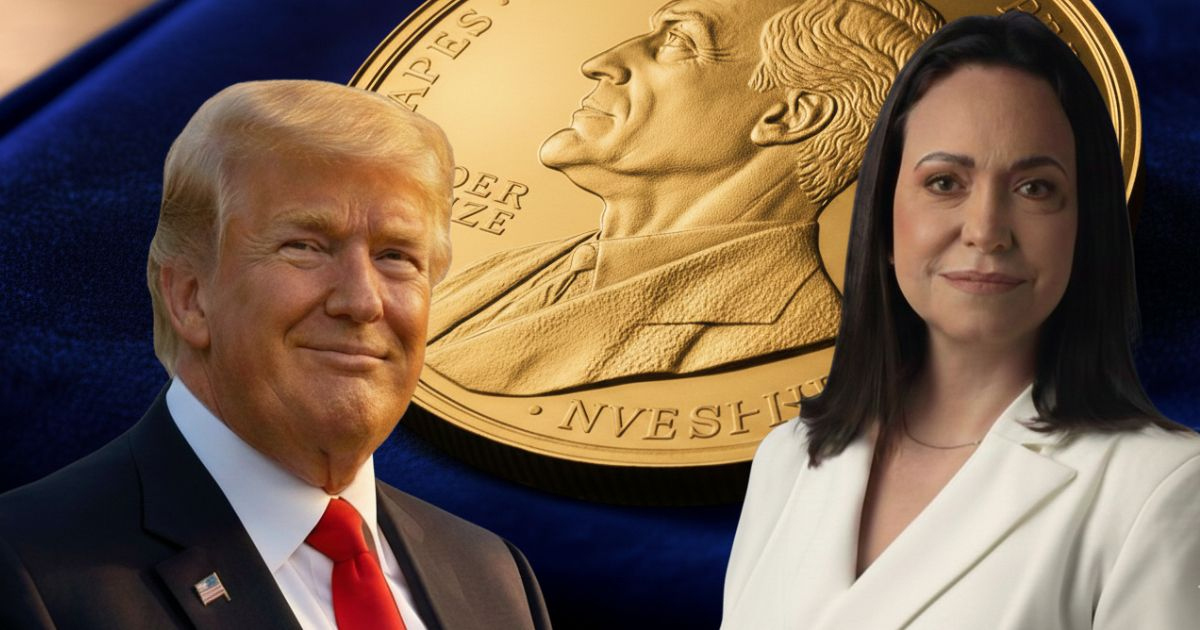
Her political calculus is plain. Trump, after ordering the dramatic capture of Venezuela’s strongman Nicolás Maduro, publicly dismissed Machado as lacking the support and respect needed to lead her country. He went so far as to praise Delcy Rodríguez, the acting president, calling her a “terrific person.” In that context, the Nobel medal becomes less a tribute and more a diplomatic offering — a golden olive branch extended to a man whose backing could make or break her political future.
CNN’s Kaitlan Collins put it bluntly: Machado wants to run Venezuela. The medal, then, is not just a symbol of peace — it is a currency of influence.
And Trump? He is a willing participant in the spectacle. For years, he has insisted he deserves the Nobel Peace Prize, claiming credit for ending wars and stabilizing conflicts. His supporters echo the claim; his critics mock it. But the record remains contested. Conflicts rage on — from Eastern Europe to the Middle East — and the world is no closer to the era of peace his rhetoric promises.
This is where the irony cuts deepest. The Peace Prize was conceived as a rebuke to militarism and coercion. Yet here it is, invoked in the same breath as military operations, regime change, and geopolitical muscle-flexing. When a prize meant to celebrate non-violence becomes entangled with power politics, it ceases to be a moral compass and becomes a stage prop.
The Nobel Committee, to its credit, rushed to clarify the rules. The prize cannot be transferred. The decision is final. The honour remains Machado’s, regardless of where the medal travels. Past winners have sold or loaned their medals; some have auctioned them for charity. But none have attempted to recast the act as a symbolic crowning of another world leader.
Because what is really being transferred here is not gold, but legitimacy. The visual of a Nobel laureate placing the medal in the hands of a sitting U.S. president sends a message — deliberate or not — that the moral authority of the prize is being lent, if not legally then theatrically, to a political figure whose global record remains deeply polarising.
For Trump, it is validation. For Machado, it is leverage. For the Nobel Peace Prize, it is erosion.
Awards derive their power from restraint. From the idea that they cannot be bent to personal ambition or political convenience. Once they are seen as tools to curry favour or score diplomatic points, they lose the very sanctity that makes them worth chasing in the first place.
The Nobel Committee now finds itself in an awkward position. It insists — rightly — that it does not comment on what laureates do after receiving their awards. But silence, in moments like this, can sound like indifference. When the world’s most famous peace honour is paraded through a geopolitical chess match, the institution that guards it cannot afford to appear detached. This episode should force a moment of reckoning.
Is the Nobel Peace Prize still a moral benchmark? Or has it become another trophy in the theatre of global politics, waved around for headlines, hashtags, and strategic handshakes?
Machado may keep her title. Trump may keep the medal. But the real casualty here is the credibility of an award that once stood above such games.
In trying to crown a king of her own choosing, Machado may have done something far more consequential: she has reminded the world how fragile even the most revered symbols can be when ambition outweighs principle.
And if the Nobel Peace Prize can be turned into a bargaining chip in a political negotiation, then perhaps the most uncomfortable question is not whether Trump deserves it — but whether the world still deserves to believe in what it stands for.


