



India today stands at a dangerous crossroads—externally challenged, internally tested, and geopolitically squeezed at a moment when hesitation could prove fatal. What is unfolding around us is not a series of disconnected events but a pattern—one that New Delhi can no longer afford to ignore or downplay.
Reports emerging from Bangladesh over the past weeks have deeply disturbed observers across the region. Multiple Hindu families have allegedly been targeted in communal attacks, with houses torched, temples vandalised, and civilians killed by radical Islamist elements. While precise numbers vary across reports, what remains indisputable is this: the Hindu minority in Bangladesh is under renewed and systematic pressure, and the response of Dhaka has been at best indifferent and at worst evasive.
What makes the situation more alarming is the political context. Bangladesh is currently being run by a caretaker dispensation headed by Muhammad Yunus—installed amid political turbulence and enjoying conspicuous goodwill from Western capitals. Yet, instead of restoring order and protecting minorities, the administration has appeared reluctant to act decisively against Islamist violence.
India must ask an uncomfortable but necessary question:
Why does the global democratic conscience fall silent when Hindus are targeted?
The United States has never hesitated to issue warnings, impose sanctions, or even conduct direct operations when it perceives instability or human rights violations in regions aligned against its interests—be it Iran, Venezuela, or elsewhere. India is not asking for military adventurism. It is asking for moral consistency.
If New Delhi cannot even issue a firm diplomatic warning to Dhaka demanding protection for Hindu minorities, then what message does that send—not just to Bangladesh, but to every hostile actor watching India test its own red lines?
Even as India watches its eastern flank burn, a familiar script is playing out at home.
Organised protests erupt suddenly at elite campuses. Slogans echo that question India’s sovereignty, its institutions, and its civilisational foundations. Jawaharlal Nehru University—once a centre of academic excellence—has repeatedly become a stage for political theatre rather than scholarship. These protests are not spontaneous eruptions of student angst; they are methodically mobilised, professionally amplified, and internationally echoed.
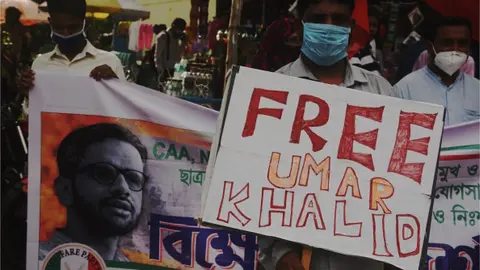
This is not conjecture. Similar protest ecosystems have been documented globally—from the Arab Spring to Hong Kong—where local grievances are magnified into regime-destabilising movements through funding networks, media amplification, and NGO activism. India is not immune to such tactics.
Within strategic and political circles, there is growing discussion—not proof, but apprehension—that India is being subjected to a long-term destabilisation strategy. This fear is sometimes loosely referred to as “Operation 37”—not as an established intelligence operation, but as shorthand for a perceived attempt to fracture India politically, socially, and electorally.
The alleged tools of such destabilisation are not tanks or missiles, but division, diversion, and deception:
- Division by fragmenting Hindu society—caste against caste, region against region, ideology against ideology.
- Diversion by pulling attention away from governance and development toward manufactured controversies.
- Deception by spreading narratives that weaken trust in institutions—courts, the Election Commission, the armed forces.
Recent events fuel these anxieties:
Attempts to provoke caste fault lines, sudden controversies around reservations, orchestrated farmer agitations with opaque leadership structures, and calculated cultural provocations—including deliberate insults to Hindu religious sentiments.
Whether one accepts the “Operation 37” thesis in totality or not, the pattern of pressure is undeniable.
Another concern frequently raised is the possibility of strategic diversion through external conflict. India’s adversaries would benefit immensely if New Delhi were dragged into a prolonged, resource-draining confrontation—whether through Pakistan-sponsored terrorism or border tensions—precisely when India is emerging as a global manufacturing and geopolitical alternative.
The Ukraine-Russia conflict has shown how wars can be prolonged to exhaust nations economically and socially. India must be vigilant against being pushed into similar traps.
Narendra Modi represents more than an individual leader. He symbolises India’s refusal to remain perpetually apologetic, dependent, or directionless. Under his leadership, India has asserted itself—diplomatically, economically, and civilisationally.
India’s growth trajectory, demographic strength, and strategic autonomy challenge entrenched global hierarchies. It is therefore naïve to believe that resistance will not come from within and without.
This does not mean indulging in paranoia. It means recognising that power attracts opposition, and progress provokes pushback.
This is not a call for violence. Not a call for suppression of dissent. And certainly not a call for reckless confrontation.
It is a call for clarity.
- Clarity that minority persecution in Bangladesh is unacceptable.
- Clarity that foreign silence will be called out.
- Clarity that India’s internal divisions will not be exploited.
- Clarity that Hindus, as a civilisational community, must remain united, vigilant, and politically aware.
History teaches us a brutal lesson: civilisations do not collapse because of external attacks alone—they fall when internal fractures are exploited, and leadership hesitates.


