



The Congress-led Opposition’s latest spectacle of a so-called “public impeachment” of the Chief Election Commissioner (CEC) exposes its constitutional duplicity in all its glory. The very leaders who brandish pocket-sized copies of the Constitution, theatrically proclaiming “Samvidhan khatre mein hai” (the Constitution is in danger), appear unwilling to respect the constitutional procedures they claim to defend. Since when did the Bharatiya Constitution recognise street demonstrations as a mechanism for impeaching a constitutional functionary? Political protests are a democratic right; inventing constitutional terminology to dress up a political campaign is quite another matter. The Constitution does not provide for any such thing as “public impeachment”. The removal of the CEC is governed by Article 324(5), which prescribes a process equivalent to that applicable to a Supreme Court judge. It is Parliament, acting through the prescribed constitutional procedure, and not a political rally, that can initiate and complete such removal. The President and constitutional courts, too, are governed by their respective removal procedures. No amount of sloganeering, celebrity-lawyer participation or mobilisation of crowds can substitute for these constitutional safeguards. If the Opposition’s eminent legal luminaries are lending their weight to a campaign branded as “public impeachment”, the obvious question is whether they are advancing a legally recognised process or merely lending constitutional respectability to a political stunt. The Constitution is neither a campaign prop nor a document whose provisions can be rewritten to suit the convenience of those who find constitutional institutions inconvenient.
The timing of the Congress-led INDIA bloc’s November 1 mobilisation also invites scrutiny. The Delhi High Court is scheduled to hear the Enforcement Directorate’s challenge in the National Herald case on November 2, following the October 12 hearing in which it declined to stay the process concerning the release of Associated Journals Limited properties. The ED has challenged the lower court’s December 16, 2025, decision declining to take cognisance of its chargesheet. Against this backdrop, the sequence of political mobilisation—October 10 at Jantar Mantar, the October 12 protest outside the Supreme Court and now the November 1 gathering—raises legitimate questions about the
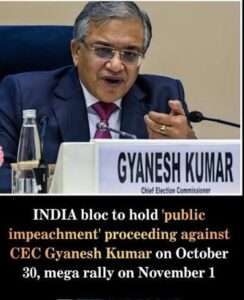
Opposition’s strategy. The proximity of a political demonstration to a judicial hearing does not, by itself, establish an attempt to intimidate the judiciary. Yet, when political pressure campaigns repeatedly coincide with sensitive legal proceedings, the Opposition owes the public an explanation of its intentions. The reported appeal by Delhi traders to spare them disruption during the Diwali business season adds another uncomfortable dimension to the proposed mobilisation. Is the Opposition genuinely defending constitutional institutions, or is it using the language of constitutional peril to advance a political narrative at a particularly convenient moment? That question deserves an answer.
The irony is inescapable. Those who accuse their political opponents of undermining the Constitution cannot claim immunity from its provisions. Constitutional morality demands restraint, institutional respect and adherence to due process—even when the institutions involved deliver outcomes one dislikes. The Opposition is free to criticise the CEC, question electoral decisions and organise peaceful protests. But it cannot manufacture a constitutional procedure that does not exist and then claim to be the Constitution’s most ardent defender. The Constitution is not in danger merely because the Opposition says so; its credibility is endangered when those invoking it treat its safeguards as optional and its institutions as instruments of political convenience.