



Nestled amidst the Aravalli hills near Sariska in Alwar district of Rajasthan, Shri Bhartrhari Nath Temple, popularly known as Bharthari Dham, is an important pilgrimage centre of the Nath Sampradaya. The sacred shrine is associated with Raja Bhartrhari of Ujjain, who is traditionally believed to have renounced his kingdom, accepted Guru Gorakhnath as his Guru and spent the later part of his life as a yogi in this region. The temple is surrounded by hills and forests, giving the place a serene and spiritual atmosphere.
The exact age of the present temple structure is not clearly established. The sacred site itself is regarded as an ancient place of worship, and the tradition of Bhartrhari’s samadhi has been preserved here for many generations. The present temple was given a new form by Maharaja Jai Singh in 1924. Thus, while the present structure dates from the early 20th century, the sacred tradition and pilgrimage associated with Bhartrhari Nath are considered much older.
The principal object of worship is the sacred samadhi of Baba Bhartrhari Nath, revered as a great yogi of the Nath tradition. Bhartrhari is traditionally remembered as the king of Ujjain who renounced his royal life and became a disciple of Guru Gorakhnath. Devotees worship his samadhi as the continuing spiritual presence of the great Nath yogi.
Two important symbols of the Nath tradition are also preserved at the shrine. The Dhuni is the sacred fire traditionally maintained by Nath yogis, while the Akhand Jyoti is a continuously burning sacred lamp. Both are maintained with great reverence and symbolise the uninterrupted spiritual tradition of the shrine.
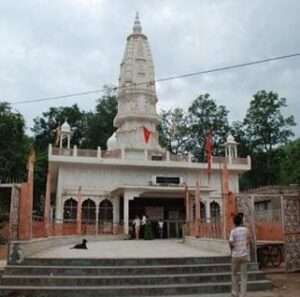
The temple stands in a beautiful natural setting among the Aravalli hills near the Sariska region. The shrine constructed over Bhartrhari’s sacred samadhi follows traditional Rajasthani architectural features, with the temple structure and surrounding mandap areas blending naturally with the rocky and forested landscape.
The temple complex has developed around the samadhi site and includes other small shrines in the surrounding area. The combination of the ancient sacred spot, traditional temple structure and the surrounding hills gives Bharthari Dham a distinctive atmosphere quite different from a conventional urban temple.
Raja Bhartrhari is traditionally remembered as the king of Ujjain and the elder brother of the legendary Vikramaditya. His story occupies an important place in the folklore and spiritual traditions of North India and particularly in the Nath Sampradaya.
Bhartrhari was once deeply attached to his royal life and to his queen Pingala. A series of events eventually made him realise the temporary nature of worldly relationships and royal pleasures. He renounced his kingdom and turned towards the path of spiritual liberation.
He subsequently accepted Guru Gorakhnath as his spiritual master and became a Nath yogi. After leaving behind his royal life, Bhartrhari travelled to secluded places where he devoted himself to yoga, meditation and severe austerities.
According to the tradition of Bharthari Dham, Bhartrhari eventually came to the forested Aravalli hills near Alwar. He spent his later years here in tapasya and meditation, and the place became closely associated with his spiritual life and eventual samadhi. His disciples and devotees preserved the sacred spot, and over generations it developed into the important pilgrimage centre known today as Bharthari Dham.
The Sthalapurana of Bharthari Dham is closely connected with the famous story of Raja Bhartrhari and his transformation from a powerful king into a Nath yogi.
According to the Nath tradition, Guru Gorakhnath once visited the court of Raja Bhartrhari and, pleased with the king, gave him a miraculous fruit known as the Amar Phal. The fruit was believed to grant immortality or exceptionally long life to the person who consumed it.
Bhartrhari, deeply attached to his queen Pingala, decided that she should receive this extraordinary gift. However, the fruit eventually passed from one person to another through the palace and, according to the popular legend, finally returned to Bhartrhari himself. When the king discovered what had happened, he was deeply shocked and realised the uncertain and temporary nature of worldly love and relationships.
This experience changed Bhartrhari completely. He lost his attachment to royal pleasures, abandoned his kingdom and possessions and sought Guru Gorakhnath once again. Under Gorakhnath’s guidance, he entered the Nath tradition and became a yogi, devoting himself to yoga, meditation and tapasya.
Bhartrhari is then believed to have travelled to the secluded Aravalli hills near present-day Alwar. The forests, hills and natural surroundings provided him with a peaceful place for prolonged meditation. Local tradition holds that he performed intense tapasya here for many years and that this became his Tapobhoomi.
Another important local tradition is associated with a sacred water source near the temple. It is believed that the region once suffered from a severe shortage of water. Through Bhartrhari’s spiritual power and prayers, water emerged from the rocks, providing relief to the people and making the spot sacred. The water source continues to be revered by pilgrims.
Bhartrhari is traditionally believed to have attained samadhi at this sacred place. His disciples and devotees preserved the site and established his samadhi shrine, which gradually developed into Bharthari Dham. For devotees, this is therefore not merely a temple but the Tapobhoomi and Samadhi Sthal of a great Nath yogi who gave up the power of a king in search of spiritual truth.
The main festival of Bharthari Dham is the annual Bhartrhari Mela held during the Hindu month of Bhadrapada. The principal gathering takes place on Bhadrapada Shukla Ashtami, when large numbers of devotees come to the shrine to worship Baba Bhartrhari Nath and seek his blessings.
The temple also observes festivals associated with Lord Shiva during the year. The annual fair is the most important occasion at the shrine and brings together pilgrims, devotees and Nath followers from different parts of Rajasthan and other regions.

