



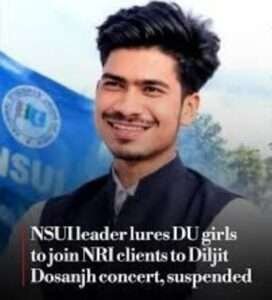
The Congress appears to be digging its own political grave, and its student wing, the National Students’ Union of India (NSUI), may just have driven another nail into the coffin. At a time when the party is desperately struggling to regain public confidence, controversies involving its senior leadership and now allegations of serious misconduct against an NSUI office-bearer have further exposed its organisational weaknesses. What should have been a platform for nurturing responsible young leaders is increasingly becoming a liability for a party already battling a credibility crisis. The latest embarrassment concerns Anas Khan, a student of Delhi University’s Ramanujan College, who was identified in an ABVP-circulated document as the vice-president of the college’s NSUI unit. Screenshots of purported WhatsApp conversations have triggered allegations that he offered female freshers monetary incentives ranging from ₹10,000 to ₹30,000, gifts, travel arrangements and VVIP access to accompany NRI clients or investors to a Diljit Dosanjh concert in Ahmedabad scheduled for November 21. The reported descriptions sought young women with a ‘good physique’ and pleasing appearance. These are deeply disturbing allegations, particularly when some of the students concerned are reportedly just 17 or 18 years old. Following a preliminary inquiry into a complaint, Ramanujan College suspended Khan until February 1, 2027, barring him from regular campus and extracurricular activities while permitting him to appear for examinations. The matter assumes greater significance because a student who reportedly exposed the messages also claimed to have received repeated calls and threats. These allegations warrant an impartial, time-bound investigation and, if substantiated, appropriate legal action. Women’s safety cannot become another casualty of student politics. Predictably, NSUI has sought to distance itself from the controversy, claiming that Khan had already been suspended during the Delhi University Students’ Union elections over indiscipline and anti-organisational activities. But this explanation raises an equally uncomfortable question: if he had already been suspended, why was his alleged association with the organisation not publicly clarified earlier? And if the ABVP-circulated document identifying him as a vice-president is genuine, who was responsible for his elevation in the first place? Simply disowning an inconvenient office-bearer after a controversy erupts is hardly an exercise in accountability.
The embarrassment comes close on the heels of another avoidable controversy involving Congress president Mallikarjun Kharge. While extending Diwali greetings, he described the festival as ‘khushiyon ka Eid’. Congress leaders, including Pawan Khera, defended the expression as an attempt to reflect India’s syncretic culture. There is nothing wrong with promoting communal harmony. But why should a festival with its own civilisational identity, traditions and significance need another religion’s terminology to convey happiness? Such unnecessary linguistic experiments only provide ammunition to political opponents and reinforce perceptions that the Congress is more concerned about political signalling than cultural sensitivity. The party’s predicament is not confined to these two incidents. Its persistent leadership contradictions, confrontational rhetoric, selective outrage and inability to maintain a consistent political narrative have steadily eroded public confidence. A national party cannot expect voters to overlook its inconsistencies merely by invoking secularism or constitutional values whenever it finds itself cornered. Nor can every criticism be dismissed as a BJP conspiracy. The Congress should also remember that its women-centric political messaging, including Priyanka Gandhi Vadra’s much-publicised ‘Ladki Hoon, Lad Sakti Hoon’ campaign, carries an obligation to practise what it preaches. Women’s dignity and safety cannot remain convenient election slogans while allegations involving those associated with its student organisation are brushed aside through organisational disclaimers. With the crucial Uttar Pradesh and Punjab Assembly elections approaching in 2027, the party can ill afford another credibility crisis. Young voters, particularly women, are unlikely to be impressed by slogans when questions of safety, dignity and accountability remain unanswered. The larger problem for the Congress is that it increasingly appears to be reacting to controversies rather than providing leadership. A party that once commanded national respect cannot survive indefinitely on its political legacy, dynastic credentials and selective moral posturing. It needs discipline, credibility and leaders who understand that public conduct matters as much as public speeches. The NSUI controversy may not, by itself, be the final nail in the Congress coffin. But unless the party stops treating every embarrassment as a public-relations inconvenience and begins cleaning up its own house, it may discover that the damage to its credibility is far more enduring than any electoral setback.