



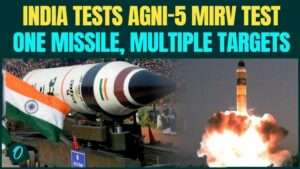
India’s latest successful test of a MIRV-capable Advanced Agni-V missile was not merely another routine missile launch. It was a strategic declaration that New Delhi is no longer content with symbolic deterrence. India is steadily building a sophisticated, survivable and technologically advanced nuclear architecture capable of standing shoulder-to-shoulder with major global powers.
Conducted from Dr. APJ Abdul Kalam Island under Mission Divyastra, the test demonstrated India’s growing mastery over one of the most complex technologies in modern warfare — Multiple Independently Targetable Re-entry Vehicle (MIRV) capability.
The significance of this achievement goes far beyond military optics. It fundamentally changes India’s strategic profile in an increasingly volatile geopolitical environment shaped by Chinese military expansion, evolving missile defence systems and intensifying nuclear modernisation across major powers.
For years, India maintained what many viewed as a restrained and modest nuclear posture. But restraint never meant technological weakness. Mission Divyastra proves that India now possesses the capability to ensure that its nuclear deterrence remains credible even in the face of rapidly changing military technologies.
What MIRV Really Means
MIRV technology is among the most sophisticated advancements in ballistic missile systems. Unlike conventional missiles carrying a single warhead, a MIRV-enabled missile can deploy multiple nuclear warheads independently towards different targets.
In practical terms, a single missile launch can simultaneously strike several strategic locations spread across vast geographical distances. Some advanced MIRV systems across the world are reportedly capable of carrying over a dozen warheads.
The technology also allows warheads to be released at varying speeds and trajectories, making interception extremely difficult. Enemy missile defence systems are forced to track multiple incoming objects simultaneously, dramatically reducing the effectiveness of anti-ballistic defence shields.
Even more significantly, MIRV systems can deploy decoys and penetration aids to confuse radar systems and exhaust enemy interceptors.
That is why MIRV capability is considered a defining feature of advanced nuclear powers.
India’s Strategic Message
The government confirmed that multiple payloads during the latest test were directed towards targets spatially distributed across a large geographical area in the Indian Ocean Region. Tracking systems stationed on the ground and aboard ships monitored the missile’s trajectory from launch till payload impact, with all mission objectives reportedly achieved successfully.
This is not just technological progress. It is strategic messaging.
India is signalling that its deterrence capability can no longer be measured merely by the number of missiles it possesses. One missile platform can now potentially neutralise multiple targets with high precision.
This significantly strengthens India’s second-strike capability — the cornerstone of credible nuclear deterrence. Even in the event of a first strike by an adversary, India retains the ability to retaliate decisively.
In an era where nations are investing heavily in missile shields and interception systems, survivability has become the true currency of deterrence. MIRV capability directly addresses that challenge.
China Factor Cannot Be Ignored
The latest achievement acquires even greater significance in the context of China’s rapid nuclear and missile expansion.
Beijing has been aggressively modernising its missile arsenal, expanding its nuclear silos and investing heavily in hypersonic delivery systems and anti-access military capabilities. China’s strategic assertiveness across the Indo-Pacific has fundamentally altered Asia’s security landscape.
India cannot afford strategic complacency in such an environment.
Mission Divyastra is therefore as much about preserving regional balance as it is about technological achievement. It signals that India is determined to maintain credible deterrence capability against any major adversary.
The message is subtle but unmistakable: India may remain committed to responsible nuclear doctrine and No First Use principles, but it will not permit strategic vulnerability.
Joining an Elite Club
Only a handful of nations possess operational MIRV capability.
The United States pioneered the technology during the Cold War, deploying MIRVed intercontinental ballistic missiles in 1970 and submarine-launched ballistic missiles shortly thereafter. The Soviet Union quickly followed, leading to a nuclear arms race that shaped global strategic doctrine for decades.
Today, the United States, Russia, China, the United Kingdom and France are among the countries possessing advanced MIRV systems.
India’s entry into this elite technological club is therefore a major milestone.
For decades, critics underestimated India’s indigenous defence research ecosystem. Yet institutions like the Defence Research and Development Organisation have steadily developed advanced missile systems despite sanctions, technology denials and geopolitical pressures.
Mission Divyastra is another reminder that India’s strategic programmes are no longer dependent on foreign technological patronage.
The Hidden Technological Triumph
Perhaps the most underappreciated aspect of the latest test is India’s apparent success in miniaturising nuclear warheads.
MIRV systems require compact yet highly effective warheads capable of fitting multiple payloads onto a single missile bus. Achieving that demands extraordinary expertise in propulsion systems, avionics, navigation, thermal shielding and precision guidance technologies.
The government stated that the missile incorporated indigenous avionics and highly accurate sensor packages capable of ensuring precise delivery of re-entry vehicles to designated targets.
This is a remarkable technological accomplishment.
Guiding multiple re-entry vehicles travelling at hypersonic speeds through the atmosphere towards independent targets remains among the most difficult challenges in missile engineering.
India has now demonstrated growing competence in precisely that domain.
Agni-6 Speculation and Strategic Ambiguity
The latest test also triggered speculation over the possible development of Agni-VI, often associated with an estimated range of 12,000 kilometres.
Although government sources clarified that no such programme has yet received official sanction, DRDO chief Samir V. Kamat recently acknowledged that India possesses the technological capability to pursue such a project whenever government approval is granted.
Originally, MIRV technology was reportedly intended for the Agni-6 programme. However, India appears to have accelerated strategic integration by incorporating the technology directly into Agni-5.
That itself reflects rising confidence within India’s strategic establishment.
India’s Deterrence Comes of Age
Mission Divyastra marks far more than another successful missile test. It represents the steady coming of age of India’s strategic deterrence capability.
For decades, India was viewed as a cautious nuclear power with limited technological reach. That perception is changing decisively.
The latest MIRV-enabled Agni test demonstrates that India’s strategic doctrine may remain responsible and restrained, but its technological ambitions are no longer modest. In an increasingly uncertain global security environment, India is quietly but firmly establishing itself as a mature nuclear power capable of protecting its interests with credibility, sophistication and strategic confidence.


